

Novel Materials Design Approach Achieves a Giant Cooling Effect and Excellent Durability in Magnetic Refrigeration Materials
— Achieving Highly Efficient and Sustainable Magnetic Refrigeration Materials Through Precise Control of Covalent Bond —2025.12.19
NIMS (National Institute for Materials Science)
Kyoto Institute of Technology
Japan Synchrotron Radiation Research Institute
University of Hyogo
Technical University of Darmstadt
Japan Science and Technology Agency(JST)
A joint research team from NIMS, Kyoto Institute of Technology (KIT), Japan Synchrotron Radiation Research Institute (JASRI), University of Hyogo, Tohoku University, and the Technical University of Darmstadt, developed a novel materials design approach that achieves a giant cooling effect and excellent durability in magnetic cooling materials whose temperature changes when a magnetic field is switched on and off. The team found that, by precisely controlling the chemistry of covalent bonds within the unit cell can reshape the energy landscape of the phase transition, thereby eliminating hysteresis and its associated irreversible energy losses. Based on this finding, the team achieved a rare combination of giant cooling effect and excellent cyclic stability. This research result paves a new pathway toward energy-efficient magnetic cooling technology and was published in Advanced Materials on December 18, 2025.
Abstract
Background
Key Findings
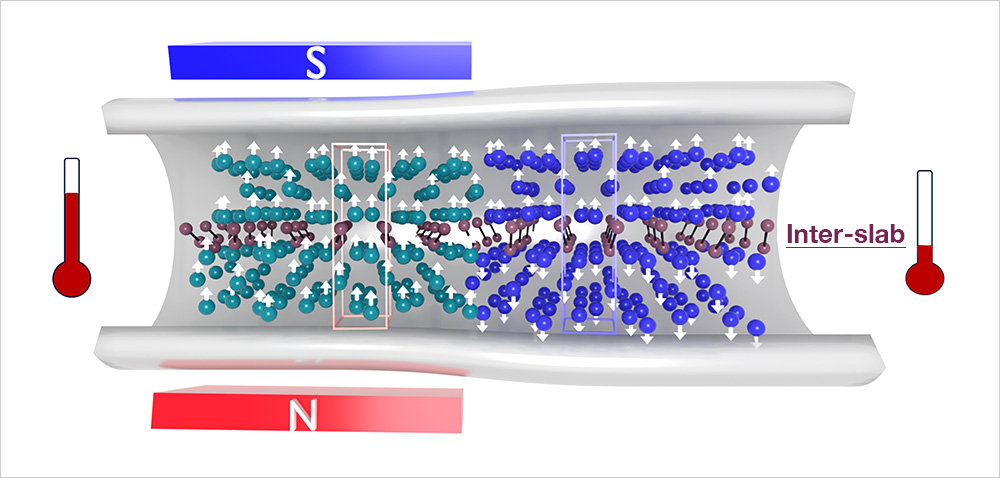
Figure. Schematic of the magnetocaloric material developed in this study. In the absence of an applied magnetic field (right), the spin moments of the Gd atoms (white arrows) in the upper and lower slabs, which are connected by inter-slab Ge atom, are not aligned. When a magnetic field is applied (left), the spins align, resulting in an increase in temperature.
Future Outlook
Other Information
- This research was conducted by a team consisting of the following researchers: Tang Xin (Senior Researcher, Research Center for Magnetic and Spintronic Materials (CMSM), NIMS); Noriki Terada (Chief Researcher, CMSM, NIMS); Xiao Enda (Postdoctoral Researcher, CMSM, NIMS); Terumasa Tadano (Group Leader, CMSM, NIMS); Andres Martin-Cid (Postdoctoral Researcher, CMSM, NIMS); Tadakatsu Ohkubo (Deputy Director, CMSM, NIMS); Hossein Sepehri-Amin (Group Leader, CMSM, NIMS); Yoshitaka Matsushita (Unit Leader, Research Network and Facility Services Division (RNFS), NIMS); Kazuhiro Hono (Fellow, NIMS); Yoshio Miura (Professor, Kyoto Institute of Technology (KIT)); Takuo Ohkochi (Senior Scientist, Japan Synchrotron Radiation Research Institute (JASRI) (currently Professor, University of Hyogo)); Shogo Kawaguchi (Senior Scientist, JASRI); Shintaro Kobayashi (Research Scientist, JASRI); Tetsuya Nakamura (Professor, International Center for Synchrotron Radiation Innovation Smart, Tohoku University); Allan Döring (PhD Student, Technical University of Darmstadt (TU Darmstadt)); Konstantin Skokov (Senior Researcher, TU Darmstadt); and Oliver Gutfleisch (Professor, TU Darmstadt). The work was supported by the Japan Society for the Promotion of Science (JSPS) International Joint Research Program (JRP-LEAD with DFG; Program No. JPJSJRP20221608), the Japan Science and Technology Agency (JST) ERATO "Uchida Magnetic Thermal Management Materials" (Grant No. JPMJER2201) and Deutsche Forschungsgemeinschaft (DFG) within the CRC/TRR 270 (Project-ID 405553726).
- This research result was published online in Advanced Materials on December 18, 2025.
Published Paper
Authors : Xin Tang, Yoshio Miura, Noriki Terada, Enda Xiao, Shintaro Kobayashi, Allan Döring, Terumasa Tadano, Andres Martin-Cid, Takuo Ohkochi, Shogo Kawaguchi, Yoshitaka Matsushita, Tadakatsu Ohkubo, Tetsuya Nakamura, Konstantin Skokov, Oliver Gutfleisch, Kazuhiro Hono and Hossein Sepehri-Amin
Journal : Advanced Materials
DOI : 10.1002/adma.202514295
Publication Date : December 18, 2025


Contact information
Regarding This Research
Group Leader
Green Magnetic Materials Group
Research Center for Magnetic and Spintronic Materials
National Institute for Materials Science
TEL: +81-29-859-2739
Deputy Director
Research Center for Magnetic and Spintronic Materials
National Institute for Materials Science
TEL: +81-29-859-2716
Professor
Electrical Engineering and Electronics
Kyoto Institute of Technology
TEL: +81-75-724-7405
URL: https://www.liaison.kit.ac.jp/researchers_db/ (Researcher Handbook* | Kyoto Institute of Technology)*Japanese
Research Scientist
Diffraction and Scattering Division
Japan Synchrotron Radiation Research Institute
TEL: +81-50-3496-8688
Professor
Laboratory of Advanced Science and Technology for Industry
University of Hyogo
TEL: +81-791-58-0017
Senior Researcher
Functional Materials Group
Technical University of Darmstadt
TEL: +49-6151-16-22151
Media Inquiries
Division of International Collaborations and Public Relations
National Institute for Materials Science
1-2-1 Sengen, Tsukuba, Ibaraki 305-0047, Japan
TEL: +81-29-859-2026
FAX: +81-29-859-2017
General Affairs and Planning Office
Kyoto Institute of Technology
Hashikamicho, Matsugasaki, Sakyo-ku, Kyoto 606-8585, Japan
TEL: +81-75-724-7016
User Administration Division
Japan Synchrotron Radiation Research Institute
1-1-1, Kouto, Sayo-cho, Sayo-gun, Hyogo 679-5198, Japan
TEL: +81-791-58-2785
University of Hyogo
Masakazu Sasaki
TEL: +81-791-58-0249
Technische Universität Darmstadt
Residenzschloss 1, 64283 Darmstadt, Germany
TEL: +49-6151-16-20018
Regarding JST Funding Programs
Green Innovation Group
Department of Research Project
Japan Science and Technology Agency
K's Gobancho, 7 Goban-cho, Chiyoda-ku, Tokyo 102-0076, Japan
TEL: +81-3-3512-3528
Same Keywords
-
Discovery of Catalysts That Prevent Boil-Off Losses in Liquid Hydrogen Production
(hydrogen)
2026.04.06
-
Breakthrough Iron-Based Magnetic Material Achieves Major Reduction in Core Loss
(magnetic materials,microstructure)
2025.09.03
-
Evolving Hydrogen-storage Technology: Guidelines Developed for the Design of Anti-evaporation Catalysts
(hydrogen)
2023.12.15