

No Need for Rare Earths or Liquid Helium!
Cryogenic Cooling Material Composed Solely of Abundant Elements
— Holding Promise for Application to Cooling in Medical MRI and Quantum Computers —
2025.12.24
NIMS (National Institute for Materials Science)
In collaboration with the National Institute of Technology (KOSEN), Oshima College, the National Institute for Materials Science (NIMS) succeeded in developing a new regenerator material composed solely of abundant elements, such as copper, iron, and aluminum, that can achieve cryogenic temperatures (approx. 4 K = −269°C or below) without using any rare-earth metals or liquid helium. By utilizing a special property called "frustration" found in some magnetic materials, where the spins cannot simultaneously satisfy each other's orientations in a triangular lattice, the team demonstrated a novel method that replaces the conventional rare-earth-dependent cryogenic cooling technology. The developed material holds promise for responding to the lack of liquid helium as well as for application to stable cooling in medical magnetic resonance imaging (MRI) and quantum computers, which is expected to see further growth in demand. This research result was published in UK scientific journal, Scientific Reports, on December 22, 2025.
Abstract
Background
Key Findings
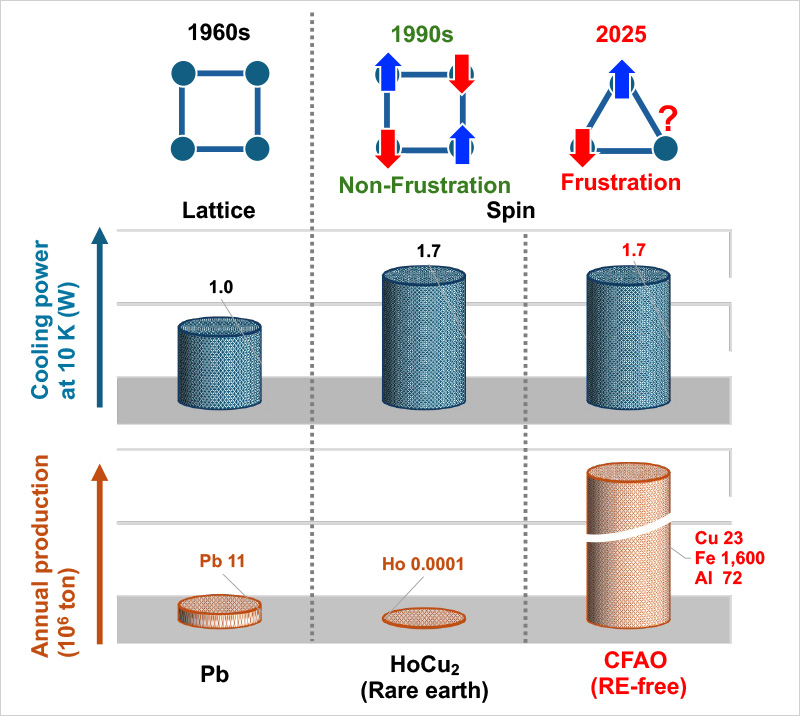
Figure. In the 1960s, GM coolers used lead (Pb) as the cold storage material, but in the 1990s, the rare-earth metal compound HoCu2 was introduced, and the cooling performance dramatically improved. While the rare-earth-free cold storage material CuFe0.98Al0.02O2 (CFAO) developed in this study has a cooling capacity comparable to them, it leads to sustainable and environmentally friendly cryogenic cooling technologies as the material is composed solely of abundant elements.
Future Outlook
Other Information
- This project was conducted by a research team consisting of Noriki Terada (Chief Researcher, Green Magnetic Materials Group (GMMG), Research Center for Magnetic and Spintronic Materials (CMSM), NIMS), Hiroaki Mamiya (Chief Researcher, GMMG, CMSM, NIMS), Akiko Saito (Chief Researcher, GMMG, CMSM, NIMS), and Shinji Masuyama (Professor, National Institute of Technology (KOSEN), Oshima College), as part of Japan Science and Technology Agency (JST) Adaptable and Seamless Technology Transfer Program through Target-driven R&D (A-STEP) "Development of regenerator materials for cryocoolers without rare-earth elements" (Principal Investigator: Noriki Terada).
- This research result was published online in UK scientific journal, Scientific Reports, on December 22, 2025.
Published Paper
Authors : Noriki Terada, Hiroaki Mamiya, Akiko T. Saito, and Shinji Masuyama
Journal : Scientific Reports
DOI : 10.1038/s41598-025-29709-5
Publication Date : December 22, 2025


Contact information
Regarding This Research
Chief Researcher
Research Center for Magnetic and Spintronic Materials
National Institute for Materials Science
TEL: +81-29-860-4627
Media Inquiries
Division of International Collaborations and Public Relations
National Institute for Materials Science
1-2-1 Sengen, Tsukuba, Ibaraki 305-0047, Japan
TEL: +81-29-859-2026
FAX: +81-29-859-2017