

Multiple Autonomous AI Systems Spontaneously Collaborate to Advance Materials Research
— Improving Overall Efficiency of Material Discovery by Autonomous AI Network Technology —2025.12.10
NIMS (National Institute for Materials Science)
University of Tsukuba
Japan Science and Technology Agency (JST)
A joint research team from NIMS and University of Tsukuba developed "autonomous AI network" technology by which multiple autonomous AI systems can efficiently discover new materials by spontaneously collaborating with each other and forming a network. The team demonstrated the effectiveness of the technology through simulations. This research result was published in npj Computational Materials on December 9, 2025.
Abstract
Background
Key Findings
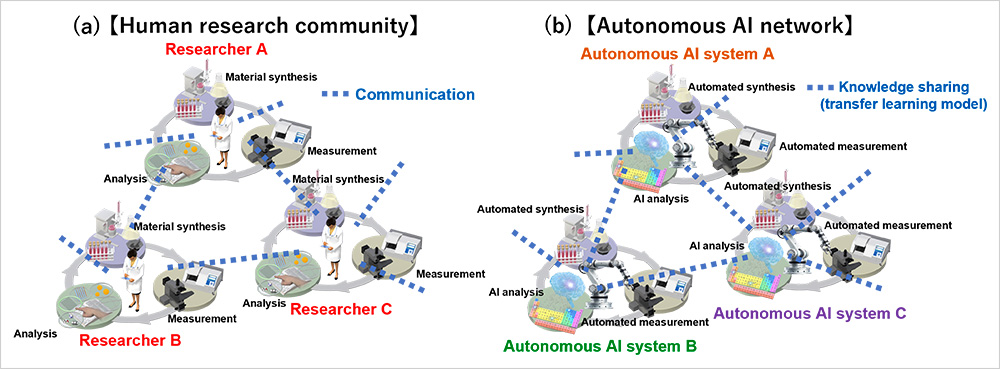
Figure. Comparison between a human research community and an autonomous AI network. (a) Researchers in different fields form a researcher network by sharing extensive knowledge through communication, and advance exploration of new materials. (b) Autonomous AI systems exploring different materials form an autonomous AI network by spontaneously sharing knowledge, and advance exploration of new materials.
Future Outlook
Other Information
- This project was conducted by a team led by Yuma Iwasaki (Principal Researcher, Data-driven Materials Design Group, Center for Basic Research on Materials, NIMS) and Yasuhiko Igarashi (Associate Professor, Institute of Systems and Information Engineering, University of Tsukuba) as part of Japan Science and Technology Agency (JST) Strategic Basic Research Program CREST "Scientists augmentation and materials discovery by hierarchical autonomous materials search" (JPMJCR21O1).
- This research was published online in npj Computational Materials on December 9, 2025.
Published Paper
Authors : Naoki Yoshida, Yutaro Iwabuchi, Yasuhiko Igarashi, Yuma Iwasaki
Journal : npj Computational Materials
DOI : 10.1038/s41524-025-01851-8
Publication Date : December 9, 2025


Contact information
Regarding This Research
TEL: +81-29-859-2288
Associate Professor
Institute of Systems and Information Engineering
University of Tsukuba
TEL: +81-29-853-5344
URL: https://www.cs.tsukuba.ac.jp/~igayasu1219 (Igarashi Lab @Tsukuba Univ.)
Media Inquiries
Division of International Collaborations and Public Relations
National Institute for Materials Science
1-2-1 Sengen, Tsukuba, Ibaraki 305-0047, Japan
TEL: +81-29-859-2026
FAX: +81-29-859-2017
University of Tsukuba
1-1-1 Tennodai, Tsukuba-shi, Ibaraki 305-8577, Japan
TEL: +81-29-853-2040
FAX: +81-29-853-2014
Regarding JST Funding Programs
Green Innovation Group
Department of Strategic Basic Research
Japan Science and Technology Agency
K's Gobancho, 7 Goban-cho, Chiyoda-ku, Tokyo 102-0076, Japan
TEL: +81-3-3512-3531
FAX: +81-3-3222-2066
Same Keywords
-
TEGNet: AI That Freely Designs Thermoelectric Devices
(AI)
2026.04.16
-
Discovery of a New Magnetic Sensor Material Using a High-Throughput Experimental Method
(artificial intelligence,AI)
2025.09.04
-
High-Precision Analysis of Microstructures in 2D Materials Using Electron Microscopy and Machine Learning
(machine learning)
2025.08.25