

Breakthrough Iron-Based Magnetic Material Achieves Major Reduction in Core Loss
— Controlled Nanostructure and Magnetic Domains Open the Door to Next-Generation Transformers and EV Components —2025.09.03
NIMS (National Institute for Materials Science)
Tohoku University
National Institute of Advanced Industrial Science and Technology (AIST)
A research team from NIMS, Tohoku University and AIST has developed a new technique for controlling the nanostructures and magnetic domain structures of iron-based soft amorphous ribbons, achieving more than a 50% reduction in core loss compared with the initial amorphous material. The developed material exhibits particularly high performance in the high-frequency range of several tens of kilohertz—required for next-generation, high-frequency transformers and EV drive power supply circuits. This breakthrough is expected to contribute to the advancement of these technologies, development of more energy-efficient electric machines and progress toward carbon neutrality. This research was published in Nature Communications on September 3, 2025.
Abstract
Background
Key Findings
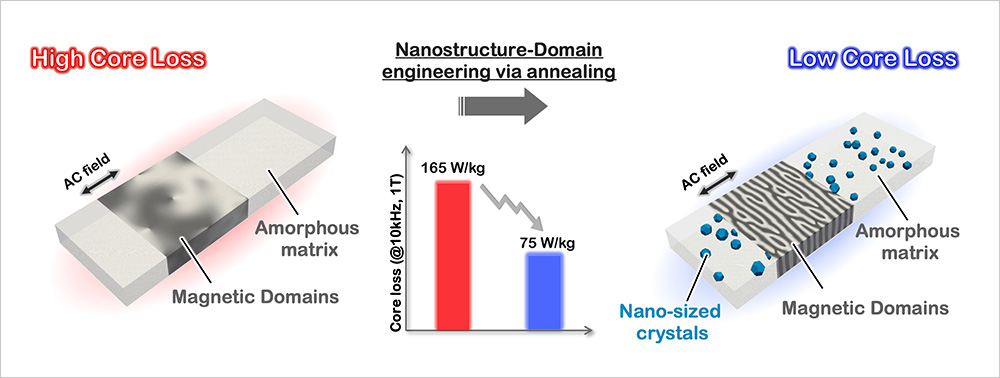
Figure. Schematic diagrams of the nanostructure and magnetic domain structure of a conventional amorphous soft magnetic ribbon (left) and the newly developed ribbon (right). The new material exhibits a controlled nanostructure and magnetic domain structure achieved using optimized thermal treatment. The central graph demonstrates that these structural controls reduce core loss by more than 50%.
Future Outlook
Other Information
- This project was carried out by a research team consisting of Ravi Gautam (Postdoctoral Researcher, Research Center for Magnetic and Spintronic Materials (CMSM), NIMS), Hiroaki Mamiya (Chief Researcher, CMSM, NIMS), Tadakatsu Ohkubo (Deputy Director, CMSM, NIMS), Hossein Sepehri-Amin (Group Leader, CMSM, NIMS), Nikita Kulesh (Research Fellow, International Center for Young Scientists, NIMS), Shozo Hiramoto (Researcher, Institute of Multidisciplinary Research for Advanced Materials (IMRAM), Tohoku University (TU)), Satoshi Okamoto (Professor, IMRAM, TU), Nobuhisa Ono (PhD student, IMRAM, TU) and Takeshi Ogasawara (Senior Researcher, Core Electronics Technology Research Institute, AIST).
This work was supported by the MEXT’s Innovative Power Electronics Technologies (INNOPEL) program (grant number: JPJ009777). - This research was published in Nature Communications, an open access journal, on September 3, 2025.
Published Paper
Authors : Ravi Gautam, Shozo Hiramoto, Nikita Kulesh, Hiroaki Mamiya, Satoshi Okamoto, Nobuhisa Ono, Takeshi Ogasawara, Tadakatsu Ohkubo, Hossein Sepehri-Amin
Journal : Nature Communications
DOI : 10.1038/s41467-025-63139-1
Publication Date : September 3, 2025


Contact information
Regarding This Research
Group Leader, Green Magnetic Materials Group
Research Center for Magnetic and Spintronic Materials
National Institute for Materials Science
TEL: +81-29-859-2739
Deputy Director, Research Center for Magnetic and Spintronic Materials
National Institute for Materials Science
TEL: +81-29-859-2716
Professor
Institute of Multidisciplinary Research for Advanced Materials
Tohoku University
TEL: +81-22-217-5357
URL: https://www2.tagen.tohoku.ac.jp/lab/okamoto/ (Okamoto Laboratory | Institute of Multidisciplinary Research for Advanced Materials) *Japanese
Senior Researcher, Correlated Electron Device Research Group
Core Electronics Technology Research Institute
National Institute of Advanced Industrial Science and Technology
TEL: +81-50-3521-3045
Media Inquiries
Division of International Collaborations and Public Relations
National Institute for Materials Science
1-2-1 Sengen, Tsukuba, Ibaraki 305-0047, Japan
TEL: +81-29-859-2026
FAX: +81-29-859-2017
Institute of Multidisciplinary Research for Advanced Materials
Tohoku University
2-1-1 Katahira, Aoba-ku, Sendai, Miyagi 980-8577, Japan
TEL: +81-22-217-5198
Branding and Public Relations Department
National Institute of Advanced Industrial Science and Technology
1-1-1 Umezono, Tsukuba, Ibaraki 305-8560, Japan
TEL: +81-29-862-6216
Same Keywords
-
Novel Materials Design Approach Achieves a Giant Cooling Effect and Excellent Durability in Magnetic Refrigeration Materials
(microstructure,magnetic materials)
2025.12.19
-
Development of a Diamond Transistor with High Hole Mobility
(power electronics)
2022.01.18
-
Demonstration of Unconventional Transverse Thermoelectric Generation
(magnetic materials)
2021.01.19