

Magnetic Material with Macroscale, Three-Dimensional Formation of Nano-Interfaces That Turn Heat into Electricity
— Providing a New Material Design Paradigm for Effective Utilization of Thermal Energy —2026.07.21
A joint research team from NIMS and the University of Tokyo developed a new composite in which three-dimensional nano-interfaces are distributed throughout the material, by coating the surface of magnetic insulator powders with metal and sintering them. Using this structure, the team succeeded in observing thermoelectric conversion driven by spins in an insulator, a phenomenon previously observed only at nanoscale thin-film interfaces, in a macroscale material. This research result, which provides a new material design paradigm for effectively utilizing thermal energy in insulators, was published in Nature Communications on July 21, 2026.
Background
Key Findings
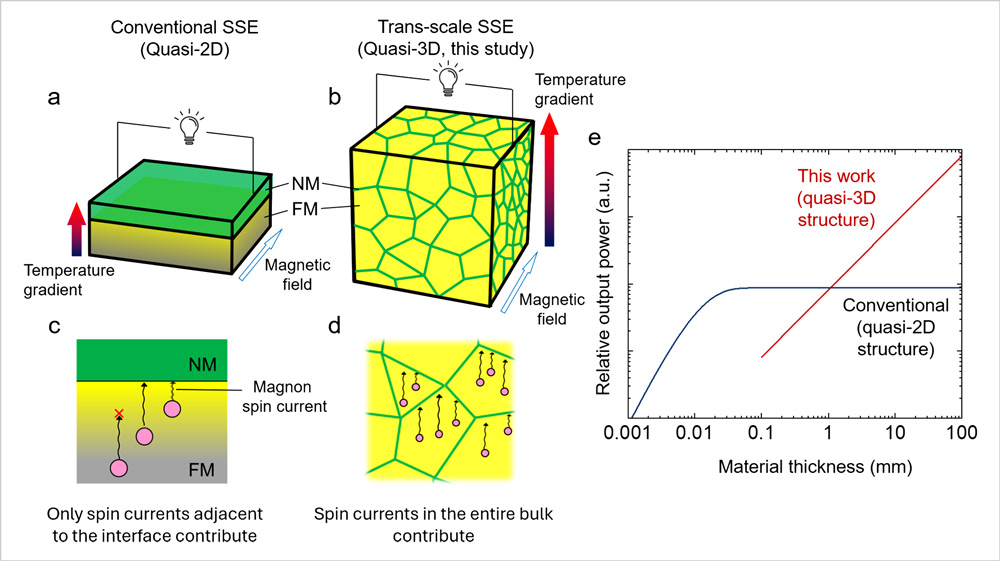
Figure. Schematic of a conventional spin Seebeck device and a trans-scale spin Seebeck device. In the conventional structure (a), only spin currents generated in the vicinity of the interface between the ferromagnetic material (FM) and the normal metal (NM) contribute to the spin Seebeck effect, as illustrated in (c). In the trans-scale composite developed in this work (b), the metal phase is distributed three-dimensionally throughout the material, allowing spin-current generation and thermoelectric conversion via the spin Seebeck effect throughout the bulk, as illustrated in (d). Panel (e) compares the thickness dependence of the relative output power for the conventional and trans-scale structures.
Future Outlook
Other Information
- This project was conducted by a team of researchers including Sang Jun Park (Postdoctoral Research Fellow, Research Center for Magnetic and Spintronic Materials [CMSM], NIMS), Ken-ichi Uchida (Distinguished Group Leader, CMSM, NIMS [Professor, Department of Advanced Materials Science (AMS), Graduate School of Frontier Science (GSFS), The University of Tokyo]), and Keisuke Hirata (Assistant Professor, AMS, GSFS, The University of Tokyo [at the start of the research, Assistant Professor, Toyota Technological Institute]). The work was supported by JST Strategic Basic Research Programs ERATO "UCHIDA Magnetic Thermal Management Materials Project" (Research Director: Ken-ichi Uchida; Grant No.:JPMJER2201).
- This research result was published in Nature Communications on July 21, 2026.
Published Paper
Authors : Sang J. Park*, Keisuke Hirata, Hossein Sepehri-Amin, Fuyuki Ando, Takamasa Hirai, and Ken-ichi Uchida*
Journal : Nature Communications
DOI : 10.1038/s41467-026-75232-0
Publication Date : July 21, 2026


Contact information
Regarding This Research
Distinguished Group Leader, Research Center for Magnetic and Spintronic Materials,
National Institute for Materials Science
Professor, Department of Advanced Materials Science, Graduate School of Frontier Sciences,
The University of Tokyo
TEL: +81-29-859-2062
URL: https://www.jst.go.jp/erato/uchida/en/
(Uchida Magnetic Thermal Management Materials | JST Strategic Basic Research Program ERATO)
URL: https://uchida-lab.k.u-tokyo.ac.jp/en/
(Spin Caloritronics Group, NIMS / Uchida & Nakanishi Laboratory, The University of Tokyo)
Media Inquiries
National Institute for Materials Science
1-2-1 Sengen, Tsukuba, Ibaraki 305-0047, Japan
TEL: +81-29-859-2026
FAX: +81-29-859-2017
5-1-5 Kashiwa-no-ha, Kashiwa City, Chiba 277-8561, Japan
Regarding the Funding Program
Ryoji Nakamura
K's Gobancho, 7 Goban-cho, Chiyoda-ku, Tokyo 102-0076, Japan
TEL: +81-3-3512-3528
Same Keywords
-
World’s First Observation of the Transverse Thomson Effect
(thermoelectric conversion,magnetism)
2025.06.26
-
Miniaturization of a Thermoelectric Device Capable of Powering IoT Products
(thermoelectric conversion)
2022.06.23
-
New Strategy for Designing Thermoelectric Materials
(thermoelectric conversion)
2022.02.21