

Demonstration of Altermagnetism in RuO2 Thin Films—A New Magnetic Material for the AI Era
— Toward the Development of High-Speed, High-Density Memory for AI and Data Centers —2025.09.24
NIMS (National Institute for Materials Science)
The University of Tokyo
Kyoto Institute of Technology
Tohoku University
A joint research team from NIMS, The University of Tokyo, Kyoto Institute of Technology and Tohoku University has demonstrated that thin films of ruthenium dioxide (RuO2) exhibit altermagnetism—the defining property of what is now recognized as the third fundamental class of magnetic materials.
Altermagnets have the potential to overcome limitations associated with current magnetic random access memory using conventional ferromagnets and are attracting attention as promising materials for next-generation high-speed, high-density memory devices.
In addition to identifying RuO2 as a strong candidate for such applications, the study also highlights the possibility of enhancing its functionality through control of crystallographic orientation.
The research findings were published in Nature Communications on September 24, 2025.
Abstract
Background
Conventional ferromagnetic materials used in memory devices allow easy data writing via external magnetic fields but are prone to recording errors caused by stray magnetic fields, which limit further increases in data density.
Antiferromagnetic materials, on the other hand, are robust against such external disturbances. However, because their atomic-level spins cancel each other out, it is difficult to electrically read information from them.
This has driven demand for magnetic materials that combine resistance to external disturbances with compatibility with electrical readout, and ideally also allow rewritability.
However, experimental results concerning altermagnetism in RuO2 have been inconsistent worldwide, hindering a clear understanding of its fundamental nature. Moreover, the lack of high-quality thin-film samples with uniform crystallographic orientation has prevented conclusive experimental verification.
Key Findings
Using X-ray magnetic linear dichroism, the team identified the spin arrangement and magnetic ordering in which the net magnetization (N–S poles) cancels out. Furthermore, they observed spin-split magnetoresistance—a phenomenon in which electrical resistance varies depending on spin orientation—thereby electrically verifying the spin-splitting electronic structure.
The results of the X-ray magnetic linear dichorism were consistent with first-principles calculations on the magneto-crystalline anisotropy, demonstrating that the RuO2 thin films exhibit altermagnetism (see Figure).
This finding strongly supports the potential of RuO2 thin films as promising materials for next-generation high-speed, high-density memory devices.
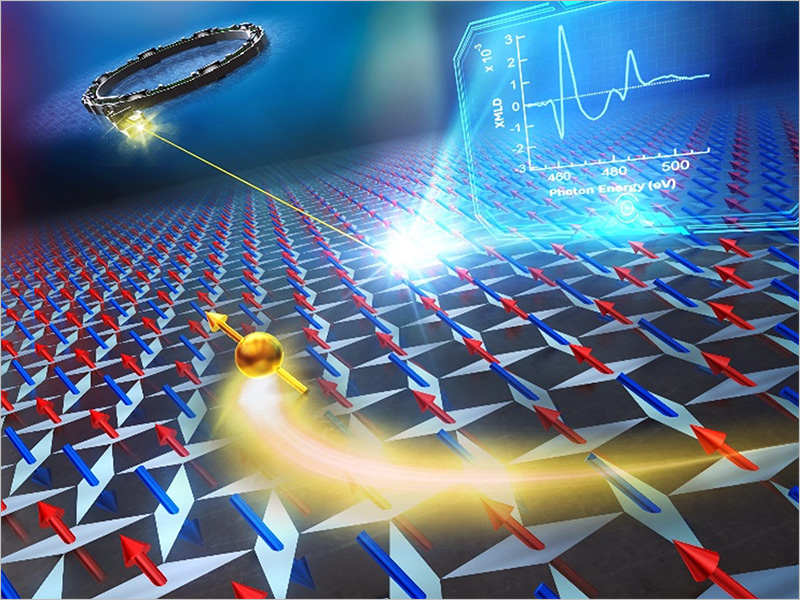
Figure. Schematic illustration of altermagnetism in a single-orientation RuO2 thin film, depicted based on X-ray magnetic linear dichroism and spin orientations.
Future Outlook
Such devices are expected to contribute to more energy-efficient information processing by leveraging the inherently high-speed and high-density characteristics of altermagnetism.
Furthermore, the synchrotron-based magnetic analysis technique established in this study can be applied to the exploration of other altermagnetic materials and the development of spintronic devices.
Other Information
- This project was carried out by a research team led by Zhenchao Wen (Senior Researcher, Spintronics Group (SG), Research Center for Magnetic and Spintronic Materials (CMSM), NIMS), Cong He (Postdoctoral Researcher, SG, CMSM, NIMS at the time of the research), Hiroaki Sukegawa (Group Leader, SG, CMSM, NIMS), Seiji Mitani (Managing Researcher, SG, CMSM, NIMS), Tadakatsu Ohkubo (Deputy Director, CMSM, NIMS), Jun Okabayashi (Associate Professor, School of Science, The University of Tokyo), Yoshio Miura (Professor, Kyoto Institute of Technology) and Takeshi Seki (Professor, Tohoku University).
- This work was supported by the JSPS Grants-in-Aid for Scientific Research (grant numbers: 22H04966, 24H00408); the MEXT Initiative to Establish Next-Generation Novel Integrated Circuits Centers (X-NICS) (grant number: JPJ011438); the GIMRT Program of the Institute for Materials Research, Tohoku University; and the Cooperative Research Projects of the Research Institute of Electrical Communication, Tohoku University.
- This research was published online in Nature Communications, an international scientific journal, on September 24, 2025.
Published Paper
Authors : Cong He, Zhenchao Wen, Jun Okabayashi, Yoshio Miura, Tianyi Ma, Tadakatsu Ohkubo, Takeshi Seki, Hiroaki Sukegawa, and Seiji Mitani
Journal : Nature Communications
DOI : 10.1038/s41467-025-63344-y
Publication Date : September 24, 2025


Contact information
Regarding This Research
Senior Researcher, Spintronics Group
Research Center for Magnetic and Spintronic Materials
National Institute for Materials Science
TEL: +81-29-859-2250
Associate Professor, Research Center for Spectrochemistry,
School of Science
The University of Tokyo
TEL: +81-3-5841-4418
URL: https://spectrum.chem.s.u-tokyo.ac.jp/index_en.html (Research Center for Spectrochemistry | The University of Tokyo)
Professor, Faculty of Electrical Engineering and Electronics
Kyoto Institute of Technology
TEL: +81-75-724-7405
URL: https://www.liaison.kit.ac.jp/researchers_db/ (Researcher Handbook* | Kyoto Institute of Technology)*Japanese
Professor, Magnetic Materials Laboratory
Institute for Materials Research
Tohoku University
TEL: +81-22-215-2095
URL: https://magmatelab.imr.tohoku.ac.jp/ (Seki Lab., Magnetic Materials Lab., IMR)
Media Inquiries
Division of International Collaborations and Public Relations
National Institute for Materials Science
1-2-1 Sengen, Tsukuba, Ibaraki 305-0047, Japan
TEL: +81-29-859-2026
FAX: +81-29-859-2017
School of Science
The University of Tokyo
7-3-1 Hongo, Bunkyo-ku, Tokyo 113-0033, Japan
TEL: +81-3-5841-8856
FAX: +81-3-5841-1035
Kyoto Institute of Technology
Hashigami-cho, Matsugasaki, Sakyo-ku, Kyoto 606-8585, Japan
TEL: +81-75-724-7016
FAX: +81-75-724-7029
Institute for Materials Research
Tohoku University
2-1-1 Katahira, Aoba-ku, Sendai, Miyagi 980-8577, Japan
TEL: +81-22-215-2144
Same Keywords
-
Fabrication of a Single-Crystal Giant Magnetoresistive Device on a Polycrystalline Film
(magnetoresistance)
2020.05.28
-
High-speed switching for ultrafast electromechanical switches and sensors
(X-ray)
2017.08.29
-
Techniques for Elemental Analysis and Imaging Using X-Ray Measurements Obtained from an Ordinary Digital Camera
(X-ray)
2017.04.10