

Discovery of Catalysts That Prevent Boil-Off Losses in Liquid Hydrogen Production
— Promoting Stabilization of Hydrogen Molecules (= Exothermic Reaction) Before Liquefaction and Contributing to the Realization of a Hydrogen Society —2026.04.06
NIMS (National Institute for Materials Science)
Institute of Science Tokyo
Kochi University of Technology
A joint research team from NIMS, the Institute of Science Tokyo, and Kochi University of Technology discovered high-performance catalysts capable of significantly reducing "boil-off losses," which had been a long-standing issue in liquid hydrogen storage and transportation. These composite catalysts, in which metallic nanoparticles, such as iron, are supported on silicon dioxide (silica) or other low-cost oxide, demonstrate significantly superior performance compared to conventional iron oxide-based catalysts. In this research, the team demonstrated a new mechanism where ortho to para hydrogen conversion is promoted, not by magnetism as in conventional mainstream mechanisms, but by an inhomogeneous electric field on the surface of the catalyst. This research result, which is expected to contribute to a hydrogen energy society, was published in The Journal of Physical Chemistry Letters on March 12, 2026.
Background
Key Findings
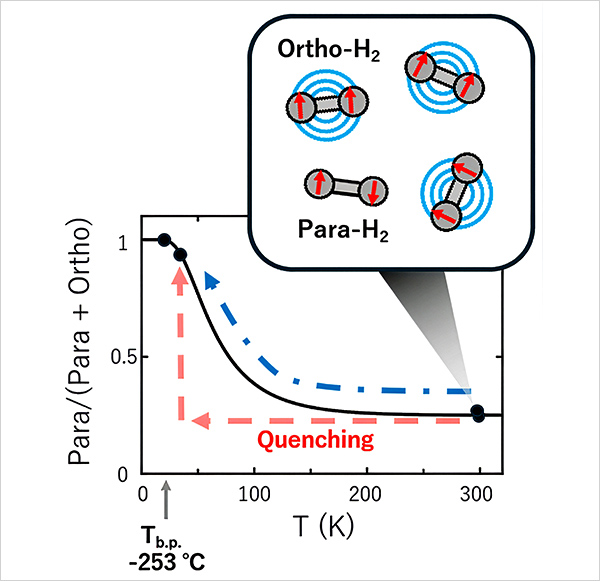
Figure. Hydrogen gas is a mixture of ortho hydrogen and para hydrogen. Their ratio depends on temperature, and is also greatly affected by the cooling rate. If hydrogen is rapidly cooled without a catalyst, the conversion from ortho hydrogen to para hydrogen is delayed as shown by the red broken line in the figure, and a substantial quantity of energetically unstable ortho hydrogen will remain in the liquid. The residual ortho hydrogen continues to be converted slowly during storage, and releases energy. This gives rise to partial vaporization of liquid hydrogen, and causes boil-off losses during storage. Therefore, it is essential to use a catalyst that completely converts ortho hydrogen to para hydrogen before the liquefaction process (shown by the blue broken line). Such catalyst prevents boil-off losses during storage and increases the hydrogen handling efficiency.
Future Outlook
Other Information
- This project was conducted by a research team consisting of Hideo Hosono (Team Leader, ElectroActive Materials Team, Research Center for Materials Nanoarchitectonics (MANA), NIMS [also Honorary Professor, Institute of Science Tokyo]) and Hideki Abe (Group Leader, Hydrogen Production Catalyst Materials Group, Research Center for Energy and Environmental Materials (GREEN), NIMS) as well as Takeshi Fujita (Professor, Kochi University of Technology). The work was supported by JST-Mirai program JPMJMI18A3.
- This research result was published online in The Journal of Physical Chemistry Letters on March 12, 2026.
Published Paper
Authors : Hiroshi Mizoguchi, Yuichi Shirako, Shusaku Shoji, Hideki Abe, Takeshi Fujita, and Hideo Hosono
Journal : The Journal of Physical Chemistry Letters
DOI : 10.1021/acs.jpclett.6c00357
Publication Date : March 12, 2026


Contact information
Regarding This Research
ElectroActive Materials Team
Research Center for Materials Nanoarchitectonics
National Institute for Materials Science
TEL: +81-29-851-3354 (ext.4705)
Hydrogen Production Catalyst Materials Group
Research Center for Energy and Environmental Materials
National Institute for Materials Science
TEL: +81-29-860-4803
ElectroActive Materials Team
Research Center for Materials Nanoarchitectonics
National Institute for Materials Science,
Honorary Professor
Institute of Science Tokyo
TEL: +81-45-924-5009
Professor
School of Engineering Science
Kochi University of Technology
TEL: +81-887-57-2508
Media Inquiries
Division of International Collaborations and Public Relations
National Institute for Materials Science
1-2-1 Sengen, Tsukuba, Ibaraki 305-0047, Japan
TEL: +81-29-859-2026
FAX: +81-29-859-2017
Institute of Science Tokyo
2-12-1 Ookayama, Meguro-ku, Tokyo 152-8550, Japan
TEL: +81-3-5734-2975
FAX: +81-3-5734-3661
Kochi University of Technology
185 Miyanokuchi, Tosayamada, Kami City, Kochi 782-8502, Japan
TEL: +81-887-53-1080
FAX: +81-887-57-2000
Same Keywords
-
TEGNet: AI That Freely Designs Thermoelectric Devices
(carbon neutrality)
2026.04.16
-
Novel Materials Design Approach Achieves a Giant Cooling Effect and Excellent Durability in Magnetic Refrigeration Materials
(hydrogen)
2025.12.19
-
Evolving Hydrogen-storage Technology: Guidelines Developed for the Design of Anti-evaporation Catalysts
(hydrogen,catalyst,ortho-para conversion)
2023.12.15