

Development of an AI Device Using Ion Gel and Graphene That Dramatically Streamlines Machine Learning Computations
— Promising Energy-Saving Technology for Edge AI —2025.10.14
NIMS (National Institute for Materials Science)
Tokyo University of Science
Kobe University
Japan Science and Technology Agency (JST)
A joint research team from NIMS, Tokyo University of Science, and Kobe University has developed a new artificial intelligence (AI) device that exploits ion behavior to perform information processing. The team succeeded in reducing the computational load to about 1/100 of that required for conventional deep learning. The technology is expected to contribute to enhancing the information processing performance of "edge AI" operating directly on terminal equipment (an edge device). This research was published in ACS Nano on October 14, 2025.
Abstract
Background
Key Findings
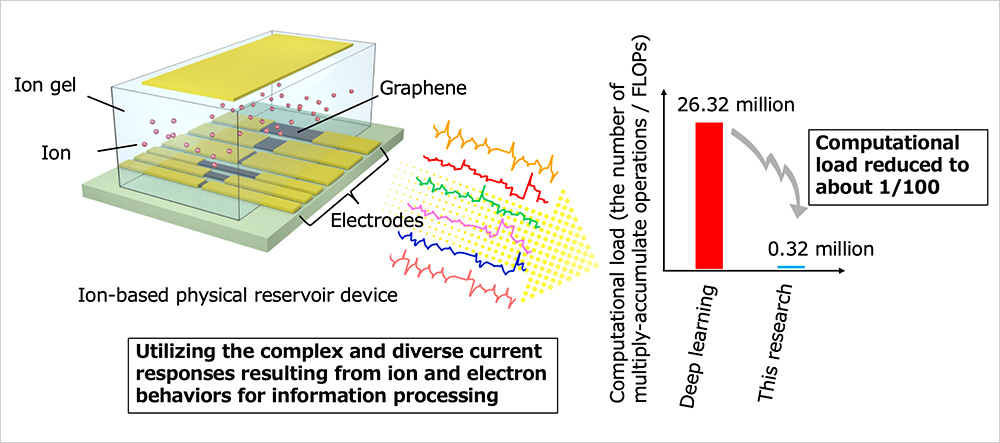
Figure. The ion-based physical reservoir developed in this research (left) and the computational load reduction achieved in a typical benchmark test (right).
Future Outlook
Other Information
- This research was conducted by a research team led by Daiki Nishioka (Research Fellow, International Center for Young Scientists, NIMS) and Takashi Tsuchiya (Group Leader, Neuromorphic Devices Group, Research Center for Materials Nanoarchitectonics (MANA), NIMS; Visiting Professor, Tokyo University of Science). Other team members include Hina Kitano (NIMS Junior Researcher, Neuromorphic Devices Group, MANA, NIMS; a first-year doctoral student, Tsuchiya Laboratory, Joint Graduate School System, Tokyo University of Science), Wataru Namiki (Researcher, Ionic Devices Group, MANA, NIMS), Kazuya Terabe (Group Leader, Ionic Devices Group, MANA, NIMS), and Satofumi Souma (Associate Professor, Department of Electrical and Electronic Engineering, Graduate School of Engineering, Kobe University). The research was conducted as part of research project "Creation of ultrafast iontronics" (JPMJPR23H4) under JST PRESTO "Nano Materials for New Principle Devices (Research Supervisor: Yoshihiro Iwasa)."
- This research was published in the online version of ACS Nano on October 14, 2025.
Published Paper
Authors : Daiki Nishioka, Hina Kitano, Wataru Namiki, Satofumi Souma, Kazuya Terabe and Takashi Tsuchiya
Journal : ACS Nano
DOI : 10.1021/acsnano.5c06174
Publication Date : October 14, 2025


Contact information
Regarding This Research
Group Leader
Neuromorphic Devices Group
Research Center for Materials Nanoarchitectonics
National Institute for Materials Science
TEL: +81-29-860-4563
URL: https://www.nims.go.jp/group/neuro/en/ (Neuromorphic Devices Group | NIMS)
Associate Professor
Department of Electrical and Electronic Engineering
Graduate School of Engineering
Kobe University
TEL: +81-78-803-6087
URL: https://www.research.kobe-u.ac.jp/eng-nanoelectronics/ (Nanostructure Electronics [EP4A] laboratory | Kobe University)
Media Inquiries
Division of International Collaborations and Public Relations
National Institute for Materials Science
1-2-1 Sengen, Tsukuba, Ibaraki 305-0047, Japan
TEL: +81-29-859-2026
FAX: +81-29-859-2017
Management Planning Division
Tokyo University of Science
1-3 Kagurazaka, Shinjuku-ku, Tokyo 162-8601, Japan
TEL: +81-3-5228-8107
General Affairs Department
Kobe University
1-1 Rokkodai-cho, Nada-ku, Kobe-shi, Hyogo 657-8501, Japan
TEL: +81-78-803-5106
FAX: +81-78-803-5088
Regarding JST Funding Programs
Green Innovation Group
Department of Research Project
Japan Science and Technology Agency
K's Gobancho, 7 Goban-cho, Chiyoda-ku, Tokyo 102-0076, Japan
TEL: +81-3-3512-3526
FAX: +81-3-3222-2066