

Demonstrating a Novel Method to Modulate Heat Flow Through the Collective Motion of Spins
— A Step Forward Toward Innovative Thermal Transport Modulation Technology Using Magnetic Materials —2025.10.06
NIMS (National Institute for Materials Science)
Graduate School of Frontier Sciences, The University of Tokyo
National Institute of Advanced Industrial Science and Technology (AIST)
The University of Osaka
Tohoku University
Japan Science and Technology Agency (JST)
NIMS, in joint research with the University of Tokyo, AIST , the University of Osaka, and Tohoku University, proposed a novel method for actively controlling heat flow in solids by utilizing the transport of magnons—quasiparticles corresponding to the collective motion of spins in a magnetic material—and demonstrated that magnons contribute to heat conduction in a ferromagnetic metal and its junction more significantly than previously believed. The creation of new principles “magnon engineering” for modulating thermal transport using magnetic materials is expected to lead to the development of thermal management technologies. This research result was published in Advanced Functional Materials on October 1, 2025.
Abstract
Background
Key Findings
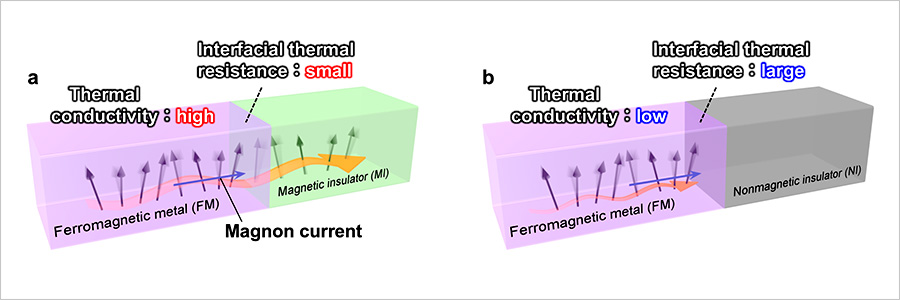
Figure. Schematic of magnon-engineered thermal transport in a ferromagnetic metal / magnetic insulator junction (a) and a ferromagnetic metal / non-magnetic insulator junction (b). When magnons can pass through the interface, the thermal conductivity of the ferromagnetic metal increases and the interfacial thermal resistance decreases compared to when they cannot pass through.
Future Outlook
Other Information
- This research was conducted by a team of researchers including Takamasa Hirai (Senior Researcher, Spin Caloritronics Group (SCG), Research Center for Magnetic and Spintronic Materials (CMSM), NIMS), Toshiaki Morita (Trainee, SCG, CMSM, NIMS; a doctoral student, SANKEN, the University of Osaka), Ken-ichi Uchida (Distinguished Group Leader, SCG, CMSM, NIMS; Professor, Department of Advanced Materials Science, Graduate School of Frontier Sciences, The University of Tokyo), Takashi Yagi (Group Leader, Thermophysical Property Standards Group, Research Institute for Material and Chemical Measurement, National Institute of Advanced Industrial Science and Technology (AIST)), Junichiro Shiomi (Professor, Institute of Engineering Innovation, School of Engineering, The University of Tokyo), and Daichi Chiba (Professor, SANKEN, the University of Osaka; Director, International Center for Synchrotron Radiation Innovation Smart, Tohoku University). The work was supported by JST ERATO "Uchida Magnetic Thermal Management Materials Project" (Research Director: Ken-ichi Uchida; Grant No.: JPMJER2201), and JSPS Grants-in-Aid for Scientific Research (S) (22H04965) and Grant-in-Aid for Research Activity Start-up (22K20495).
- This research result was published online in Advanced Functional Materials on October 1, 2025.
Published Paper
Authors : Takamasa Hirai, Toshiaki Morita, Subrata Biswas, Jun Uzuhashi, Takashi Yagi, Yuichiro Yamashita, Varun Kumar Kushwaha, Fuya Makino, Rajkumar Modak, Yuya Sakuraba, Tadakatsu Ohkubo, Rulei Guo, Bin Xu, Junichiro Shiomi, Daichi Chiba, and Ken-ichi Uchida
Journal : Advanced Functional Materials
DOI : 10.1002/adfm.202506554
Publication Date : October 1, 2025


Contact information
Regarding This Research
Senior Researcher,
Research Center for Magnetic and Spintronic Materials,
National Institute for Materials Science
TEL: +81-29-859-2565
URL: https://uchida-lab.k.u-tokyo.ac.jp/ (Spin Caloritronics Group | NIMS, UTokyo)
Distinguished Group Leader,
Research Center for Magnetic and Spintronic Materials,
National Institute for Materials Science
Professor,
Department of Advanced Materials Science,
Graduate School of Frontier Sciences,
The University of Tokyo
TEL: +81-29-859-2062
URL: https://www.jst.go.jp/erato/uchida/en/ (Uchida Magnetic Thermal Management Materials (MTMMs) Project | JST ERATO)
Media Inquiries
Division of International Collaborations and Public Relations
National Institute for Materials Science
1-2-1 Sengen, Tsukuba, Ibaraki 305-0047, Japan
TEL: +81-29-859-2026
FAX: +81-29-859-2017
Graduate School of Frontier Sciences,
The University of Tokyo
5-1-5 Kashiwa-no-ha, Kashiwa City, Chiba 277-8561, Japan
Branding and Public Relations Department,
National Institute of Advanced Industrial Science and Technology
1-1-1 Umezono, Tsukuba City, Ibaraki 305-8560, Japan
SANKEN, (The Institute of Scientific and Industrial Research)
The University of Osaka
8-1 Mihogaoka, Ibaraki City, Osaka 567-0047, Japan
International Center for Synchrotron Radiation Innovation Smart,
Tohoku University
468-1 Aramaki Aza-Aoba, Aoba-ku, Sendai City, Miyagi 980-8572, Japan
TEL: +81-22-752-2331
Regarding JST Funding Programs
Green Innovation Group,
Department of Research Project,
Japan Science and Technology Agency
K's Gobancho, 7 Gobancho, Chiyoda-ku, Tokyo 102-0076, Japan
TEL: +81-3-3512-3528
Same Keywords
-
Development of a High-Performance AI Device Utilizing Ion-Controlled Spin Wave Interference in Magnetic Materials
(magnon)
2024.11.22
-
Data Science Approach to Identifying Thermal Conductivity-Related Structural Factors in Amorphous Materials
(thermal conductivity)
2024.01.19
-
Development of an Inorganic Composite Material with the Lowest Thermal Conductivity Using MI
(thermal conductivity)
2018.07.04