

Discovery of Significant Expansion of a Dense Oxide
— "Giant Irreversible Expansion" Achieved Through Atomic Rearrangement While Retaining the Basic Crystal Framework and Chemical Composition —2026.06.01
NIMS (National Institute for Materials Science)
The National Institute for Materials Science (NIMS) discovered a thermal response phenomenon in which Ba4Ru3O12, a dense, inorganic oxide formed by high-pressure synthesis, increases in volume by about 4.4% when heated, and this expanded state is retained even after cooling. Normally, such a large volume change is accompanied by substantial changes in the crystal structure or chemical reactions and alters the material properties. In this research, however, NIMS elucidated that “giant irreversible expansion” occurs through atomic rearrangement within a crystal, while retaining the basic crystal framework, i.e., the symmetry of the crystal structure, and chemical composition. The research result demonstrates a new thermal response mechanism in oxide materials, and is expected to lead to new design guidelines for ceramic materials used in a high-temperature environment or materials that control thermal deformation and stress.
Background: Difficulty of causing a large thermal response in a dense and stable oxide
Key Findings: Discovery that an oxide expands significantly through internal atomic rearrangement
As a result of analyses including precision structural analysis using synchrotron X-ray diffraction, it was found that this expansion was driven not by decomposition, redox processes, or electronic or magnetic phase transitions, but by the rearrangement of ruthenium (Ru) atoms within the crystal. This result is characterized in that a large, irreversible thermal response occurs while the symmetry of the crystal structure and chemical composition are retained.
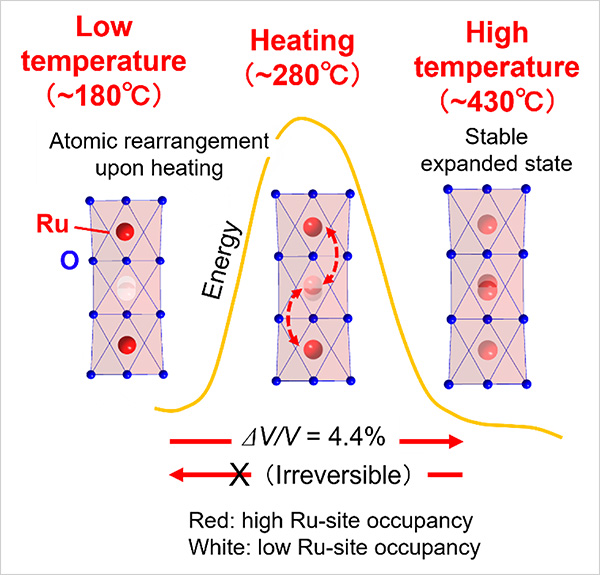
Figure. Schematic of the rearrangement of Ru atoms by heating and the volume increasing while the basic crystal framework is retained. The diagram shows the changes caused by heating from left to right. The redder the color, the higher the site occupancy by Ru atoms. The volume does not revert to its original state even after cooling, and the expanded state is retained. The changes in the lattice size are emphasized for better visibility.
Future Outlook
In the future, this phenomenon is expected to be applied to materials that suppress thermal stress that poses a problem in electronic devices and power devices, thereby enhancing the reliability and lifespan of components.
Other Information
- This project was conducted by a research team consisting of Zhijun Li (Graduate Research Assistant, Quantum Solid State Materials Group (QSSMG), Research Center for Materials Nanoarchitectonics (MANA), NIMS), Hongbo Yuan (Graduate Research Assistant, QSSMG, MANA, NIMS), Alexei A. Belik (Chief Researcher, QSSMG, MANA, NIMS), Yoshihiro Tsujimoto (Principal Researcher, QSSMG, MANA, NIMS), Kazunari Yamaura (Group Leader, QSSMG, MANA, NIMS), and Terumasa Tadano (Group Leader, Spin Theory Group, Research Center for Magnetic and Spintronic Materials, NIMS).
- The work was supported by the Japan Society for the Promotion of Science, Grants-in-Aid for Scientific Research (Grant Nos.: JP25K01657, JP25K01507).
- This work was published online in Journal of the American Chemical Society on May 20, 2026.
Published Paper
Authors : Zhijun Li, Hongbo Yuan, Alexei A. Belik, Terumasa Tadano, Yoshihiro Tsujimoto, Kazunari Yamaura
Journal : Journal of the American Chemical Society
DOI : 10.1021/jacs.6c07579
Publication Date : May 20, 2026


Contact information
Regarding This Research
Group Leader
Research Center for Materials Nanoarchitectonics
National Institute for Materials Science
TEL: +81-29-860-4658
Media Inquiries
Division of International Collaborations and Public Relations
National Institute for Materials Science
1-2-1 Sengen, Tsukuba, Ibaraki 305-0047, Japan
TEL: +81-29-859-2026
FAX: +81-29-859-2017