Overturning a 200-Year Belief: New Surface Design Enabling Two Distinct Wetting States on a Single Substrate

— Opening a Path to Development of PFAS-Free Water-Repellent Materials. Presenting New Design Guidance for Wettability Control. —

NIMS (National Institute for Materials Science)

NIMS discovered a phenomenon in which droplets on a single solid surface exhibit both "sticky" and "repellent” state simultaneously; namely, the wetting behavior branches into two states. This is a discovery that overturns interface chemistry scientists' belief held for over 200 years that, on a non-textured surface, wetting state is uniquely determined by solid/liquid combinations. Furthermore, the research team also clarified a universal surface design principle that causes this phenomenon. This research result was published in Advanced Materials Interfaces on April 2, 2026.

Background

When a droplet is cast on a solid, it may spread out flat (sticks to the surface) or be repelled like a rolling ball. This phenomenon called "wetting" is observed in all kinds of situations, from natural phenomena to our daily life. Wetting control serves as fundamental technology in various industrial sectors, including inkjet printing and coating industries. In 1805, Thomas Young discovered a law that a single wetting state is always determined according to the combination between a solid and a liquid. This had been considered common understanding in interface science for a long time.

Key Findings

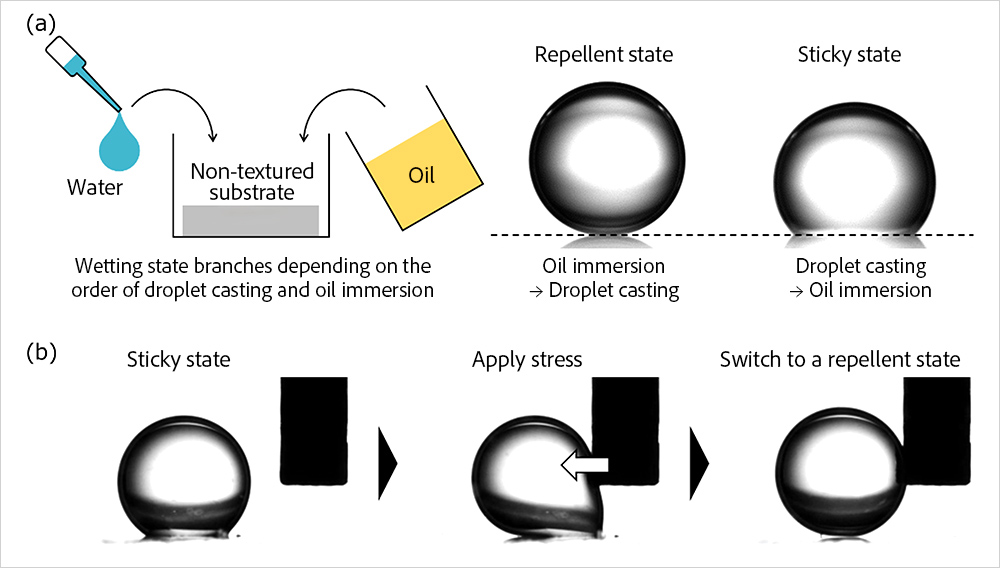
In this study, the research team discovered a phenomenon in which droplets on the same substrate coexist in two contradicting states—sticky and repellent—in an experiment that casts water droplets onto a non-textured substrate immersed in oil. The key to design is to provide hands of specific molecules called "hydrogen bonds" between the solid surface and oil, and to precisely control the number of those hands. As a result, the droplet state was found to branch into two states—sticky and repellent—by merely changing the order of droplet casting and oil immersion, despite using the same combination of substrate and oil (Figure (a)). Moreover, the team demonstrated that it is possible to switch from a sticky state to a repellent state by applying an external stimulus (Figure (b)).

Figure: (a) Droplets in repellent and sticky states are simultaneously observed on the same non-textured substrate. The repellent state is formed by first immersing the substrate in oil, and then casting a water droplet. The sticky state is formed by first casting a water droplet, and then immersing the substrate in oil. (b) Switching from a sticky state to a repellent state by applying an external stimulus. A water droplet in a sticky state can be switched to a repellent state by applying stress in the direction parallel to the substrate with a Teflon needle.

Future Outlook

The proposed design principle is considered to contribute to development of functional surfaces as a new "wettability control technique." Being able to create a liquid repellent state even with a substance combination that normally produces a sticky state means there is a potential to form water- and oil-repellent surfaces without relying on such highly water-repellent materials as per- and poly-fluoroalkyl substances (PFAS) that are feared to have environmental impacts. In addition, the non-textured surface used in this study has remarkably higher mechanical durability compared to conventional microtextured structures. Therefore, it leads to design of new functional surfaces capable of maintaining performance in the long term even in an environment prone to scratches. Moreover, if design conditions can be met, it may be possible to form a non-textured surface that repels liquid merely by casting oil on it, without having to form a special surface structure. Furthermore, the surface is expected to be applied to a microfluidic operation platform as a smart surface capable of switching the wetting state beyond mere liquid repellent/sticky states as branching conditions.

Other Information

  • This project was conducted by a research team consisting of Mizuki Tenjimbayashi (Independent Researcher, Research Center for Materials Nanoarchitectonics (MANA), NIMS) and Shunto Arai (Independent Researcher, Research Center for Macromolecules and Biomaterials, NIMS).
  • This research result was published online in Advanced Materials Interfaces on April 2, 2026.

Published Paper

Title : Bistable Wetting States on a Smooth Surface
Authors : Mizuki Tenjimbayashi, Shunto Arai
Journal : Advanced Materials Interfaces
DOI : 10.1002/admi.70495
Publication Date : April 2, 2026

Related File/Link

Contact information

Regarding This Research

Mizuki Tenjimbayashi
Independent Researcher
Research Center for Materials Nanoarchitectonics
National Institute for Materials Science
E-Mail: TENJIMBAYASHI.Mizuki=nims.go.jp (Please change "=" to "@")

Media Inquiries

Public Relations Office
Division of International Collaborations and Public Relations
National Institute for Materials Science
1-2-1 Sengen, Tsukuba, Ibaraki 305-0047, Japan
E-Mail: pressrelease=ml.nims.go.jp (Please change "=" to "@")
TEL: +81-29-859-2026
FAX: +81-29-859-2017