


Smart Interface Team
Semiconductor Materials Field
We create a reliable and reversible hybrid interconnection technology for next-generation multiscale system integration from FEOL to BEOL.
Group Leader:Akitsu Shigetou
Low-temperature reversible hybrid bonding using vapor-assisted vacuum ultraviolet surface modification (V-VUV) for next-generation Chiplet Packaging interconnections
Current Topics
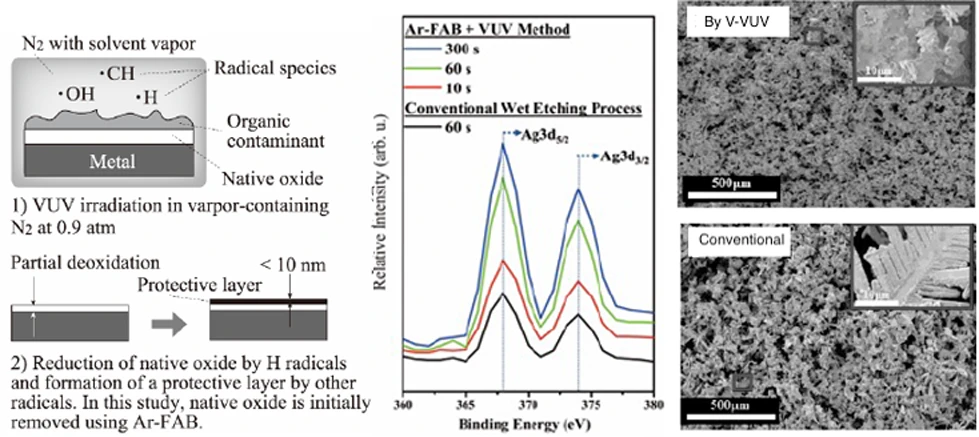
It is important to design the physical and chemical nanostructure of the interfaces to ensure seamless signal and thermal transmission from the FEOL to the BEOL regions. Solid-state debonding would also be key to chip replaceability in future Chiplet Packaging. We have developed hybrid bonding at low temperatures without vacuum using vapor-assisted vacuum ultraviolet (V-VUV) surface modification. In the V-VUV method, a few nm-thick functional bridge layer can be formed on diverse materials, and a limited volume of oxide nanocrystals from the starting materials is spontaneously generated within the bridge Using the V-VUV method, we have improved the reliability of the hybrid interfaces, including their anti-hydrolysis properties. Furthermore, particularly at the Cu-Cu interfaces, the fundamentals of solid-phase chip delamination technology have been established, based on the expansion of CuO nanocrystals due to the spin-lattice coupling effect. In addition, we have demonstrated the tunability of molecular adsorption on semiconductor and metal oxides using this method. This would enable high bondability between novel conductive materials and conventional semiconductor substrates in interconnections for the "beyond 2nm era." We have also demonstrated improved Ag coverage on Cu electrodes to enhance conductivity and an outstanding increase in the sensitivity of a MEMS vapor sensor by modifying the number of adsorbed molecules.
References
-
Modified galvanic replacement using ethanol vapor-assisted vacuum ultraviolet (E-VUV) for enhanced Ag deposition, Materials Letters.403, 139482 (2025). DOI: 10.1016/j.matlet.2025.139482
-
Surface modification of aluminum on a silicon chip by citric acid treatment, Results in Surfaces and Interfaces20, 100625 (2025). DOI: 10.1016/j.rsurfi.2025.100625
Group members
-

Akitsu Shigetou
- Team Leader