


Fact and Figures
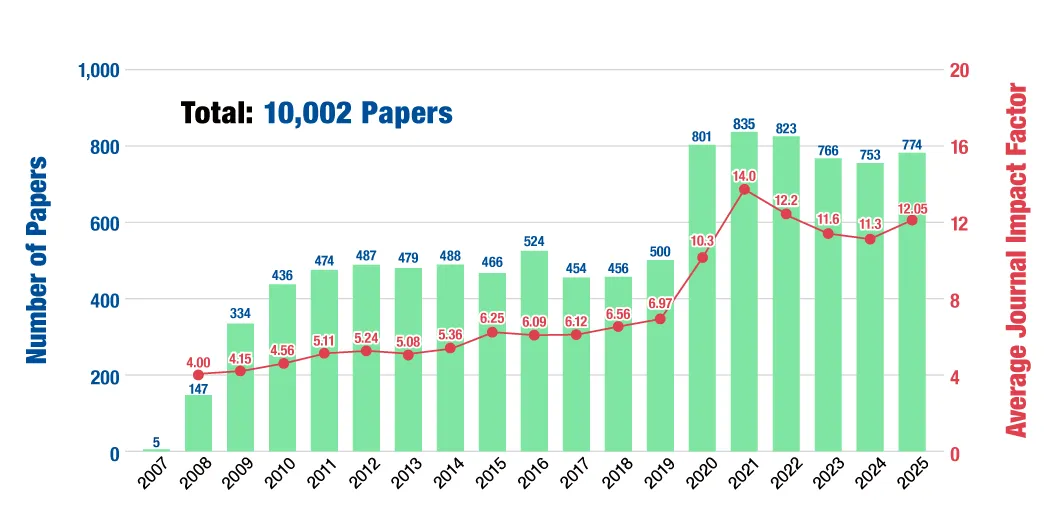
Number of Papers - 774 papers (in 2025)
In 2025, researchers affiliated with MANA published a total of 774 peer-reviewed papers in a wide range of international journals. The average impact factor of the journals by web of Science in which these papers appeared was 12.05, underscoring the consistently high quality and global recognition of our research output.
* Impact factor: A numerical measure quantifying the influence of academic journals, based on the frequency with which their published articles are cited.
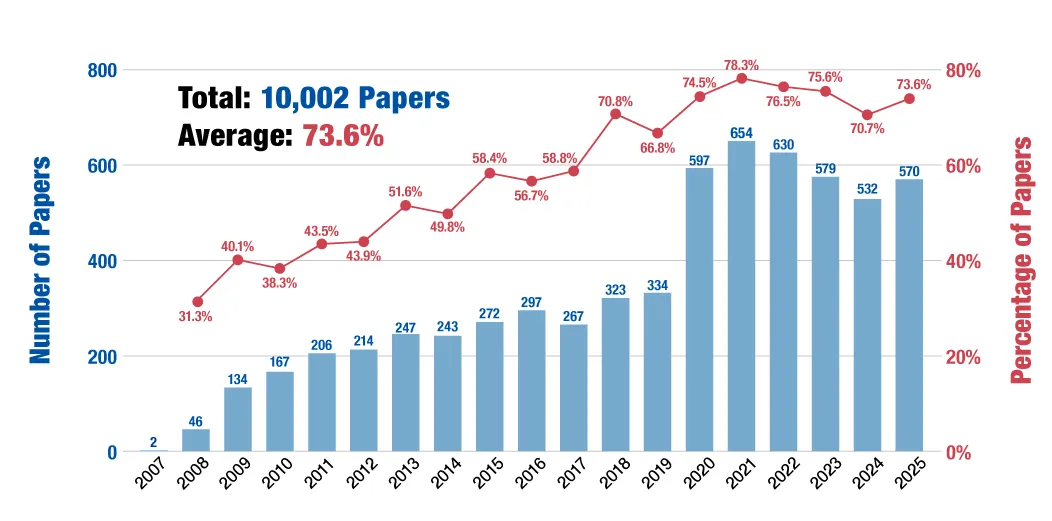
Internarionally Co-Authored Papers - 73.6% (in 2025)
The number of internationally collaborative research papers originating from MANA has shown an overall upward trend since the center’s establishment. This trend indicates the continued expansion of international research collaboration activities at MANA. Since 2015, more than 50% of the papers published by MANA researchers have involved international collaboration. In 2025, this figure reached 73.6%, continuing to exceed 70% since 2020. This high level of international collaboration reflects MANA’s active engagement in global research partnerships. Through collaboration with institutions and researchers worldwide, MANA contributes to knowledge exchange and the advancement of interdisciplinary research.
Top 1% Highly Cited Papers - 7.0%
From 2022 to 2025, MANA published 3,106 papers. The annual average percentage of papers recognized as Top 1% Highly Cited Papers over the four-year period was 7.0%, based on the Scopus database definition.
Patent Registrations - 454
MANA, dedicated to the promising and rapidly evolving fields of nanomaterials and quantum materials, has achieved a total of 454 patents in 2025— including 276 domestic and 178 international patents. This remarkable accomplishment underscores MANA’s proactive efforts to translate cutting-edge research into practical innovations. It also reflects our strong commitment to bridging fundamental science with real-world applications, contributing to technological progress in diverse areas such as energy, electronics, healthcare, and environmental sustainability. Through ongoing collaboration among researchers, engineers, and industry partners, MANA continues to play a leading role in driving innovation in advanced materials.
FWCI(Field Weighted Citation Impact From 2022 to 2025) - 1.82
Field Weighted Citation Impact (FWCI) by Scopus, is a field-normalized metric used to assess the citation impact of research outputs. An FWCI of 1.82 (2022–2025) means that papers from MANA are cited about 1.82 times as often as the world average for similar publications. than twice as often as the world average for similar publications.