


Qubit Materials Group
Quantum Materials Field
We aim to develop solid-state materials for quantum science and technology to enhance quantum control and maximize quantum coherence.
Group Leader:Yusuke Kozuka
Numerical Simulation of Thermal-History-Controlled Metastable Phases toward Switching Materials
Current Topics
Phase-change memory (PCM) demonstrates how metastable states can be exploited for switching devices by using rapid heating, quenching, and annealing to reversibly switch between crystalline and metastable amorphous states. This functionality suggests that thermal-history-controlled metastability may serve as a general design concept for switching materials. Extending this idea from structural glasses to electronic phase transitions, such as metal–insulator and magnetic transitions, could enable diverse switching functionalities based on correlated electron systems.
For structural glasses, extensive studies have established conditions for metastable-state formation by avoiding crystallization under thermal quenching, where ordering processes are constrained by conserved quantities such as atomic density or composition. In contrast, electronic phase transitions involve order parameters that are generally non-conserved, and general principles for stabilizing metastable states by thermal history therefore remain poorly understood.
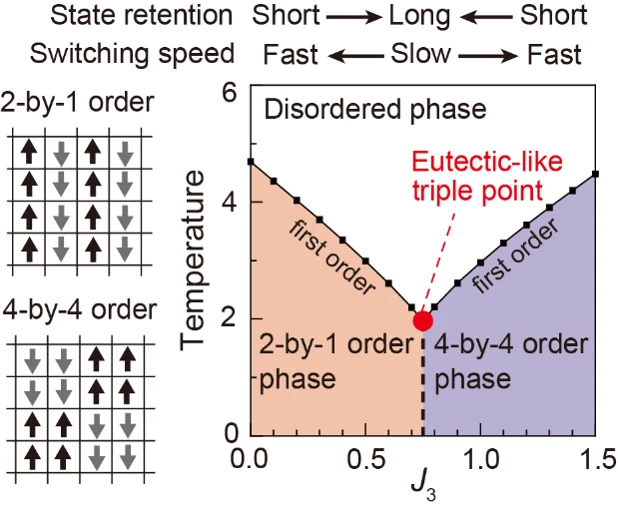
Here, we address this issue through numerical simulations of an Ising model with competing interactions, representing a minimal model for non-conserved systems with energetically competing ordered phases. We show that near eutectic-like triple points, where two ordered phases energetically compete, ordering kinetics slows down, allowing a supercooled disordered phase to persist as a metastable state for longer times than away from the competing regime.
Importantly, our results reveal a trade-off between switching speed and state retention (Fig). Near phase-competing regimes, long-lived metastable states are obtained at the cost of slow switching, whereas faster switching is achieved away from the competing regime with reduced state lifetime. This trade-off highlights the importance of parameter control guided by the phase diagram for balancing speed and stability in thermal-history-controlled switching materials.
References
Group members
-

Yusuke Kozuka
- Group Leader
-
Tomohiro Otsuka
- NIMS Invited Researcher
-
Shuichi Iwakiri
- Senior Researcher
-

Hiroshi Oike
- Senior Researcher
-

Takuya Iwasaki
- Senior Researcher