


Soft Chemistry Group
Nanomaterials Field
We produce oxide and hydroxide nanosheets/nanomeshes by exfoliating layered compounds, and we develop functional materials by organizing them as a 2D building block.
Group Leader:Takayoshi Sasaki
Understanding of swelling/delamination processes of layered transition metal oxides to obtain large regular-shaped nanosheets
Current Topics
We systematically investigated a process in which flux-grown microcrystals of layered transition metal oxides (K0.8Ti1.73Li0.27O4 and KCa2Nb3O10) were treated with quaternary ammonium ions (tetramethylammonium (TMA), -ethyl- (TEA), -propyl- (TPA), and -butyl- (TBA)) to induce extensive hydration and swelling, followed by exfoliation into nanosheets via mechanical agitation [ 1 ]. As a result, it was found that TPA and TBA ions achieved nearly 100% monolayer exfoliation; however, the nanosheets were fragmented, yielding small lateral sizes of several hundred nanometers). In contrast, although the exfoliation yield was lower for TMA and TEA ions, large-area nanosheets with lateral dimensions of several micrometers were obtained (Fig. 1a-d).
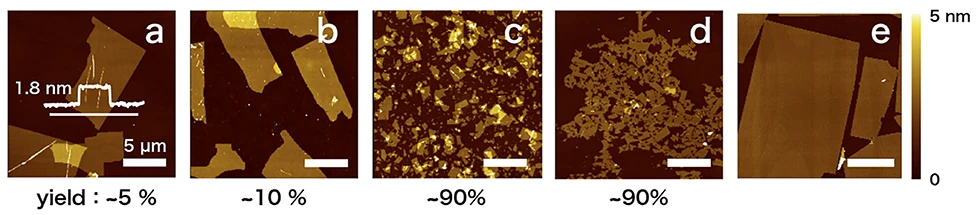
Based on compositional and structural consideration of these results, we propose that when TPA and TBA ions adsorb onto and cover the oxide layer surfaces, entanglement of alkyl chains occurs between neighboring ions. The resulting intermolecular forces generate mechanical stress, which leads to sheet fracture. Guided by this idea, exfoliation was attempted in organic solvents where intermolecular interactions are reduced. As a result, rectangular nanosheets with lateral sizes of several tens of micrometers—the largest reported to date—were successfully obtained (Fig. 1e).
The insights gained into controlling the lateral dimensions of two-dimensional nanosheets are expected to enable the effective development of a wide range of applications. Besides this study, we have reported the preparation of various nanomeshes [ 2 ], [ 3 ].
References
Group members
-
Takayoshi Sasaki
- Group Leader
-

Yasuo Ebina
- Principal Researcher
-
Nobuyuki Sakai
- Principal Researcher