


High-Pressure Structural Controls Group
Nanomaterials Field
We promote basic research on various functional materials using our high-pressure facilities together with the advancement of high-pressure base technology.
Group Leader:Hitoshi Yusa
Unique functional materials realized by high-pressure synthesis, and in situ x-ray observation to unveil high-pressure behavior of high-coordinated materials
Outline of Research
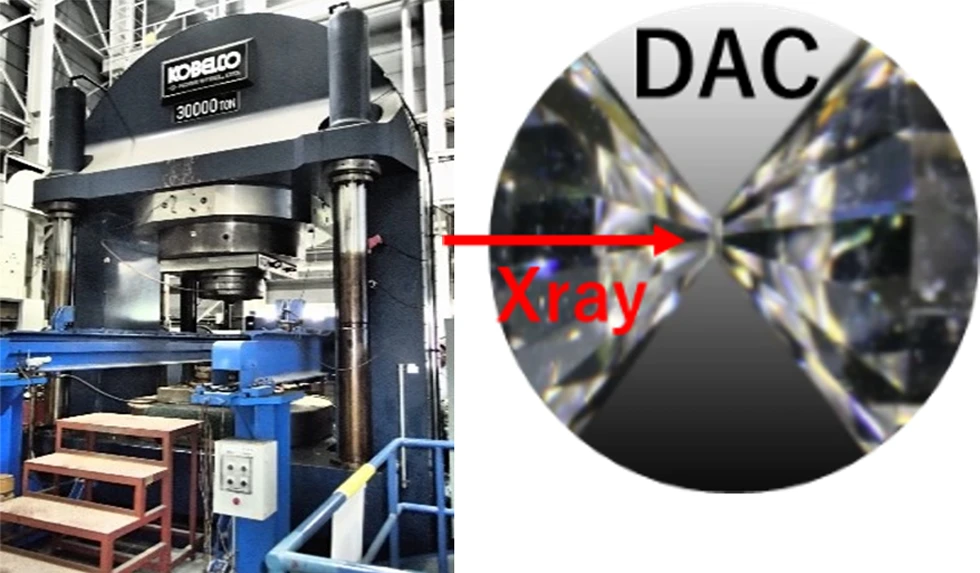
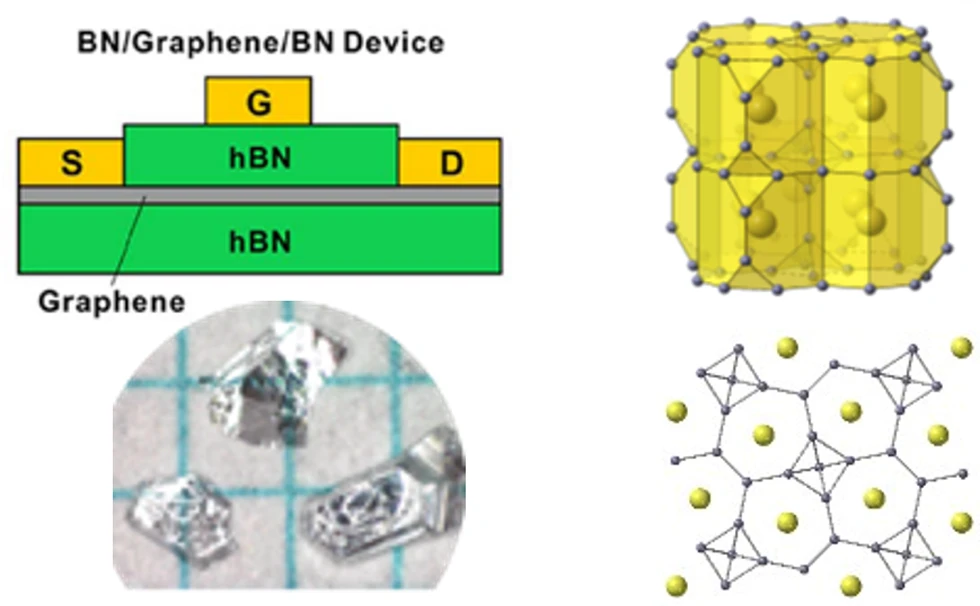
The high-pressure synthesis method using a belt-type appatus with a large volume enables the synthesis of various functional crystals unique to ultra high-pressure synthesis. 2-dimensional high-purity hBN crystals have been provided as insulating films for research on graphene-related materials, contributing to many international collaborative studies. We are also conducting research to determine the structure and synthesis conditions of high-pressure phases by in-situ observation under high pressure using synchrotron radiation X-ray.
Current Topics
The quality of hBN crystal substrates significantly impacts the carrier transport properties of graphene devices fabricated on them. Our collaborative research with the University of Manchester has achieved a mobility exceeding 10 million cm²/V·sec at low temperatures in FY2025[ 1 ]. Precise determinations of the bulk modulus and thermal expansion coefficient were performed for the rare earth high-coordinated boride RB₄ with Shastry-Sutherland Lattices (SSL) using synchrotron X-ray diffraction experiments. Structural anisotropy is more pronounced at low temperatures than under high pressure, suggesting it results from magnetic interactions within the SSL lattice[ 2 ].
References
Group members
-

Hitoshi Yusa
- Group Leader
-

Norimasa Nishiyama
- Chief Researcher
-

Satoshi Nakano
- Principal Researcher
-
Masashi Miyakawa
- Senior Researcher
-

Takashi Taniguchi
- Executive Vice President Director of MANA / Fellow
Activities
Links
- High-Pressure Structural Controls Group (MANA official Website)
- ※ As of April 2026, the group name has been changed to High-Pressure Materials Synthesis Group.