


Ionic Devices Group
Semiconductor Materials Field
Our group aims to develop electronic information devices with various functions, including neuromorphic devices based on ionic nanoarchitectonics..
Group Leader:Kazuya Terabe
Enhancing Electronic Information Devices through Ionic Nanoarchitectonics
Outline of Research
Significant progress has been made in electronic information equipment thanks to technologies such as semiconductors and other electronic devices. However, concerns have been raised about the performance limitations of semiconductor devices that rely on ultra-fine processing technologies. For this reason, attention is shifting towards developing new types of multifunctional devices, such as brain-inspired ones. In addition to electronic technologies, the integration of solid-state ionic technologies is also important for these new devices. We are developing novel devices with unique functions and performance characteristics using an 'ionic nanoarchitectonics' approach that combines solid-state ionics, electronics, and nanotechnology.
Current Topics
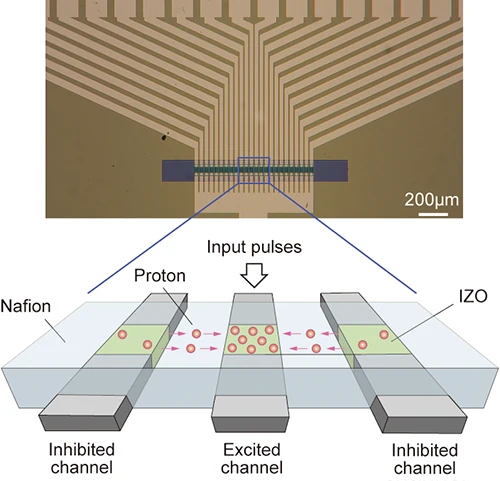
We have developed a visual device that mimics the lateral inhibition function of the neurons in the human retina. By utilizing this function, we have successfully detected edges in real images. Figure 1 shows the multichannel visual element operated by proton transport that we created. It is composed of an indium zinc oxide (IZO) multichannel and the proton conductor Nafion.[ 1 ]
References
Group members
-

Kazuya Terabe
- Group Leader
-

Tohru Tsuruoka
- Chief Researcher
-

Wataru Namiki
- Researcher