


ElectroActive Materials Team
Nanomaterials Field
Development of functional materials based on original concepts and ideas.
Group Leader:Hideo Hosono
Exploration and development of new catalysts and devices utilizing unique quantum material surface states
Current Topics
Achieving hole conduction in wide-gap compound semiconductors is challenging because the anionic p orbitals that form the valence band maximum (VBM), which acts as the conduction pathway for holes, are highly localized. We proposed a new method to modify the VBM through covalent interactions with filled cationic p orbitals. In rocksalt-type LaN, the interaction between N 2p orbitals and filled La 5p orbitals broadens the valence band width and imparts the delocalization of the holes (Fig. 1(a))[ 1 ].
Barium orthosilicate oxynitride-hydride Ba3SiO5-xNyHz is a newly synthesized compound as a transition-metal-free catalyst for efficient ammonia synthesis. Using DFT calculations, we determined the optimized structure for Ba3SiO2.5NH2 consists of SiO2NH tetrahedra and Ba6H octahedra (Fig.1(b)), which is prone to anion vacancies and activates hydrogen and nitrogen. [ 2 ]. A striking result is that this material exhibits high catalytic activity for NH3 synthesis, comparable to that of Ru-Cs-loaded MgO, a milestone catalyst, without loading a transition metal.
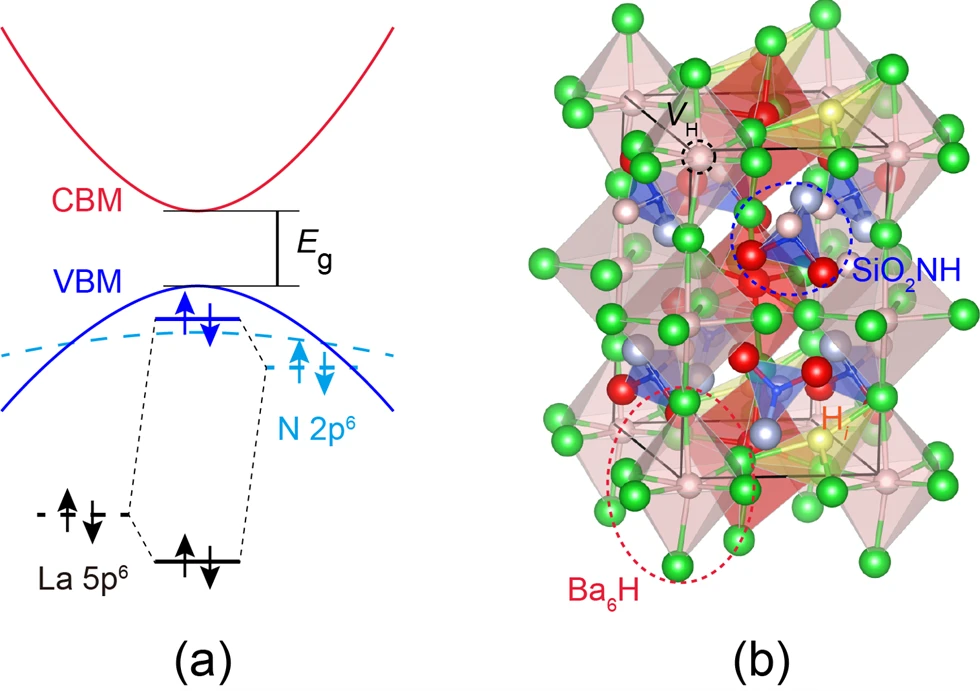
(a) Schematic electronic structure of LaN. (b) Crystal structure of Ba3SiO2.5NH2.
References
Group members
-

Hideo Hosono
- Team Leader
-

Satoru Matsuishi
- Principal Researcher