


2D Quantum Materials Group
Quantum Materials Field
Low-dimensional nanostructures provide a unique environment in which confinement strongly modifies electron and phonon dynamics, leading to responses to external stimuli that are distinct from those in bulk materials. This creates opportunities to uncover emergent physical phenomena and realize new device concepts. Our research focuses on nanostructures based on one- and two-dimensional nanomaterials, supported by in-house capabilities in advanced spectroscopy, crystal growth, and nanodevice fabrication.
Group Leader:Ryo Kitaura
Explanation of two-dimensional quantum materials
Current Topics
In monolayer TMDs, broken inversion symmetry and strong spin–orbit coupling make the K/K′ valleys distinct quantum degrees of freedom. Valley–polarization–locked optical selection rules enable selective excitation with circular polarization and coherent K/K′ superpositions with linear polarization.[ 1 ] Using polarization-resolved PL in monolayer MoSe₂, we quantified valley coherence and found that improving sample quality alone does not substantially enhance coherence; the inferred decoherence time is extremely short, suggesting intrinsic (phonon-related) scattering dominates. In type-II heterobilayers, interlayer excitons spatially separate electrons and holes, suppressing intervalley exchange and thereby enabling longer valley-polarization lifetimes (Fig.). In moiré superlattices, additional localization can further stabilize valley states. With time- and polarization-resolved spectroscopy of double-gated WS2/WSe2 devices, we demonstrated strong electric-field control of valley relaxation, achieving intervalley scattering times exceeding 700 ns, while coherence remains limited. We are extending these studies to more strongly localized MoSe2 /WSe2 using ~100 nm-aperture Au masks to mitigate inhomogeneity, aiming to achieve long-lived, optically addressable valley states for quantum technologies. We are also developing machine-learning-assisted crystal growth methods and studying the fundamental optics of low-dimensional systems.[ 2 ],[ 3 ]
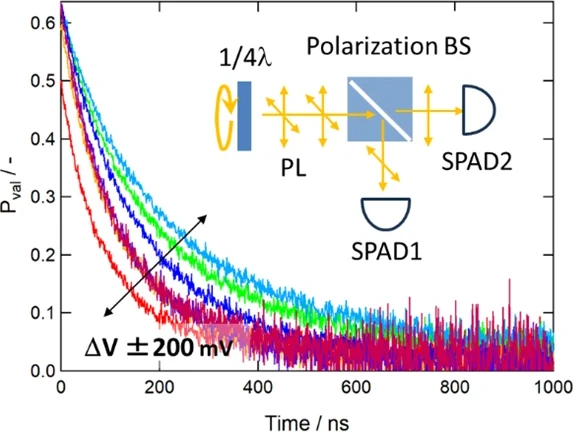
Time dependence of valley polarization of a moire superlattice under external out-of-plane electric field
References
-
Appl. Phys. Exp.16, 065003 (2023).
-
ACS Appl. Mater. Int.16, 43, 59109000 (2024).
-
Phys. Rev. Lett.13, 176101 (2025).
Group members
-

Ryo Kitaura
- Group Leader
-

Toshikaze Kariyado
- Senior Researcher
-

Daichi Kozawa
- Senior Researcher