



About the Quantum Solid State Materials Group
Create. Resolve. Measure. Understand.
Creating unknown materials and uncovering their structures and quantum functionalities.
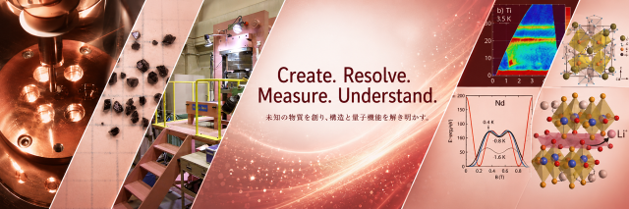
From Creating Materials to Discovering the Principles of Quantum Functionality
We create new solid-state materials that cannot be found in nature or obtained under conventional synthesis conditions by employing high-temperature and high-pressure synthesis, elemental substitution, crystal-structure control, and mixed-anion chemistry.
We combine crystal-structure analysis; measurements of magnetic, electrical, and thermal properties; advanced characterization using neutron and synchrotron radiation; and theoretical calculations to clarify the relationships between crystal structures and quantum properties.
One of our key strengths is our ability to conduct the entire research process—from conceiving and synthesizing new materials to determining their structures, evaluating their physical properties, and developing a theoretical understanding—through close collaboration within and beyond the group.
- Our Research
- Four Strengths
- Group Members
- For Students and Early-Career Researchers
- Related Materials
- Related Links
Our Research
Designing Atomic Arrangements to Create Unprecedented Functions
The properties of solid-state materials are not determined solely by the elements they contain.
Magnetism, electrical conductivity, dielectric properties, superconductivity, and other characteristics can change dramatically depending on where the atoms are located, which elements occupy particular crystallographic sites, and what symmetry the crystal possesses.
We control chemical composition, cation arrangements, anion composition, and crystal symmetry to explore magnetic, electronic, and quantum phenomena that are not found in existing materials.
We also investigate physical properties under extreme conditions, including low temperatures, high magnetic fields, and high pressures, to determine which interactions operate within a material and how its functions emerge.
Our goal is not simply to discover new materials. We feed the knowledge gained from each material back into the next stage of materials design, thereby continuously creating solid-state materials with new functions.
Four Strengths
Creating Materials That Cannot Be Obtained under Conventional Conditions
High-Temperature and High-Pressure Synthesis and Crystal Growth
High pressure can stabilize combinations of elements, oxidation states, coordination environments, and crystal structures that are unstable under ambient pressure.
Using high-temperature and high-pressure synthesis, we explore metastable phases, new oxides, complex perovskite-type compounds, and other previously inaccessible materials.
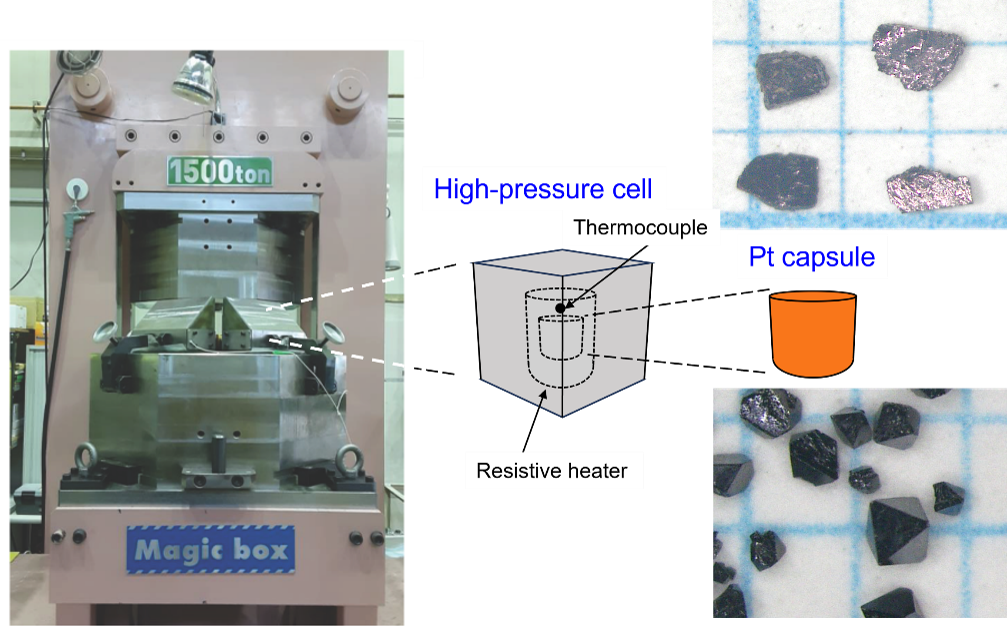
A distinctive feature of our research is that we use high pressure not merely as a synthesis condition, but as a materials-design tool for controlling crystal structures and atomic arrangements.
Although high-pressure synthesis often yields only polycrystalline samples, we also grow high-quality single crystals suitable for detailed structural analysis and measurements of direction-dependent physical properties.
Using belt-type and multi-anvil high-temperature and high-pressure apparatuses, we conduct exploratory synthesis of new materials and grow functional single crystals.
Designing Atomic Arrangements and Anions, Not Just Selecting Elements
New Materials Design Based on Crystal Chemistry
Even materials composed of the same elements can exhibit dramatically different physical properties when their atomic arrangements or crystal structures differ.
By controlling ordered cation arrangements, lattice distortions, and crystal symmetry, we design magnetic, dielectric, electrically conductive, and other functionalities.
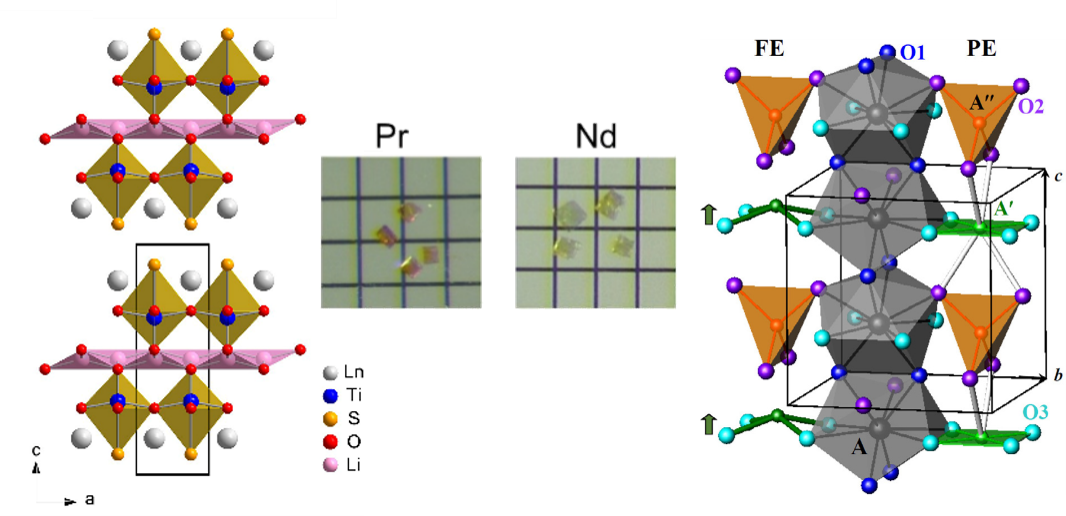
In particular, we investigate the synthesis and physical properties of multiply ordered perovskites, in which several types of cations are arranged in an ordered manner over distinct crystallographic site.
We also use mixed-anion chemistry to expand the structural and electronic degrees of freedom available in solid-state materials. Unlike conventional oxides containing only oxygen as the anion, mixed-anion compounds combine several types of anions, such as oxygen, nitrogen, sulfur, and halogens.
Changing the types and arrangements of anions can produce chemical bonds, layered structures, open frameworks, and ion-conduction pathways that are not found in conventional oxides. This enables the design of solid-state materials with new magnetic, electronic-conduction, ionic-conduction, and optical properties.
Uncovering Structures and Physical Properties from Multiple Perspectives
X-ray and Neutron Techniques and Physical-Property Measurements under Extreme Conditions
Obtaining a new material alone does not explain why its functions emerge.
We use powder and single-crystal X-ray diffraction, neutron diffraction, inelastic neutron scattering, small-angle scattering, and related techniques to investigate crystal structures, atomic distributions, magnetic structures, and magnetic excitations.
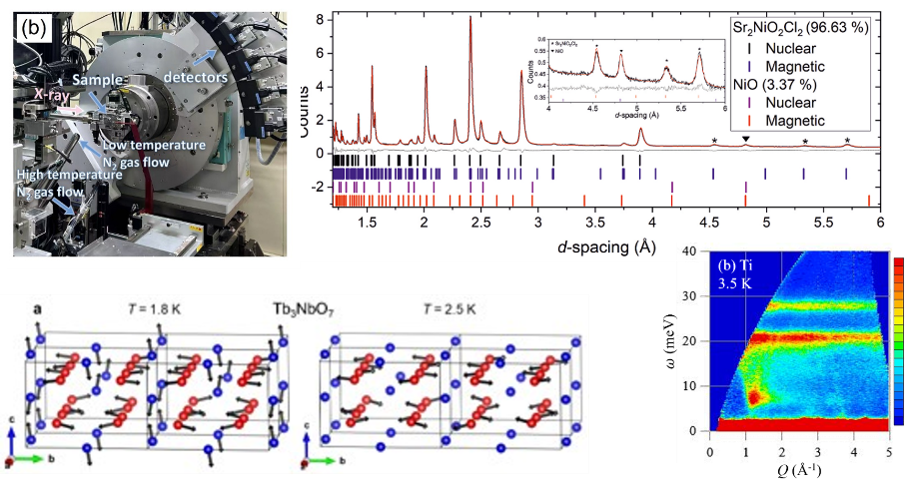
X-ray diffraction reveals atomic arrangements and crystal symmetry, while neutron diffraction determines the arrangements of magnetic moments. Inelastic neutron scattering allows us to directly investigate the energies at which spins are excited and how these excitations propagate through a material.
In addition to evaluating fundamental properties such as magnetization, electrical resistance, heat capacity, and dielectric response, we conduct measurements under extreme conditions, including low temperatures, high magnetic fields, and high pressures. These measurements allow us to explore phase transitions and quantum states that are difficult to observe under conventional conditions.
Through collaboration with neutron and synchrotron radiation facilities and researchers in Japan and overseas, we examine individual materials using multiple complementary techniques, thereby clarifying the relationships between structure and physical properties from a broad perspective.
Moving Back and Forth between Experiment and Theory to Guide the Next Stage of Materials Design
Statistical Mechanics, Atomistic Models, and Computational Science
Rather than merely describing experimental results, we model why particular phenomena emerge and use this understanding to guide the next stage of materials design.
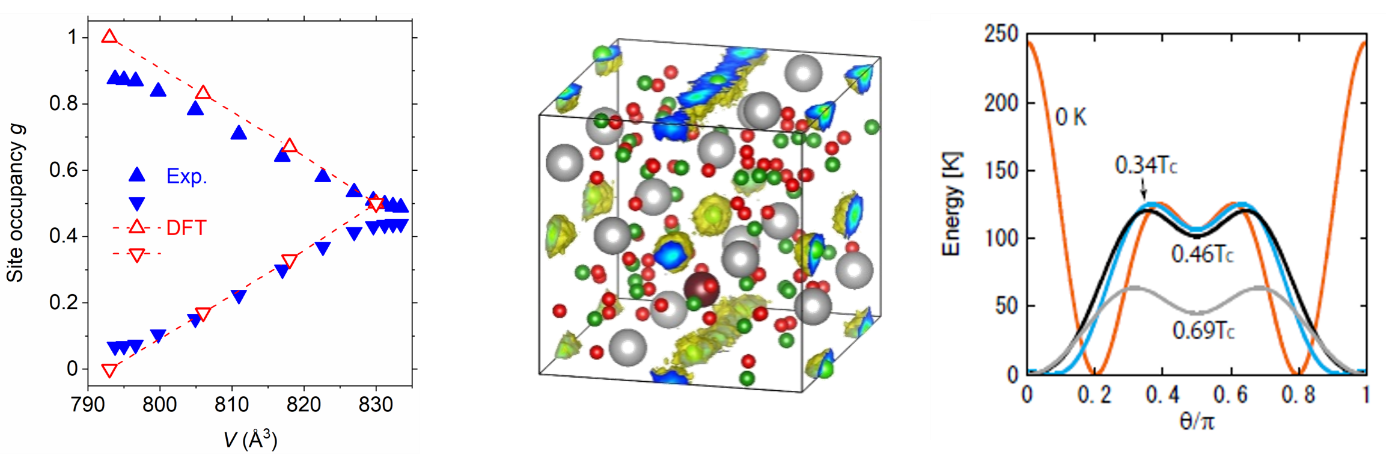
We use statistical mechanics and atomistic models to investigate phase transitions, critical phenomena, magnetization processes, spin reorientation, thermal fluctuations, nonequilibrium phenomena, and related behavior.
Our atomistic models incorporate individual atomic spins, exchange interactions, magnetic anisotropy, thermal fluctuations, and other factors. These models enable us to analyze processes such as magnetization reversal and phase transitions that are difficult to observe directly in experiments.
Theoretical calculations are not used only to explain experimental results after the fact. By comparing theory with experiment, we identify the interactions and control parameters governing physical properties and derive new guidelines for the chemical compositions, elemental substitutions, and crystal structures that should be synthesized next.
Group Members





For Students and Early-Career Researchers
Create, with your own hands, a material that no one has ever investigated before.
For Those Interested in Graduate Study or Research Opportunities
NIMS Joint Graduate School Program
We accept doctoral students through the NIMS Joint Graduate School Program with the Graduate School of Chemical Sciences and Engineering at Hokkaido University.
By taking advantage of the research facilities at NIMS and our domestic and international collaborative research networks, students can experience the entire research process, from designing and synthesizing new materials to structural analysis, physical-property measurements, and theoretical understanding.
The materials studied in our group have not yet appeared in textbooks. A target material may not be synthesized as expected, and the significance of a newly observed phenomenon may not immediately be clear.
Through this process of trial and error, students develop the ability to evaluate materials, design experiments, verify data, and explain their results using the languages of both physics and chemistry.
Our group provides an environment in which students and early-career researchers with diverse expertise and interests can work together. This includes those who wish to focus on experimental research, those interested in relationships between crystal structures and physical properties, those who wish to study quantum magnetism using neutron techniques, and those seeking to understand materials functionality through computational science.
Laboratory Visits and Graduate Study Consultations
We welcome inquiries regarding laboratory visits and graduate study opportunities throughout the year.
Please contact one of the group members by email according to the research topic in which you are interested.
Opportunities for Postdoctoral Researchers and Research Fellows
We also welcome inquiries regarding research opportunities supported by fellowship programs such as the JSPS Postdoctoral Fellowship for Research in Japan and the JSPS Research Fellowship for Young Scientists.
Prospective applicants should contact the relevant group member and provide information about their desired research topic and academic or professional background.
International Collaborative Research and Researcher Exchange
We promote international collaborative research and researcher exchange through frameworks such as the JST LOTUS Programme.
Collaborative Research Inquiries
We welcome inquiries regarding collaborative research in areas including new materials synthesis, structural analysis, magnetic and transport properties, neutron scattering, and theoretical calculations.
Please contact one of the group members according to the proposed research topic.
Contacting Group Members
The group does not have a general shared email address.
Please contact individual group members directly according to the relevant research topic or the nature of your inquiry.
Related Materials
- Our Research Approach
- Research Environment
- Selected Research Achievements
- Brief Profiles of Group Members