



Jan. 30, 2026
A novel study demonstrates that droplets at a miniscule level can be precisely controlled, opening new avenues in micro-scale systems.
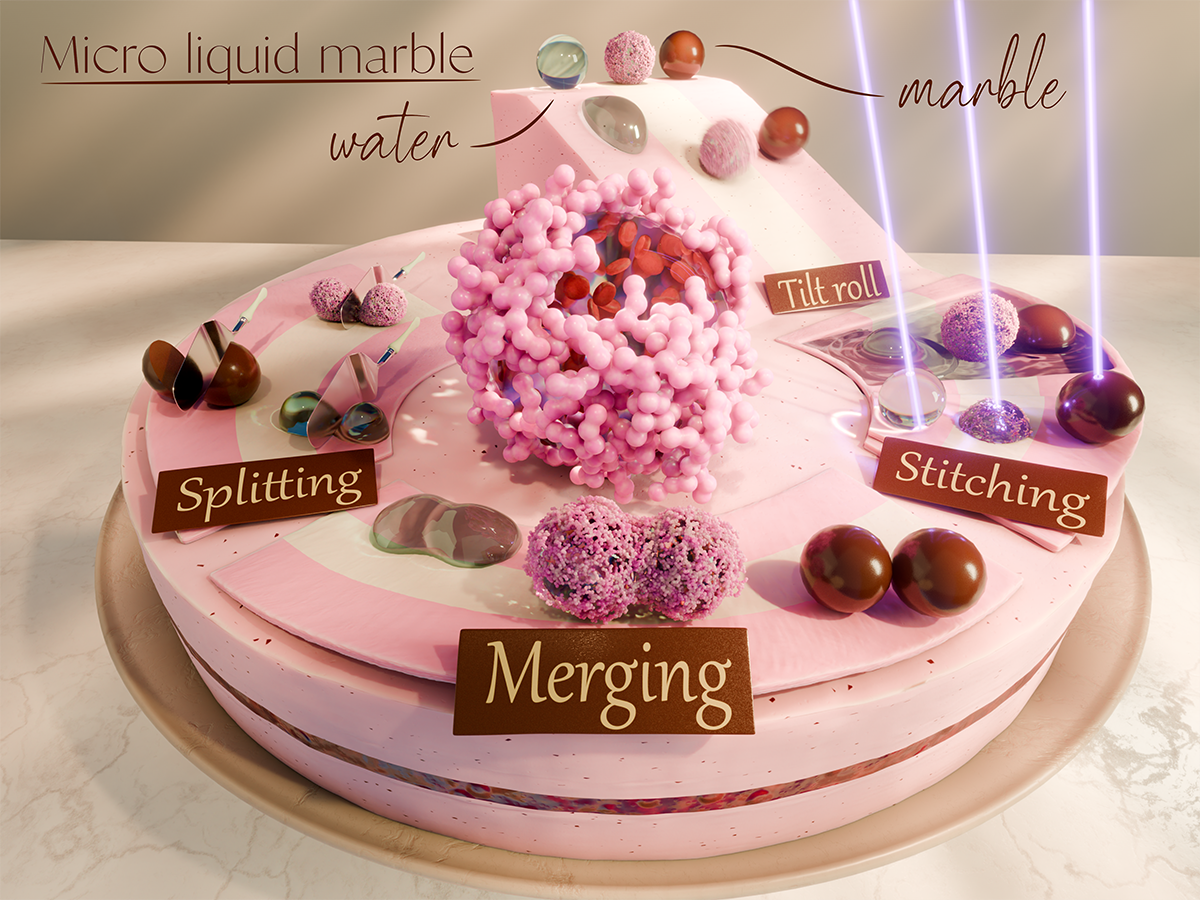
Caption: The pink particle-decorated microdroplet, so-called micro liquid marble, exhibits functionalities of both water and marble. Liquid marble is not sticky like a solid, yet it can split and merge like a liquid, opening a door to a microfluidics wonderland!
Copyright: MANA, NIMS and VIZCIE
Scientists from the Research Center for Materials Nanoarchitectonics (MANA), one of the centers under the National Institute for Materials Science (NIMS) in Japan developed a liquid-repellent particle coating that allows pico- and nanoliter liquid droplets to be handled like dry powder, enabling precise control of ultra-small liquid volumes in microfluidics applications.
The precise control of tiny droplets on surfaces is essential for advanced manufacturing, pharmaceuticals, and next-generation lab-on-a-chip diagnostics. However, once droplet volume reaches pico- and nanoliter scales, the droplets become extremely sensitive to microscopic surface irregularities, and friction at the solid–liquid interface becomes a major obstacle to smooth transport.
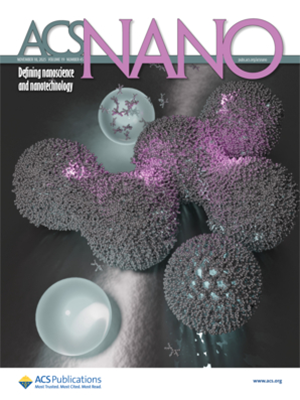
Against this backdrop, a study led by Dr. Mizuki Tenjimbayashi and his colleagues at Materials Nanoarchitectonics (MANA) proposed a novel strategy that involved coating the droplet with a repellent material instead of engineering a perfectly smooth surface. This study published in the journal ACS Nano has been selected as the “Supplementary Cover Article.”
Using an ultrasonic spray, the team coated picolitre droplets with fluorocarbon-modified fumed titania particles of 20 nanometers diameter, forming a dynamic nano–micro coating around them.
Once coated, the droplets no longer experienced high friction at a solid–liquid interface. Instead, they moved over the particle layer via solid–solid contact, which dramatically reduced the force required for sliding, down to a subnanonewton level.
When the team compared sliding behavior across different droplet volumes, they found that this technique reduced the droplet-repellent volume by three to four orders of magnitude compared to that of classical liquid-repellent interfaces. Importantly, the particle coating preserves the droplet’s ability to change shape, allowing droplets to merge, split, or reshape when stimulated, displaying capabilities that are crucial for microfluidic applications.
The ability to control droplets at such tiny scales could transform pico- and nanofluidics, soft microrobotics, and systems where droplets behave collectively like particles. It could then be possible to miniaturize chemical and biomedical procedures. Experiments, diagnostic tests, and sensing tasks could be performed using only picolitre amounts of liquid, reducing reagent consumption and chemical waste and facilitating more sustainable scientific and industrial practices
References
| Journal | ACS Nano |
|---|---|
| Title | Manipulating Pico- to Nanoliter Droplets on Surfaces without Sticking |
| Authors | Mizuki Tenjimbayashi1,, Shunto Arai2, Hiroshi Mizoguchi1,Satoshi Ishii1 |
| Affiliations |
|
| DOI | 10.1021/acsnano.5c14919 |