



Mar. 2, 2026
New study explains how external stimuli can modify electronic energy bands in Mott and Kondo insulators
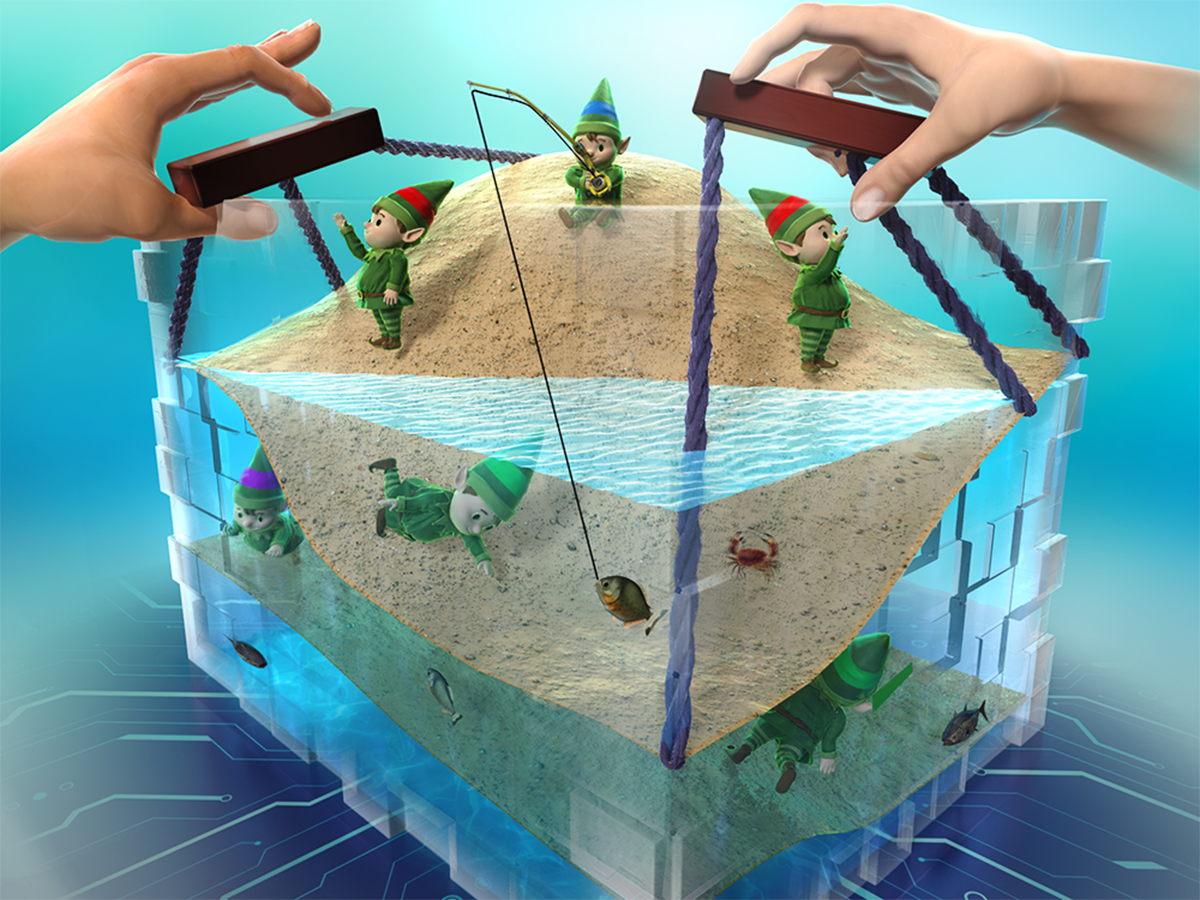
Caption: The electron world, where electrons (dwarfs) explore their energy band (beach), can be manipulated using external fields or light in strongly correlated insulators. This ability enables new electronic devices with advanced functionality.
Copyright: MANA,NIMS and Science Graphics. Co., Ltd.
A study from the Research Center for Materials Nanoarchitectonics (MANA), one of the centers under the National Institute for Materials Science (NIMS), Japan has uncovered a theoretical mechanism showing how the electronic band structures of strongly correlated insulators can be reshaped by spin and charge perturbations, opening up new possibilities for electronics with tunable band structures.
Imagine an electronic material whose fundamental properties could be changed not by replacing atoms or fabricating new structures, but by applying light, a magnetic field, or an electric signal. A solar cell, for example, could temporarily reshape its energy bands under illumination to harvest light more efficiently.
Such flexibility is not usually possible in conventional semiconductors, where external controls can only change how electrons occupy energy levels rather than the energy band structure itself. Now, a study published in Physical Review B by Chief Researcher Masanori Kohno from MANA demonstrates that strongly correlated insulators such as Mott and Kondo insulators can behave very differently.
In these materials, disturbing spins or charges via doping (addition of holes or electrons through a chemical-potential shift), magnetization, or light can induce entirely new electronic states inside the gap between energy bands. This occurs because electrons interact strongly with one another. Unlike ordinary band insulators, where spin and charge excitations are tightly linked, correlated insulators allow low-energy spin excitations to exist independently.
By theoretical analyses and numerical calculations, this study elucidates how spin and charge perturbations affect the band structures of these insulators, clarifying the microscopic mechanism responsible for the emergence of these electronic modes. The results show that when a large collective number of spins or charges are excited, the induced states can have significant intensity, reshaping the electronic band structure.
“This research shows that, unlike conventional semiconductors, spin and charge perturbations can create new electronic modes that actively modify band structures,” says Dr. Kohno.
The findings could lay the groundwork for band-structure engineering based on strong electron correlations, enabling future electronic and optoelectronic devices with enhanced and tunable functionality.
References
| Journal | Physical Review B |
|---|---|
| Title | Electronic modes induced by spin and charge perturbations in Mott and Kondo insulators |
| Authors | Masanori Kohno1 |
| Affiliations |
|
| DOI | 10.1103/ythd-s2x8 |