History of High Magnetic Field Characterization Unit
- 1956
-
Establishment of National Research Institute for Metals
National Research Institute for Metals (NRIM) was established as a national laboratory under auspices of Science and Technology Agency (the former ministry of Ministry of Education, Culture, Sports, Science and Technology). Researches on superconductivity such as nuclear fusion and multicore research project have been proceeded to develop several high magnetic field devices.
- 1960s
-
Development of superconducting materials
1960s was the important decade for our magnet technology. The remarkable breakthrough was the identification and specification of the molecular structure of superconducting materials. Achievements in the design of wire, conductor and magnet had also significant impact. These tremendous efforts in in-house researches have led to further advance of TML.
- 1976
-
17.5T Superconducting Magnet
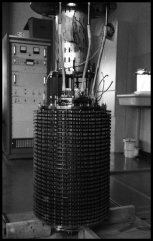
17.5T superconducting magnet which brought TML the first world's record of the magnetic field strength was developed. It consisted of an outer Nb3Sn solenoid with a 160 mm bore producing 13.5 T, and an inner V3Ga solenoid with a 32 mm bore producing an incremental 4T. This system was a successful result of the fruitful collaborative efforts with a large number of researchers and engineers from Intermagnetics General Corporation (Guilderland, NY), Vacuum Metallurgical Co. Ltd. (Tokyo, Japan) and NRIM. After the installation at NRIM, it has contributed many research programmes including high field superconductors.
- 1986
-
18.1T Superconducting Magnet
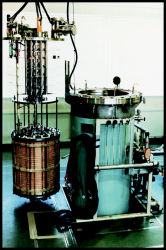
The new super conducting magnet has developed by combining (Nb,Ti)3Sn, NbTi and V3Ga wires. It has broken the own magnetic field record by generating 18.1 T in a 32 mm bore.
Discovery of Bi-based oxide superconductor
Many rare earth elements have been researched as the new superconducting material in 1980s, yet no materials topped YBa2Cu3O7 (YBCO), the yttrium compound with 90K superconductivity. NIRM researchers led by Dr Hiroshi Maeda discovered a BiSrCaCu2Ox (BSCCO) system, a bismuth compound without rare earth elements. It has approximately 105K Tc, which is higher than that of the YBa2Cu3O7.
A key of attaining high-Tc in the Bi oxides is the coexistence of two kinds of alkaline earth elements, Sr and Ca. The Ca ion, by allowing CuO2 layers to stack up, provides the Tc increase by approximately 105K, more stability and ductility. The breakthrough has become one of the turning points in high-Tc superconducting research, by stimulating many researchers to have hope again to discover the new compounds.
In 1991, the Bernd T Matthias Prize was given to Dr Maeda for the discovery. The detail is described in a paper "A New High-Tc Oxide Superconductor without a Rare Earth Element" which has been cited about 2,400 publications. - 1988
-
Construction of hybrid magnet started
Following by the successful developments in high-field superconducting magnet and the related research, the new project was launched in 1988. Aiming to establish a comprehensive high-magnetic field research centre, NRIM started constructing an 80T long-pulsed magnet and a 20T large-bore superconducting magnet as well as the major project, a 40T-class hybrid magnet.
Pulsed magnet is used for studying superconducting and ferromagnetic materials. In order to ensure capacity and efficiency to study properties of high-Tc superconductor, 80T long-pulsed magnet was constructed by applying materials: owing to stronger and higher electrical conductivity, and the coil structure optimisation including the insulation materials and the volume fraction. It also featured the capacitor bank system with 1.6 MJ maximum stored energy, 5 kV dc maximum voltage and 128mF capacitance. - 1993
-
21.1T Superconducting Magnet
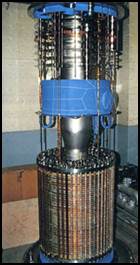
21.1 T was obtained by the new superconducting magnet with a larger clear bore, 50 mm. The innermost wind and react coil was wound around with a new superconductor, developed (Nb, Ti, Ta)3Sn. Saturated superfluid helium was applied as a coolant for this magnet, which was the first successful coolant application for large superconducting magnet system.
73.4T Pulse Magnet
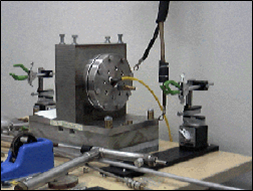
A long-pulse magnet with optimised layer brought the first world record for pulsed magnet by generating 73.4T non-destructively in a 10 mm bore. The small pulsed magnet coil, made of a Cu-Ag alloy wire with interlayer reinforcement of glass fibre, generated 73.4T with the pulse duration of 5ms.
Establishment of Tsukuba Magnet Laboratory
Tsukuba Magnet Laboratory, a high magnetic field research centre in NRIM, was established with a completion of the main building construction. The new laboratory started the research installation including long-pulsed magnet, 40T class hybrid magnet, a 21T superconducting magnet and several high resolution magnets.
- 1995
-
36.5T hybrid magnet
The first hybrid magnet was completed with Toshiba Corporation in 1994, which utilities a helium liquefier/refrigerator of 150 litres per hour, a 1500 A dc power supply, a 15MW dc power supply and a 15MW water-cooling system.
Two kinds of inner water-cooled magnets were designed to use with the outer superconducting magnet which generates up to 15T in a room temperature: an 18-helix insert made of Cu-Al3O3 alloy with 30 mm bore generates up to additional 25T, and a 50 mm bore insert combined with 6 inner helices of Cu-Cr alloy and 9 outer helices of Cu-Al3O3 alloy generates up to additional 20T. They successfully made the new world records for steady magnetic fields without ferromagnetic pole pieces, by generating total magnetic fields of 35.7T and 32.1T, respectively. - 1998
-
TML becomes an open facility
Our magnet facility gained the certain stability and quality for operation, as a result of several breakthrough and the subsequent development. It became a valuable tool in scientific technology and research such as condensed matter physics, material science, chemistry, biology and medicine. We also had been constantly receiving requests for the facility use. These requests came not only from NRIM researchers, but also from people engaged in several activities. We saw the wide possibility of magnet technology, Tsukuba Magnet Laboratory thus became an open facility from April.
- 1999
-
37.3 Hybrid Magnet
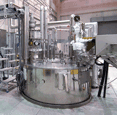
TML has also developed pulsed magnets and resistive magnets. A field of 37.9 T was generated with 33.25 kA operating current at 431V. The 32mm room-temperature bore insert magnet is divided into 3 coaxial coils: the bitter plates of the two inner coils are made of hard-worked Cu-Ag plates, and those of the outermost coil are made of GlidCop AL-25. the thickness of the plates used in the two inner coils was 0.84mm, and the 0.2% proof stress in the direction parallel to the roll work was about 800MPa at 375K. This temperature is designed to be the maximum of the innermost coil at 37.3T. In addition to that, the water flow in the insert magnet was highly regarded in the design for the better cooling.
23.4T superconducting magnet
In September 1999, a field of 23.4 T was generated by the new superconducting magnet. Application of a Bi-2212 coil had demonstrated a promising performance as a high-field insert coil. By inserting a small Bi-2212 double-pancake coil in a 61mm bore Bi-2212, fabrication and application of the breakthrough by Dr Maeda in 1989 reached to the new level of the progress. It has also become an important step for our 1 GHz NMR magnet project since 1995.
- 2001
-
Establishment of National Institute for Materials Science
Due to legal body reform for governmental organisations and the new law implementation, NIRM was merged with National Institute for Research in Inorganic Materials (NIRIM), and has become an independent administrative institution, NIMS. This reform has given remarkable autonomy in research programs and budget distribution, resulting research collaboration with universities and private sector has become more active.
920 MHz (21.6T) high-resolution NMR magnet
In April 2001, high-field NMR magnet generated 21.6T (920 MHz) the highest field ever in a persistent mode operation. The magnet was made of four (Nb, Ti)3Sn solenoid coils, three NbTi solenoid coils, and two split-paired NbTi coils. The room-temperature bore of the cryostat is 54mm in diameter. The magnet was cooled to 1.55K with pressurised super-fluid helium. In order to optimise the field homogeneity, superconducting shim coils cover around the main magnet.
- 2002
-
Completion of NMR Laboratory I
Having succeeded in NMR magnet in the previous year, the new TML building was constructed for the 920 MHz high-resolution NMR magnet. The magnet room is surrounded by particular steel walls. The design is to reduce negative impact by the magnet as well as the noise from the external environment. The stray field from the magnet is significantly reduced from 50 to less than 6 gauss. The field homogeneity by maintaining the symmetry of the opening parts such as door is also prevented. Since the NMR started the regular operation, the technology has been particularly applied for protein structural and functional analysis.
- 2003
-
Completion of NMR Laboratory II
Aiming to the installation of new 930 MHz NMR spectrometer, the new building was constructed. Minimising the background field perturbation between the TML magnets including the interaction with a hybrid magnet was well concerned to the design and the construction. Eventually 9 magnets were installed in the tow NMR buildings: a 930 MHz, two 500 MHz, a 400 MHz and a 270 MHz magnets for solid-state NMR measurements as spectrometers, and two narrow-bore (54mm) NMR magnets, a 920 MHz and a 600 MHz for solution NMR measurements using 1H-13C-15N triple-resonance probes. The new NMR facilities are expected to improve the quality as a measurement tool.
- 2004
-
930MHz NMR Magnet
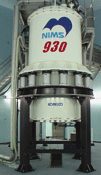
As the three dimensional structure of protein molecule was determined by the 920 MHz NMR in an effective manner, stronger magnetic field is able to provide NMR spectroscopy the better sensitivity, resolution and the chemical-shift dispersion.
The main feature was changing the innermost coil to a 16% Sn-bronze processed (Nb, Ti)3Sn conductor, which enabled to add more coil turns by the significant magnet size reduction. It obtained up to 21.6T without quenching and has been operated in a persistent mode at 920 MHz for more than a month, and eventually reached up to 930.7 MHz (21.9T).
Since the 930 MHz NMR magnet was launched, the previous NMR has mainly been used for solution NMR measurement, the new NMR has been utilised for solid-state NMR measurement. - 2005
-
Power supply modification
In response to the development of the hybrid magnet, a plan to overhaul the hybrid magnet system was initiated. 15 MW power supply system was upgraded by installing the electric wiring system, active filter and DCCT. Introducing the new MOS-FET in place of a transformer coupled regulator in the active filter system has improved the magnet operation – significant reduction was seen in the magnetic field fluctuation and the noise.
The modification enabled NMR structural analysis by hybrid magnet, and the accuracy enhancement of magnetic/superconductive property measurement. - 2008
-
Cooling system improvement for hybrid magnet
As a part of the hybrid magnet system modification, cooling system for the water cooled magnet was improved. In order to provide more flexible operation of the water cooled magnet and to decrease the total energy requirement, the water cooling system was modified to utilise indirect cooling via a heat exchanger. After the upgrade of the water system, the water temperature can be controlled regardless of any field changes. Thus, the magnet can correspond to a wider range of possible experiments. The magnetic field strength of the water cooled magnet improved from 25 to 27T with the firm stability.