
News
2026
Achieving highly efficient Lithium recovery using bacteria as a micro power source
2026.06.29A joint research team from our lab at NIMS, Tohoku University, and The University of Tokyo has developed a new lithium recovery method that combines electroactive bacteria Shewanella oneidensis MR-1 with a lithium ion battery cathode material. The system recovers over 95% lithium within a few hours even under low-concentration conditions like seawater, without external electrodes or power supplies, promising greater scale and reduced environmental impact compared to conventional technologies. The results of this research are published in Nature Communications. Read more about this development in the Press Release - 細菌をマイクロ電源とした高効率リチウム回収を実現 (in Japanese)
Read Full Text at Nature Communcations
2025
Decoding Intracellular Respiratory Enzymes’ Interactions
2025.03.25Researchers from University of Tsukuba and our group have developed a method to study respiratory enzymes in microbial cells using electron mediator in conjunction with our proprietary High-Throughput Potentiostat. We believe this method has potential to be used for exploring complex intracellular enzymatic interactions. Read more about this development at Tsukuba Journal - 複雑に相互作用する酵素を細胞内で直接調べる新技術を開発 (in Japanese)
2024
NHK Highlights NIMS-Caltech Study on Dormant Bacterial States and Biofilm Resistance
2024.12.31We are excited to announce that our Group’s Research, in collaboration with Diane Newman’s Group at Caltech (Pasadena, USA) was featured on NHK Japan!
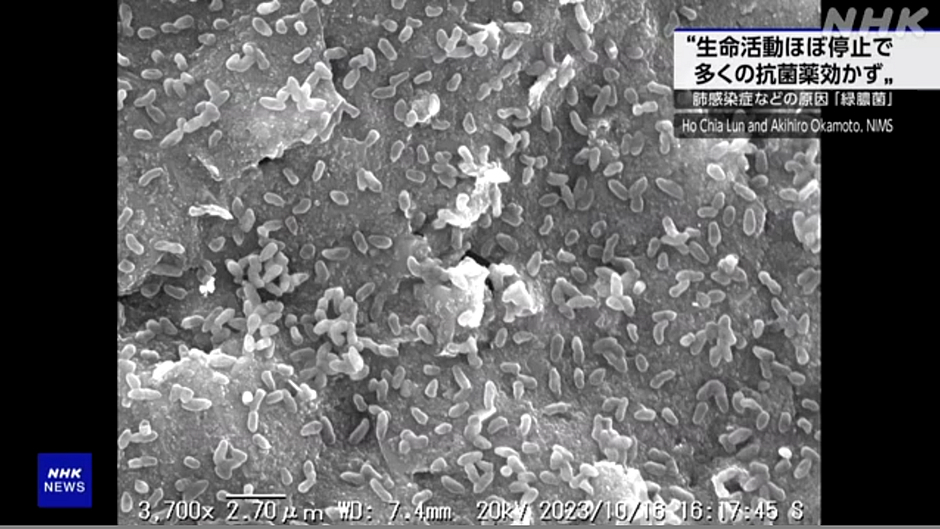
Bacteria in Hibernation Mode illuminated by our High-Throughput System
2024.10.23We are thrilled to announce our latest publication, in collaboration with Diane Newman’s Group at Caltech (Pasadena, USA). We have used our in-house developed High-Throughput Potentiostat to study survival mechanisms and antibiotic resistance in dormant, low-metabolic bacteria in biofilms. The publication is also featured in Caltech’s Press Release - New Technology Illustrates Bacterial "Hibernation States"
Understanding Microbial Electrical Conductivity without Biofilms
2024.02.27We are pleased to announce our findings for a new method to measure electrical conductivity in microbial colonies without biofilm formation of electrodes, which can expand the field of bioelectrochemistry. You can read more at University of Tsukuba’s Press Release - A New Method for Successfully Measuring Electrical Conductivity in Microorganisms―Approaching Understanding of Microbial Ecosystems
Read Full Text at ACS Environmental Science & Technology
2020
Divya NNARADASU's paper published in Molecules
2020.07.04D. Naradasu, W. Miran, A. Okamoto, "Metabolic Current Production by an Oral Biofilm Pathogen Corynebacterium matruchotii", Molecules, 25(14), 3141(2020)