Sulfur Segregation at the Oxide/Ni-base Superalloy Interface
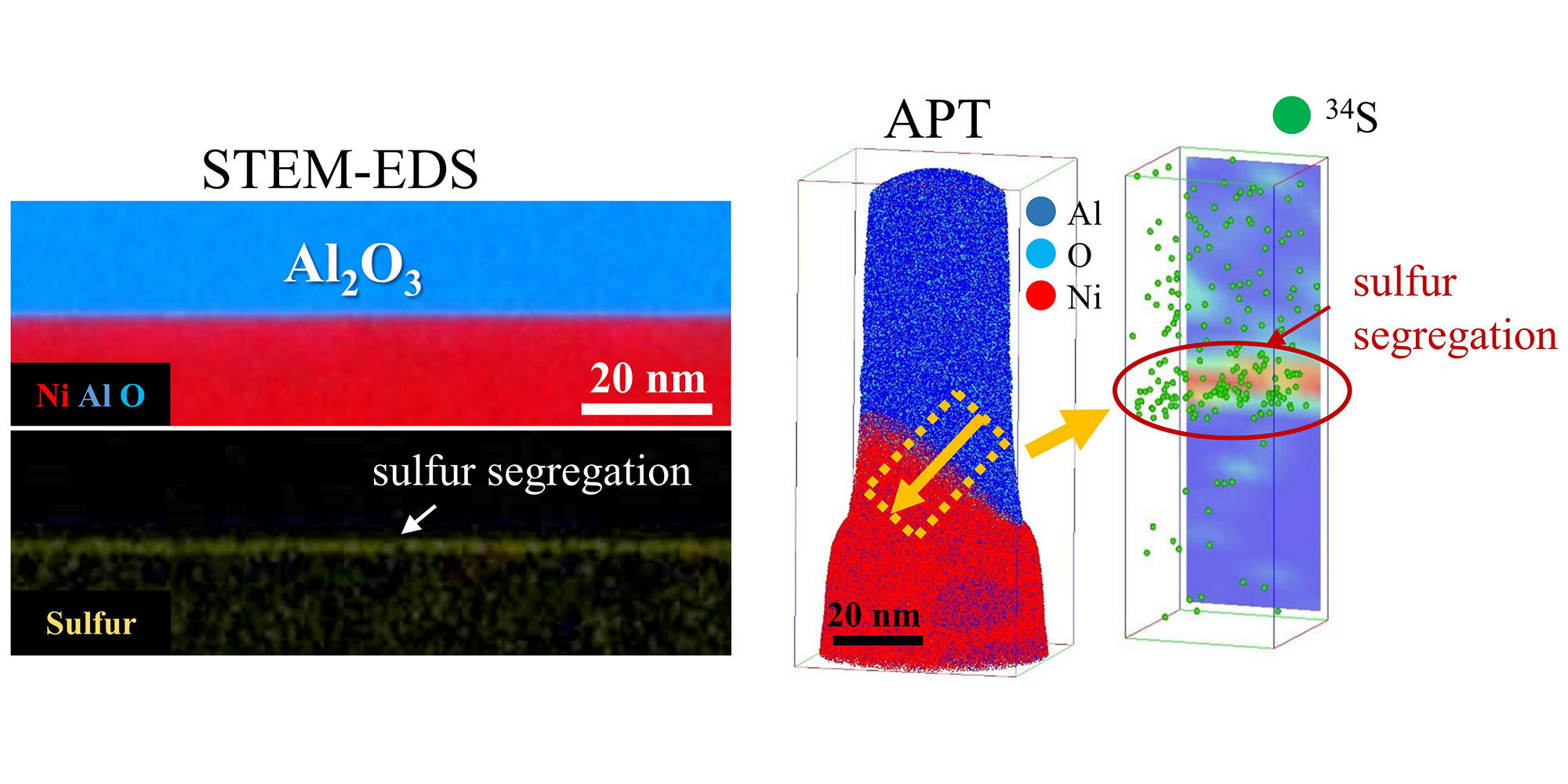
Compared to melting in an Al2O3 crucible, Ni-based single crystal superalloys exhibit significantly improved oxidation resistance when melted in a CaO crucible. To elucidate this mechanism, the distribution of sulfur—which is a trace impurity element—at the oxide/Ni-based superalloy interface was analyzed using aberration-corrected scanning transmission electron microscopy with energy-dispersive X-ray spectroscopy (STEM-EDS) and atom probe tomography (APT). Sulfur segregation at the interface was observed for samples melted in both Al2O3 and CaO crucibles; however, the sulfur concentration peak at the interface was much lower for the sample melted using the CaO crucible. Additionally, the formation of CaS inclusions near sub-grain boundaries was confirmed. These experimental results suggest that the significant improvement in oxidation resistance when using a CaO crucible is due to the suppression of sulfur segregation at the oxide/Ni-based superalloy interface, resulting from the capture of sulfur by dissolved calcium.
- C. Tabata, K. Kawagishi, J. Uzuhashi, T. Ohkubo, K. Hono, T. Yokokawa, H. Harada, S. Suzuki, "Quantitative analysis of sulfur segregation at the oxide/substrate interface in Ni-base single crystal superalloy", Scr. Mater. 194, 113616 (2021)