Nanocrystalline Soft Magnetic Materials
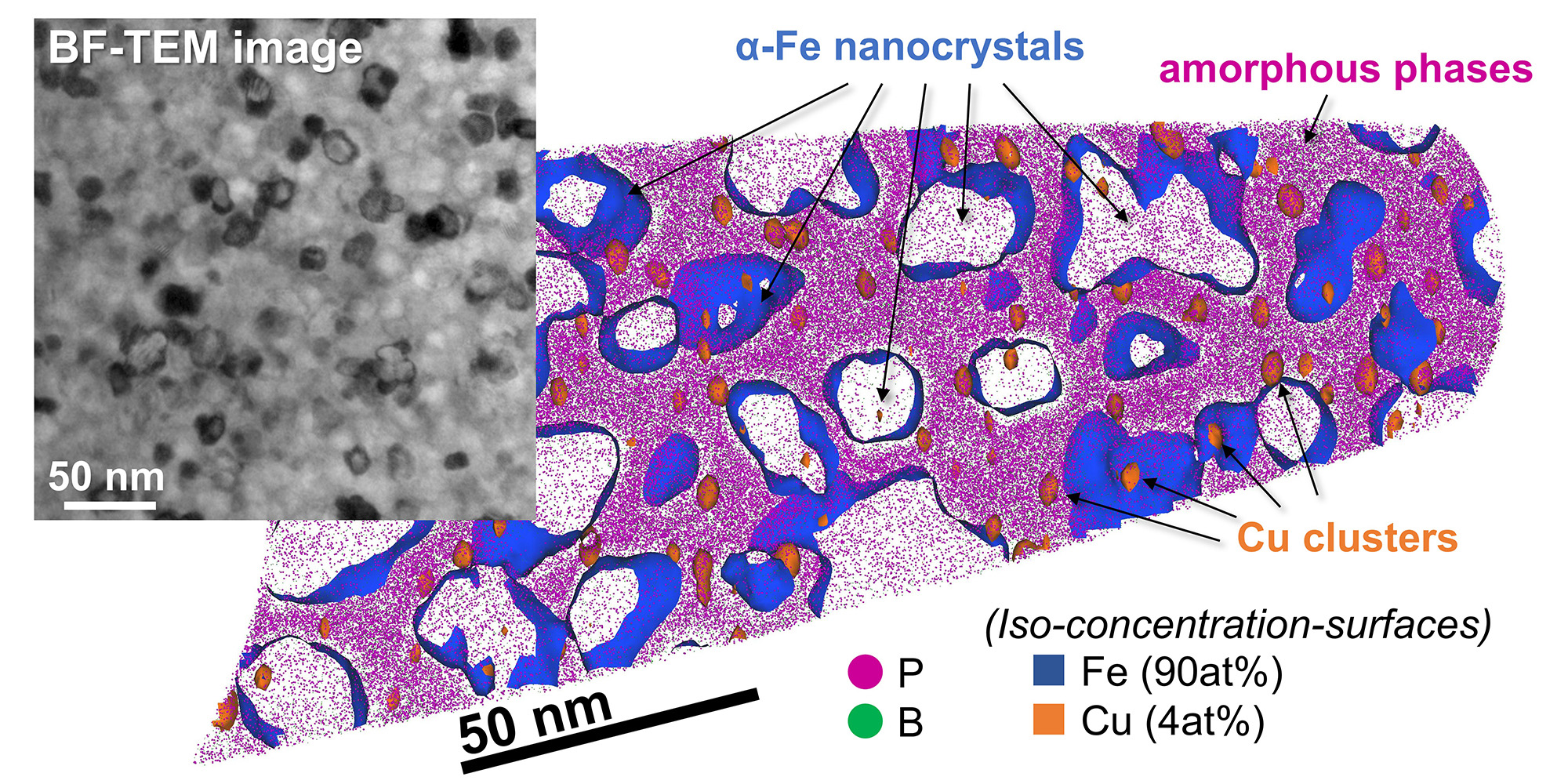
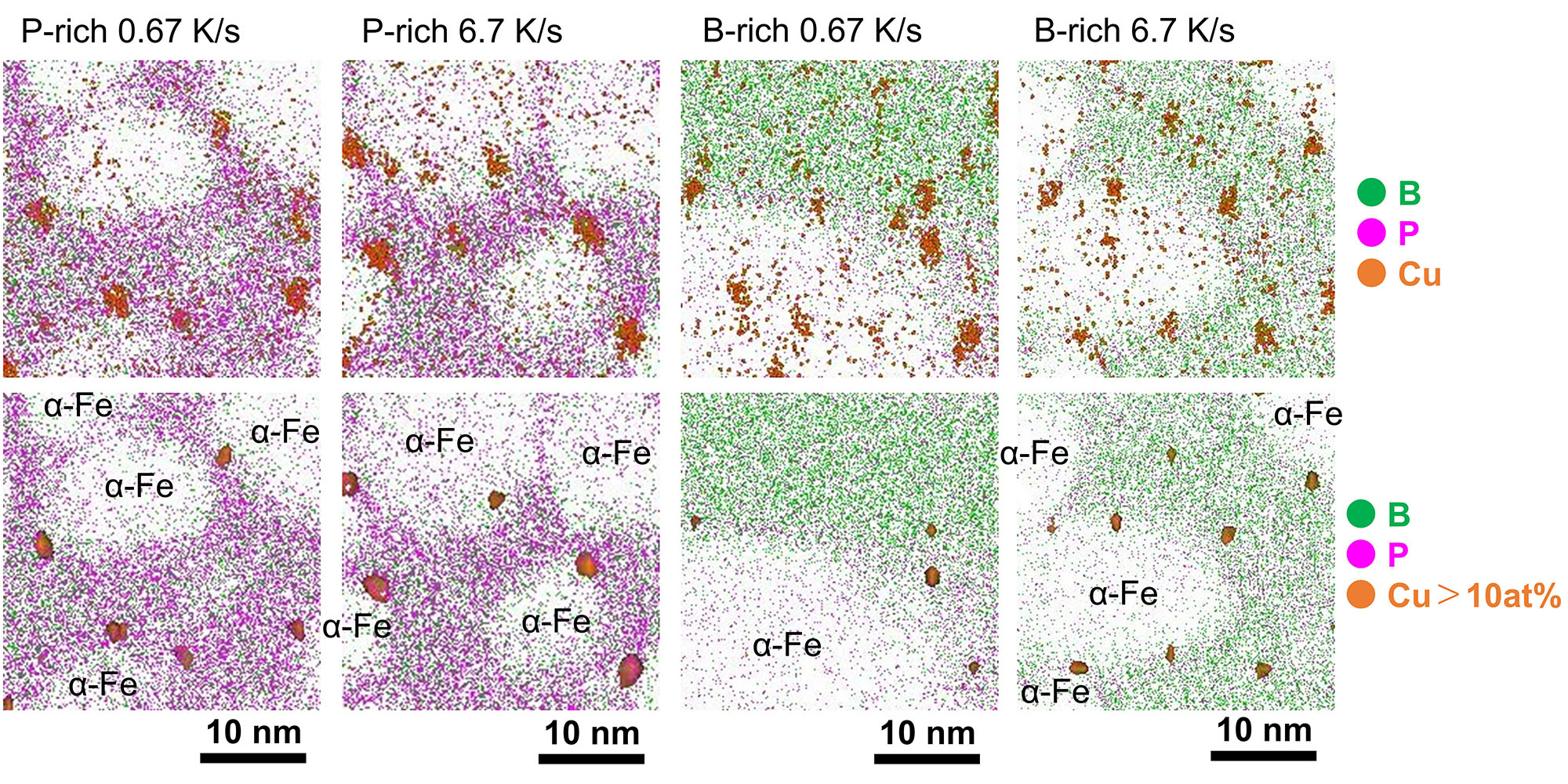
In general, when analyzing structures and elemental distributions at the nanoscale, (scanning) transmission electron microscopy ((S)TEM) is often combined with elemental analysis techniques such as EDS or EELS. However, it is fundamentally difficult to quantitatively evaluate atomic clusters or precipitates that are smaller than the thickness of a TEM specimen (typically around 50 nm) by TEM. Atom probe tomography (APT) offers unique advantages, including high detection sensitivity down to several tens to hundreds of ppm, nanoscale spatial resolution, and the ability to quantitatively evaluate three-dimensional elemental distributions, even for light elements. Shown in the upper left is a bright-field TEM image of an Fe-P-B-Cu-based nanocrystalline soft magnetic material. About 10 nm fine α-Fe nanocrystals are observed to be dispersed within an amorphous matrix. However, information on how solute elements containing B are distributed between the nanocrystalline and amorphous phases is essential for elucidating the mechanism behind the material’s properties. For this specimen, an APT analysis was performed, and the obtained three-dimensional atom map was sliced with a thickness of 2 nm for visualization. The distributions of B and P, as well as the Fe isoconcentration surface, allow the α-Fe nanocrystals to be clearly identified. As a result of quantitatively evaluating the elemental distributions in the α-Fe nanocrystals and the surrounding amorphous phase, the composition of the nanocrystals was found to be Fe96.2P2.6B0.6Cu0.6, indicating a small amount of P and B in solid solution within the α-Fe phase. In addition, the solute elements are concentrated in the residual amorphous phase with a composition of Fe74.5P17.0B8.2Cu0.3, leading to the stabilization of the amorphous phase. Furthermore, several-nanometer-sized Cu clusters, which cannot be identified in TEM images, were also found to form around the α-Fe nanocrystals. This suggests that, as reported for many nanocrystalline soft magnetic materials, Cu clusters serve as heterogeneous nucleation sites for α-Fe nanocrystals.
- Y. Nomura, J. Uzuhashi, T. Tomita, T. Takahashi, H. Kuwata, T. Abe, T. Ohkubo, K. Hono, "Heating rate dependence of coercivity and microstructure of Fe-B-P-Cu nanocrystalline soft magnetic materials", J. Alloys Compd. 859, 157832 (2021)