
Themes
Development of highly reliable CMCs using sandwich-structured prepregs
We are developing SiC-based ceramic matrix composites (CMCs) for use in the severe high-temperature environments encountered in aerospace, advanced nuclear energy, and fusion applications. By integrating ceramic nanopowder dispersion technology with unidirectional prepreg fabrication, we have developed a semi-automated process for producing sandwich-structured prepregs. Sandwiching fiber bundles between ceramic sheets containing uniformly dispersed nanopowders enables homogeneous infiltration of the raw materials into the fiber bundles and the fabrication of complex-shaped components, including plates, tubes, and flanges. Furthermore, by controlling the fiber content, matrix architecture, and fiber–matrix interfaces to disperse and deflect cracks, we aim to develop lightweight, heat-resistant, and highly reliable CMCs that resist catastrophic failure.

Evaluation and materials design using advanced synchrotron X-ray CT techniques
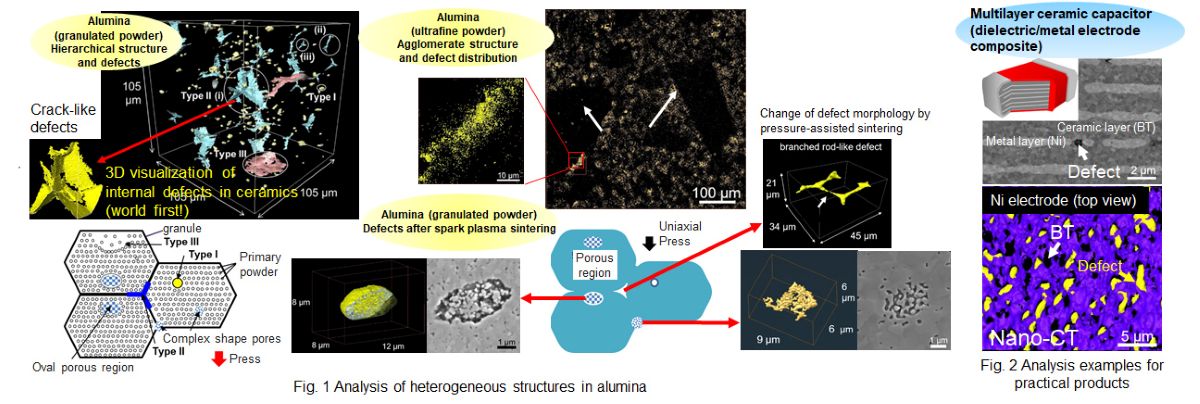
Synchrotron X-ray multiscale CT enabled three-dimensional, non-destructive characterization of internal defects in ceramics that are difficult to assess by conventional optical or 2D SEM observations. The morphology, size, and spatial distribution of these defects were quantitatively revealed, providing new insights into the evolution of structural heterogeneity and defect formation during sintering.
These findings provide a basis for controlling processing-induced defects and improving the reliability and lifetime of ceramic components, as well as for predicting local strength in complex-shaped components with non-uniform green density.
High-temperature optical microscopy up to 1500°C
We have established a microscopy technique that enables in-situ observation of the deformation, damage, and chemical degradation of heat-resistant materials used in aircraft jet engines under high-temperature conditions. These materials are repeatedly exposed, during every takeoff and landing cycle, to temperature changes from room temperature to combustion-gas environments exceeding 1700°C. At such high temperatures, intense thermal radiation emitted from the material itself makes conventional optical observation extremely difficult. In our technique, this thermal radiation is blocked using optical filters, while the material surface is illuminated with ultraviolet light at wavelengths shorter than those of the thermal radiation. This enables clear optical microscopic observation of changes occurring in the material at high temperatures without interference from thermal radiation. The technique can also be used to measure strain distributions on the material surface. By combining this optical observation technique with high-temperature mechanical testing systems or thermal cycling test systems, it is now possible to determine precisely when and how fracture, damage, and material degradation occur under severe high-temperature conditions.
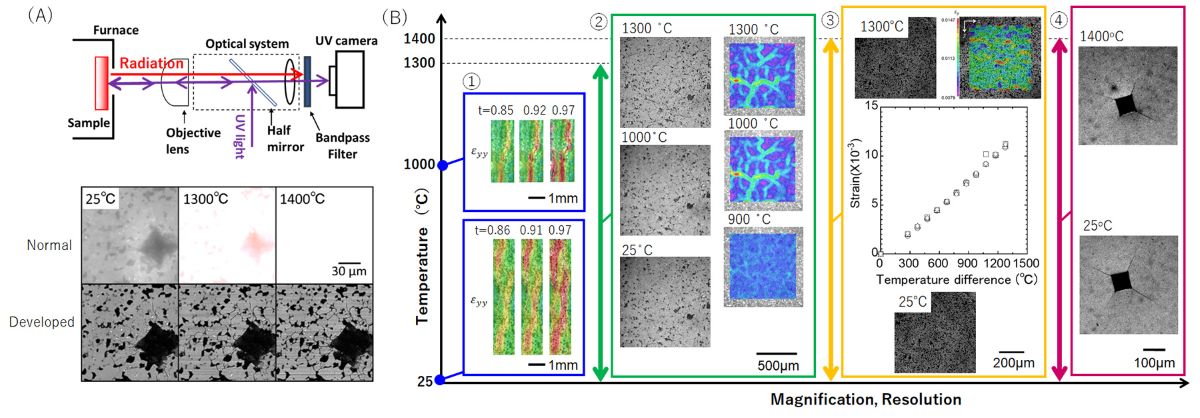
(A) Schematic overview of the developed high-temperature optical microscopy system.
(B) Examples of applications of the developed system over a wide range of temperatures and length scales: ① Strain distributions in a ceramic matrix composite (CMC) under tensile loading were measured at 25°C and 1000°C, enabling clarification of the fracture mechanism. ② The damage evolution of an environmental barrier coating (EBC) for CMCs was observed in situ during thermal cycling, successfully capturing the moment when mud cracks formed at 1000°C during heating. ③ The thermal strain of an EBC was measured during cooling. Using these measurements, the in-plane coefficient of thermal expansion was obtained as a function of temperature from room temperature to 1400°C. ④ The crack-healing process at high temperature was observed in situ for cracks initiated from the corners of a Vickers indentation on a polycrystalline ceramic.
Interfacial fracture toughness evaluation for ceramic coatings
Ceramic matrix composites (CMCs) used in jet engines are protected with environmental barrier coatings (EBCs) to prevent corrosion caused by combustion gases. Quantitative evaluation of the interfacial fracture toughness between the EBC and the CMC substrate, which represents the resistance of the EBC to delamination, is essential for EBC development and lifetime prediction. However, because CMCs have relatively low interlaminar strength, conventional interfacial fracture tests may cause failure within the CMC substrate before delamination occurs at the EBC/substrate interface. To overcome this problem, we developed a new test method that avoids applying load in the interlaminar direction of the substrate, together with a procedure for calculating the interfacial fracture toughness from the load measured during the test. The developed method was applied to thermally sprayed EBCs, and its validity for evaluating EBC/substrate interfacial fracture toughness was confirmed.
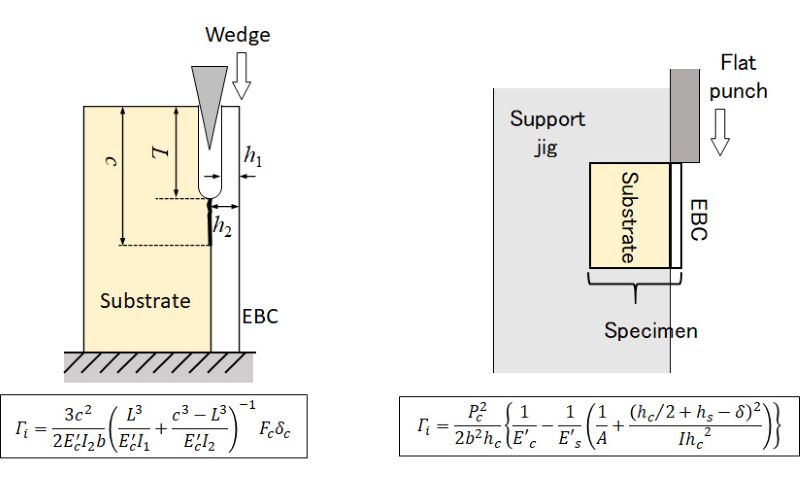
The proposed interfacial fracture test methods. To enable testing under different phase angles, two configurations were developed: (A) a Mode I-rich test and (B) a Mode II-rich test. These methods enable interfacial fracture to be induced while preventing failure of the CMC substrate, which has relatively low interlaminar strength.