The History of World-Record High-Field NMR at NIMS
A Quest for the World's Highest Magnetic Fields, Advancing the Frontiers of Human Observation.
The Solid-State NMR Group at NIMS has set new world records for magnetic field strength in high-resolution NMR superconducting magnets on three separate occasions. These achievements have enabled significant advances in NMR sensitivity and resolution, opening new opportunities for discovery in materials science, chemistry, and the life sciences. This page highlights these world-record accomplishments and their scientific and societal impact.
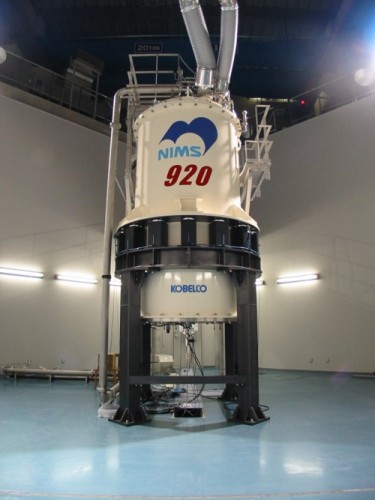
・920 MHz (21.6T) High-Resolution NMR Magnet (2001)
In 2001, NIMS, Kobe Steel, Ltd., JEOL Ltd., and other organizations completed the development of an ultra-high-field superconducting NMR magnet, which was developed as part of MEXT's Superconducting Materials Research Multi-core Project (Phase II) "Development of a 1GHz-class NMR magnet." This system began operation at a then world-record magnetic field strength of 21.6 Tesla (corresponding to a proton resonance frequency of 920 MHz). For the innermost coil, where the magnetic field is strongest, a bronze-route Ti-doped Nb₃Sn wire with a tin concentration in the bronze increased to 15 wt.% was used. By introducing a cryogenic cooling system utilizing pressurized superfluid technology, it became possible to achieve extreme conditions—free from vibration, with highly uniform temperature, and extremely stable pressure. As a result, the team succeeded in achieving, for the first time globally, operation in persistent current mode at 920 MHz.
At the time, recognizing that analytical technology could determine the trend of scientific and technological progress, there was fierce worldwide competition to develop the most advanced analytical devices. The successful development in Japan of the world's highest-performance superconducting NMR magnet opened new horizons for NMR analysis and made a major impact on science and technology in Japan. In particular, in the field of life sciences, it provided strong momentum for national projects such as the "Protein 3000 Project," which aimed to elucidate the three-dimensional structure of proteins playing a central role in vital biological activity.
-
Persistent-mode operation of a 920 MHz high-resolution NMR magnet
T. Kiyoshi et al., IEEE Trans. Appl. Superconductivity, 12(1), 2002, 711-714. -
Achievement of a 920-MHz high resolution NMR
K. Hashi et al., Journal of Magnetic Resonance, 156(2), 2002, 318-321.
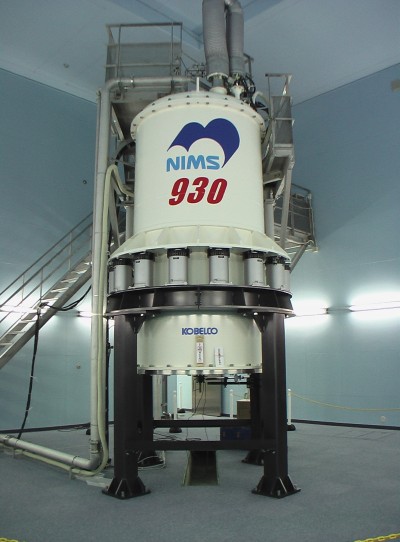
・930 MHz (21.9 T) High-Resolution NMR Magnet (2004)
In 2004, a research team led by NIMS and Kobe Steel, Ltd. succeeded in developing a high-resolution NMR magnet operating at the world’s highest magnetic field at that time, 21.9 T (corresponding to a proton resonance frequency of 930 MHz). By using Ti-doped Nb₃Sn wire with a tin concentration of 16 wt.%—exceeding that of the inner coil wire utilized for the 920 MHz magnet—the critical current density was improved, allowing the same current to be passed through a smaller cross-sectional area. As a result, it became possible to generate a magnetic field of 21.9 T, corresponding to 930 MHz, at the same operating current as the 920 MHz magnet.
Through this series of developments, NMR measurements of low-gamma amd quadrupolar nuclei—previously considered difficult—became possible, and solid-state NMR analysis came within the realm of practical application. This achievement prompted NIMS to launch the MEXT Promotion and Coordination Funds Project “High-Field Solid-State NMR for the Development of Advanced Functional Materials,” which subsequently led to significant advances in structural analysis of solid catalysts and novel phosphors.
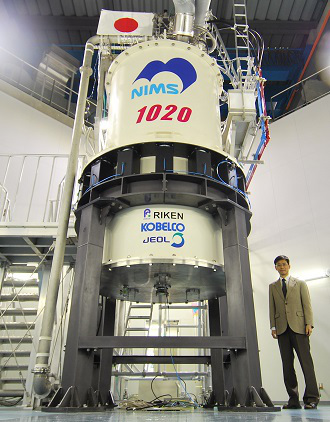
・1,020 MHz (24.0 T) High-Resolution NMR Magnet (2015)
In 2015, a research team composed of NIMS, RIKEN, Kobe Steel, Ltd., and JEOL RESONANCE Inc. succeeded in developing an ultra-high magnetic field NMR system as part of the JST program “Development of NMR Systems Beyond 1 GHz.” For the first time in the world, this system generated a magnetic field of 24.0 Tesla (corresponding to a proton resonance frequency of 1,020 MHz), exceeding the 1 GHz threshold.
It had long been considered that the realization of NMR systems above 1 GHz would require high-temperature superconducting technology; however, high-temperature superconductors are brittle and difficult to process, making practical implementation a significant challenge for many years. The research team overcame these hurdles by introducing multiple new technologies, including the wire fabrication of Bi-2223 high-temperature superconductors developed at NIMS in 1988. Overcoming numerous difficulties, such as the destruction of the system just before its completion due to the Great East Japan Earthquake, the helium supply crisis, and the sudden passing of the team leader, the team finally completed the world’s first NMR system exceeding 1 GHz after 8 years of construction and nearly 20 years since the initial concept.
This study generated a significant response, earning the Most Downloaded Article Award for two consecutive years in Journal of Magnetic Resonance (Elsevier). It was also honored with numerous awards, including the prestigious Minister's Commendation (MEXT). Currently, the development of ultra-high-field NMR systems beyond 1 GHz using high-temperature superconductors (HTS) is advancing globally. In this field, this study delivered a major breakthrough by making the practical application of HTS a reality, marking a vital first step toward future progress. Today, this work is widely recognized as the foundation of ultra-high-field NMR development and remains highly acclaimed more than ten years after its release.