Magnetic Refrigeration System Group
Members
KAMIYA Koji
SAMURAI
Deputy Director, Research Center for Energy and Environmental Materials (GREEN)
Group Leader, Magnetic Refrigeration System Group, Hydrogen Technology Materials Field, Research Center for Energy and Environmental Materials

XU Ya
SAMURAI
Principal Researcher, Magnetic Refrigeration System Group, Hydrogen Technology Materials Field, Research Center for Energy and Environmental Materials

NATSUME Kyohei
SAMURAI
Principal Researcher, Magnetic Refrigeration System Group, Hydrogen Technology Materials Field, Research Center for Energy and Environmental Materials

HIRAYAMA Takashi
SAMURAI
Senior Researcher, Magnetic Refrigeration System Group, Hydrogen Technology Materials Field, Research Center for Energy and Environmental Materials

Topics
Invited talk
Koji Kamiya, “Development of an active magnetic refrigerator for hydrogen liquefaction”, “The 28th International Workshop on Rare Earth and Future Permanent Magnets and Their Applications (REPM)” July 29, 2025.
Invited talk
K. Kamiya, K. Natsume, A. Uchida, T. Shirai, A. T. Saito, T. Numazawa, K. Matsumoto, “Hydrogen liquefaction by active magnetic refrigeration”, The 7th International Conference of Asian Union of Magnetics Societies (IcAUMS) April 23, 2025
Invited talk
Koji Kamiya, “Hydrogen liquefaction by magnetic refrigeration”, Breakthrough Energy Fellows Workshop, Tokyo, January 16, 2025
Invited talk
Koji Kamiya et al., “Development of small superconducting magnets used for adiabatic demagnetization refrigerators (ADR) for cooling of superconducting quantum computers”, 36th International Symposium on Superconductivity (ISS 2023) at Takina, Wellington, New Zealand, November 28-30, 2023.
Invited talk
Koji Kamiya et al., “Magnetic Refrigerators for Hydrogen Liquefaction, 26th international congress of refrigeration”, Paris, France 21st – 25th August 2023.
Motivation and Outline
Magnetic refrigeration systems utilizing the magnetocaloric effect can achieve higher cooling efficiency than conventional gas compression refrigeration systems in principle, thereby contributing significantly to the realization of a low-carbon society. The Magnetic Refrigeration System Group is developing high-efficiency hydrogen liquefiers and cooling systems for ultra-low temperatures for quantum computers. Additionally, we are working on improving hydrogen resistance through coatings for magnetic materials and developing high-performance hydrogen-related catalytic materials through microstructure control.
Facilities
The main equipment owned by the Magnetic Refrigeration System Group consists of winding machines and measuring devices.
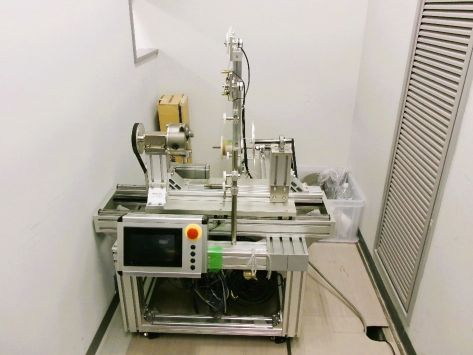
Winding machine
We have two winding machines for superconducting magnets. We can handle magnets with bore diameters ranging from approximately 5 cm to 16 cm. We can also handle high-temperature superconducting tapes.
Koji Kamiya, et al., APEX., 15[5] (2022) 053001
Kyohei Natsume, et al., IEEE Trans. Appl. Supercond., 34[5] (2024) 3801005.
S. Matsunaga, et al., IEEE Trans. Appl. Supercond., 34[5] (2024) 4605705.
Koji Kamiya, et al., Cryogenics, 152 (2025) 104205.
Measurement apparatus

Fixed-bed flow reactor system
Huixin Jin, et al., ChemSusChem. 18 (2025) e202501424.
Haruka Yoshikawa, et al., FUEL 345 (2023) 128171-1-12.
Ya Xu, et al., Applied Catalysis A: General 608 (2020) 117872.
Ya Xu, et al., Catalysis Science & Technology 10 (2020) 2004-2019.

Hydrogen-environmental X-ray diffractometer
Shu Mizutome, et al., Next Materials. 9 (2025) 101313.
Tsukasa Nakasone, et al., Materials Transactions 64 (2023) 2410-2416.
Ryota Tsukuda, et al., Journal of Physical Chemistry C 125 (2021) 20919-20929.

Hydrogen Storage Measurement System
Ya Xu, et al., Nature Communications. 17 (2026) 4952.
Hirone Iwamoto, et al., Journal of Physics and Chemistry of Solids 125 (2019) 64-73.

Specific surface area analyzer
Haruka Yoshikawa, et al., Materials Transactions 64 (2023) 2425-2430.
Ya Xu, et al., International Journal of Hydrogen Energy 43 (2018) 15975-15984.

Thermal analysis system (Differential Scanning Calorimeter (DSC), Thermomechanical Analyzer (TMA), Thermogravimetric Analyzer (TGA)
川島 唯, 許 亜, 亀岡 聡. 日本金属学会誌. 89 [9] (2025) 280-286.
Ya Xu, et al., Science and Technology of Advanced Materials 20 (2019) 622-631.

Sputtering equipment
Ryota Tsukuda, et al., Materials Transactions 63 (2022) 343-350.
Research Results
The Magnetic Refrigeration System Group has successfully developed a hydrogen liquefaction system utilizing highly efficient magnetic refrigeration. The developed hydrogen liquefaction magnetic refrigerator employs Active Magnetic Regenerative Refrigeration (AMR), which is a practical magnetic refrigeration method capable of covering a wide temperature range, making it promising for application in low-cost, energy-efficient hydrogen liquefaction and storage systems.
Additionally, we are developing ultra-low temperature magnetic refrigeration systems suitable for cooling quantum computers and superconducting detectors.
We also developed a coating method for magnetic refrigeration materials by combining electroless Cu plating with an oxidation treatment. This low-cost and highly scalable method significantly improved the hydrogen resistance of the materials. In addition, we discovered an Al-Cu-Fe quasicrystal catalyst that exhibits excellent catalytic properties for the reduction of carbon dioxide (CO2) to carbon monoxide (CO), holding great promise for converting CO2 into valuable resources or fuels.

Large-scale magnetic refrigerator for hydrogen liquefaction under development
Mohamed Gado, et al., Cryogenics, 158 (2026) 104347.
Tsuyoshi Shirai, et al., Cryogenics, 161 (2026) 104405.

Magnetic refrigerator for hydrogen liquefaction
Koji Kamiya, et al., APEX., 15[5] (2022) 053001
Kyohei Natsume, et al., IEEE Trans. Appl. Supercond., 34[5] (2024) 3801005.
S. Matsunaga, et al., IEEE Trans. Appl. Supercond., 34[5] (2024) 4605705.

Magnetic refrigerator for ultra-low temperatures
Koji Kamiya, et al., IEEE Trans. Appl. Supercond., 34[5] (2024) 3800805.
Selected Recent Results
- Successful assembly and test operation of a large-scale hydrogen liquefaction magnetic refrigeration machine.
- Our research paper (Koji Kamiya et al 2022 Appl. Phys. Express 15 053001) was selected as one of the Highlights of 2022 in Applied Physics Express.
- Successfully liquefied hydrogen for the first time in the world using AMR and issued a press release.
- Achieved excellent hydrogen resistance by applying electroless plating and oxidation treatment to magnetic refrigeration material particles.