国立研究開発法人物質・材料研究機構
高分子・バイオ材料研究センター 高分子材料分野
電気化学センサグループ
電気化学センサグループ
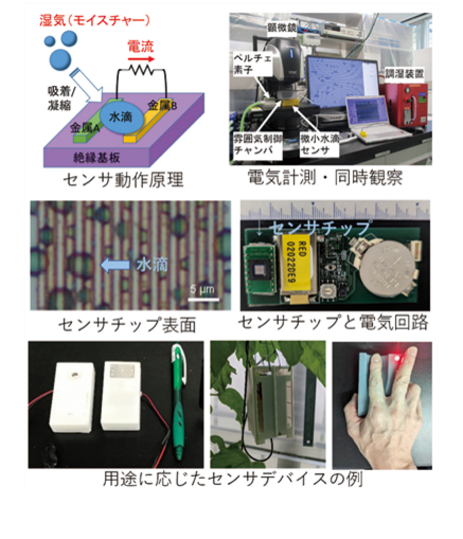
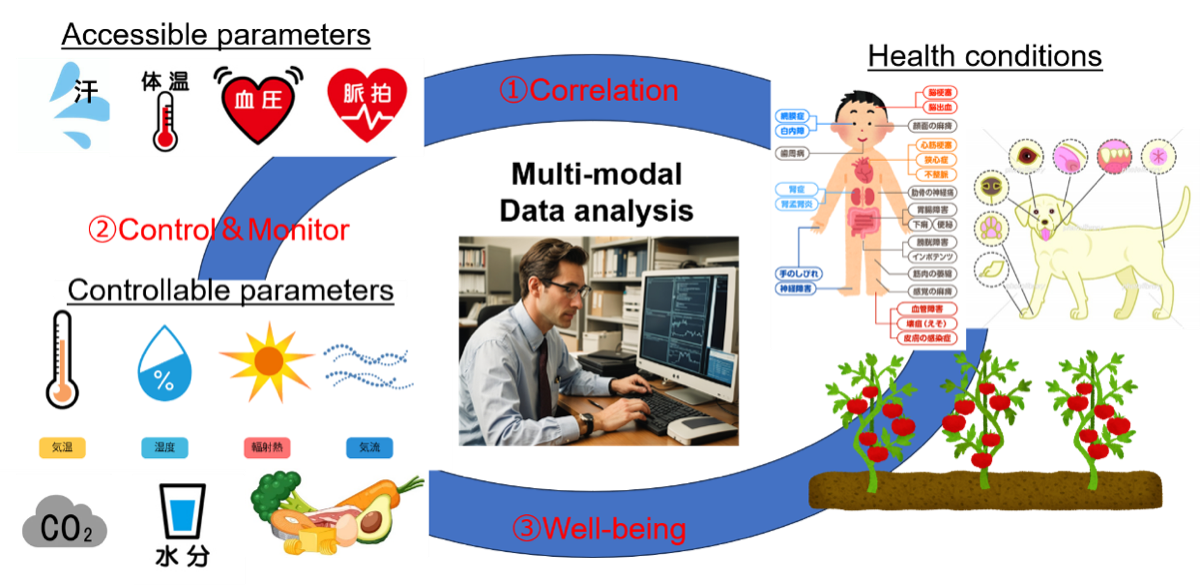
微細な金属を並べたアレイ構造による電気特性の評価方法に関する研究を行っている。この評価方法を用いて、水分子が凝集した状態や凝縮した状態の電気的性質を解明してきている。これらの研究成果を展開することで、実験的に長時間保持することが困難な過冷却状態にある水の物性の評価にも取り組んでいる。さらに、微小・微量な水を検知・計測できる特徴を生かし、様々なセンサへの応用を進めている。得られたセンサデータとその他のバイタル情報や環境因子を統合したマルチモーダル解析基盤を構築することで、体調変化を早期に推定する評価体制の確立を目指している。
I am conducting research on evaluating electrical properties using array structures composed of finely arranged metallic elements. This method has enabled us to clarify the electrical characteristics of water molecules in aggregated and condensed states. Building on these findings, we are also investigating the physical properties of supercooled water, which is difficult to maintain experimentally for long periods. Furthermore, by leveraging the ability to detect and measure extremely small amounts of water, we are advancing applications to various types of sensors. By integrating the obtained sensor data with other vital signs and environmental factors, we aim to establish a multimodal analysis platform capable of estimating physiological changes at an early stage.
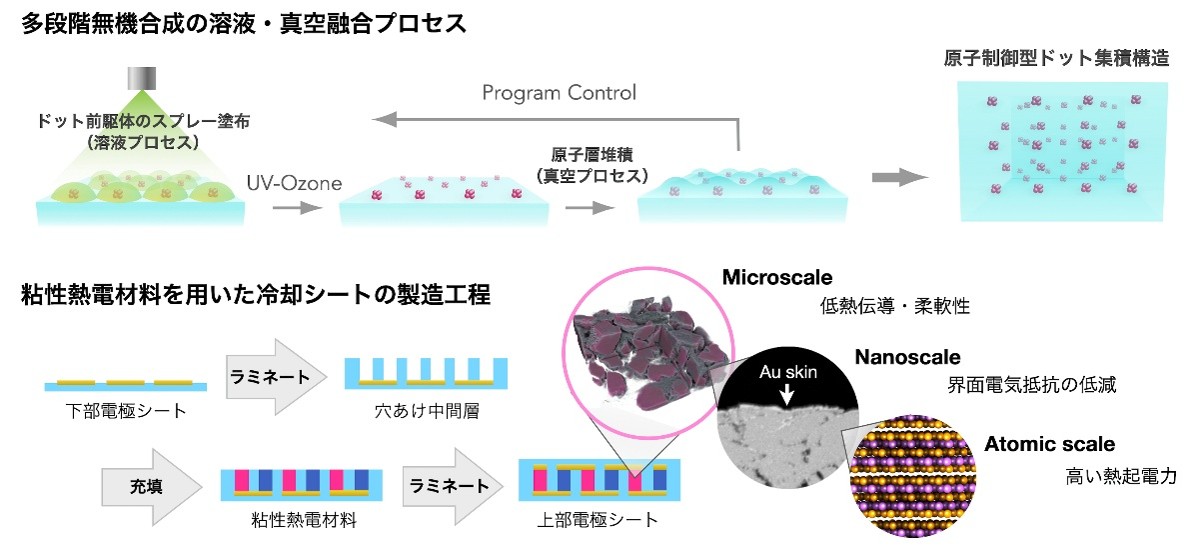
既に先達によって多種多様な概念やナノ構造を有する物質・材料が切り拓かれている現状で、種類に限りがある周期表上の元素からさらに未踏の物質・材料を創出するには、非従来型の化学構造を創り出せる新たな合成論や各構成要素の単体からは想像できない機能を創発できる高次階層構造の開拓が必要。そこで、様々な有機分子を原子精度で精密合成できる多段階有機合成(ノーベル化学賞2017年)を無機合成に展開することで原子制御型ドット集積構造を合成可能とする多段階無機合成、フレキシブルな大面積冷却シートの実現に必要な複雑に絡み複数要求を原子スケールからマクロスケールまでの各階層で制御することで応えることを特徴とした粘性熱電材料を探求している。
To create entirely new materials from the limited elements of the periodic table in a current research condition where predecessors have already developed a wide variety of materials with diverse concepts and nanostructures, we require innovative synthetic strategies capable of generating unconventional chemical structures, as well as the exploration of higher-order hierarchical structures that can exhibit emergent functions unimaginable from their individual components. To address this challenge, we are extending multistep organic synthesis—recognized by the 2017 Nobel Prize in Chemistry for enabling the atomic-precision construction of complex organic molecules—to inorganic synthesis. This approach aims to establish multistep inorganic synthesis capable of producing atomically controlled dot-assembly structures. Furthermore, we have developed sticky thermoelectric materials that can meet the multiple, intricately intertwined requirements necessary for realizing flexible, large-area cooling sheets by controlling structural features across all hierarchical levels, from the atomic scale to the macroscopic scale.