
2022 Topic1
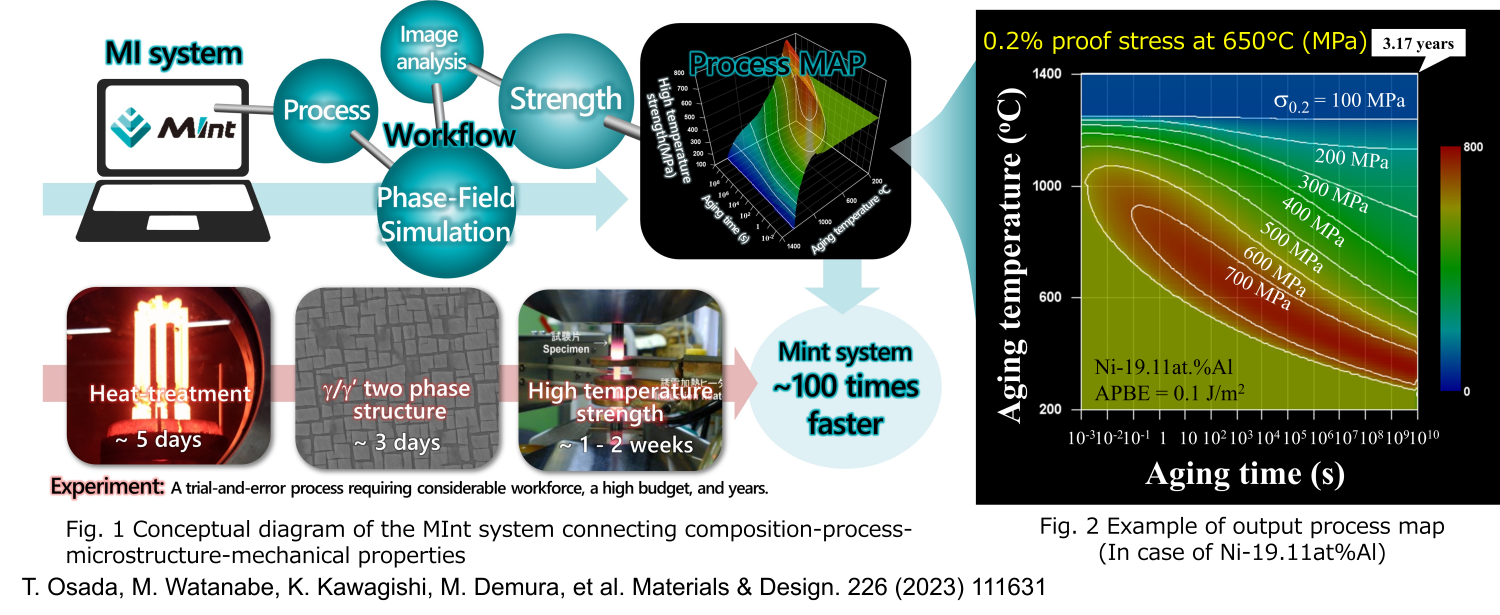
Composition-Process-Microstructure-Property Prediction System Construction for Ni-based Alloys
~Virtual heat treatment speeds up material design. ~

Q&A
What are Ni-based alloys? Where are they used?
Ni-based superalloys are alloys designed by mixing more than 10 different elements. They are excellent for use in extremely harsh environments where temperature and stress are very high in the atmosphere. They are currently used in jet engines, gas turbines for power generation, and rockets to support society. In the future, they will be used in hydrogen turbines.
How do you create a prediction system?
I developed a program that can quickly predict strength from complex structures. To do this, it is important to see and imagine the phenomena occurring in actual industrial sites. If you model the phenomena you experience there, you may be able to predict them surprisingly easily. The experimental data that NIMS has accumulated over the years is very important for performing virtual testing with a prediction system.
Why is the prediction system necessary?
To create a strong alloy, it is important not only to combine elements, but also to create a structure through heat treatment. Since there are countless heat treatment conditions, it is very difficult to conduct preliminary experiments. If we could use a prediction system to conduct experiments in advance in a virtual space, we should be able to greatly accelerate the speed of development.
What did you enjoy most about this research?
All I created was a strength prediction program. Only when I implemented it in Mint, a materials integration system developed by NIMS, did process-structure-property prediction became possible. The most enjoyable part of this research was being able to have discussions with system experts, image processing experts, and structure prediction experts from different perspectives, all with the same goal.