
2021 Topic2
-Recapturing the intrinsic corrosion resistance of stainless steel-

Q&A
Why did you use a laser 3D printing process for this research?
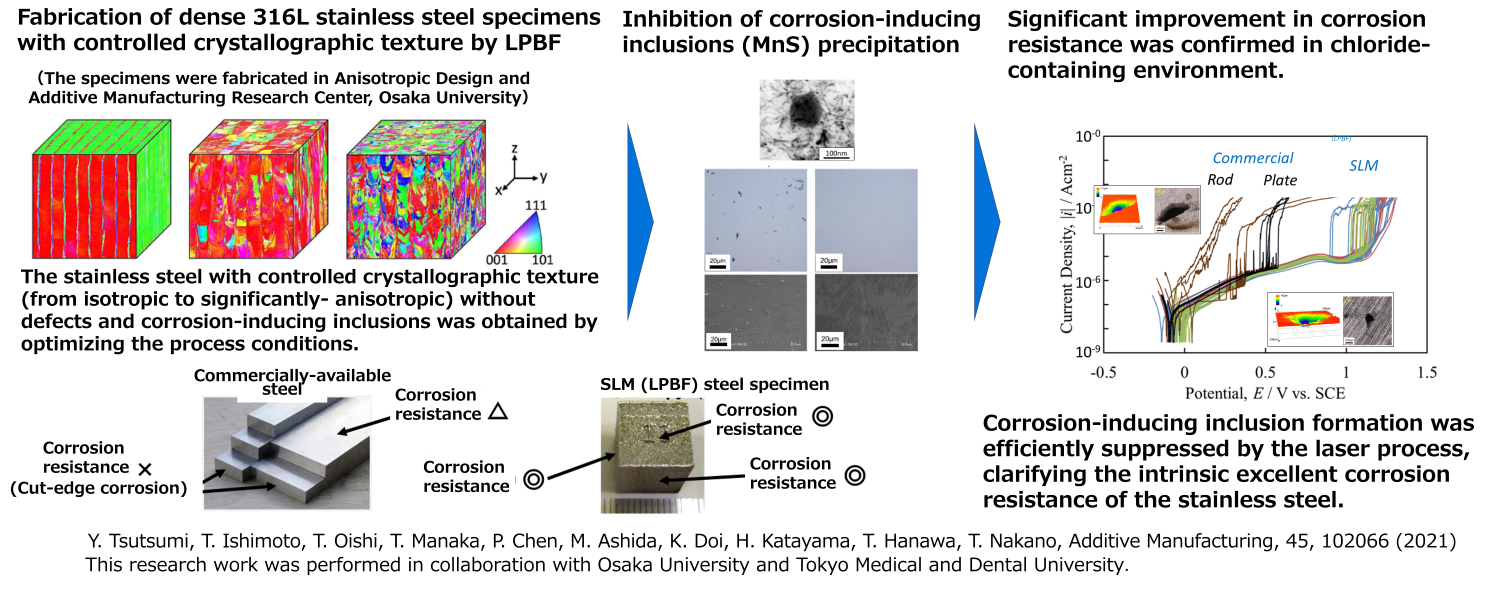
A major feature of 3D printers is flexibility in shape shifting. However, in fact, the mechanical properties of the materials are changed significantly, and strong anisotropy (difference in properties depending on the testing direction) also appears. Although corrosion resistance is one of the most important properties of materials, little literature was available at the time. Based on my prior experience, I had a hunch that we would get good results, so I decided to investigate in detail and started this research with my collaborators, who have outstanding knowledge about additive manufacturing processes.
What are the key points of this achievement?
We have found that if the LPBF process is properly conducted to prevent the introduction of defects such as voids, the corrosion resistance of stainless steels could be significantly improved, regardless of the crystallographic texture and exposed surfaces. This means that corrosion-free stainless steel can be obtained without relying on the rare and expensive alloying elements.
How can LPBF stainless steels be utilized?
Stainless steels easily corrode under certain practical environments due to microscopic impurity particles called inclusions. The reliability of stainless steels, which has been underestimated due to these inclusions, can be improved with new processing techniques. For example, the improved steels are expected to be applied to medical implants and key components of fuel cells, where even the slightest corrosion is not allowed, under extremely corrosive environments.
Why did you decide to become a corrosion researcher?
While “material manufacturing” is a fascinating research field, corrosion may seem to be a sober one. However, when I started working in this field, I soon realized that corrosion engineering field is quite profound, and many people have problems caused by corrosion, so there is a high demand for insights into corrosion reaction. Therefore, I was immediately attracted to this academic field. Now I enjoy my work in “material protecting” research at NIMS.