
The 176th Structural Materials Seminar: Prof. Karsten Durst (Physical Metallurgy, Technical University Darmstadt, Germany)
On September 29, 2025, Prof. Karsten Durst,(Physical Metallurgy, Technical University Darmstadt, Germany)gave a lecture at NIMS as the 176th Structural Materials Seminar.
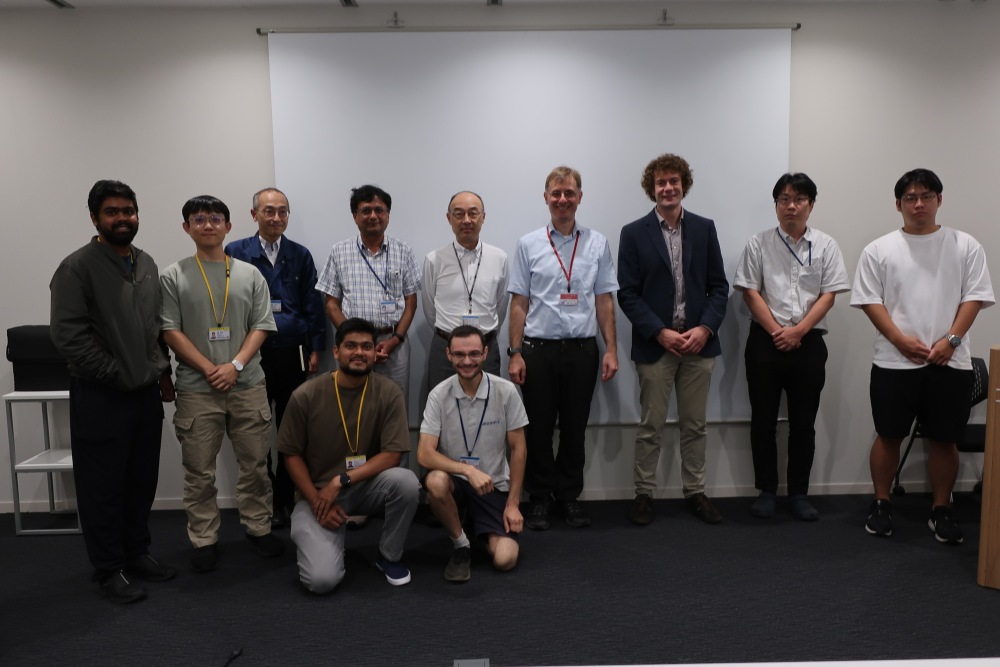
Prof. Karsten Durst (front row, 4th from right)
- Date and Time
-
Monday, September 29, 2025, 14:00-15:00
- Location
-
Conference Room, 5th Floor, Advanced Structural Materials Building, NIMS Sengen Site
- Title
-
Advanced Nanoindentation testing for studying thermally and electron-beam induced deformation mechanism in alloys and glasses.
- Speaker
-
Prof. Karsten Durst, Physical Metallurgy, Technical University Darmstadt, Germany
Abstract
Thermally activated mechanism play an important role in the plastic deformability of a wide variety of materials, for instance in the brittle to ductile transition of bcc metals, oxide glasses, as well as the superplastic behaviour of nanocrystalline materials. Using a newly developed high temperature nanoindenter and different nanoindentation protocols, it is possible to analyze these mechanisms in a wide range of temperatures (RT to 1100°C) as well as a wide range of strain rate (10-10-7). Furthermore, it has been shown recently that even the electron flux inside the SEM can strongly enable viscous flow mechanism even at room temperature.
In this talk, we will give an overview on the different testing protocols and will show how the so called high temperate scanning indentation method can be used to assess the brittle to ductile transition of Mo and Cr pure metals via an analysis of the activation volume as a function of testing temperature. In a second example, we will show also a brittle to ductile transition for oxide glasses, highlighting that cracking can be effectively suppressed during electron beam irradiation, similar to effects observed during high temperature testing. Finally, the reversible and irreversible softening of an Cu-X nanocrystalline alloy series during high temperature deformation will be assessed via indentation testing as well as uniaxial testing. In a certain temperature regime, the nanocrystalline alloys reversibly soften and have a even lower flow stress compared to their coarse grained counter parts.