


1. Stimulus-responsive materials
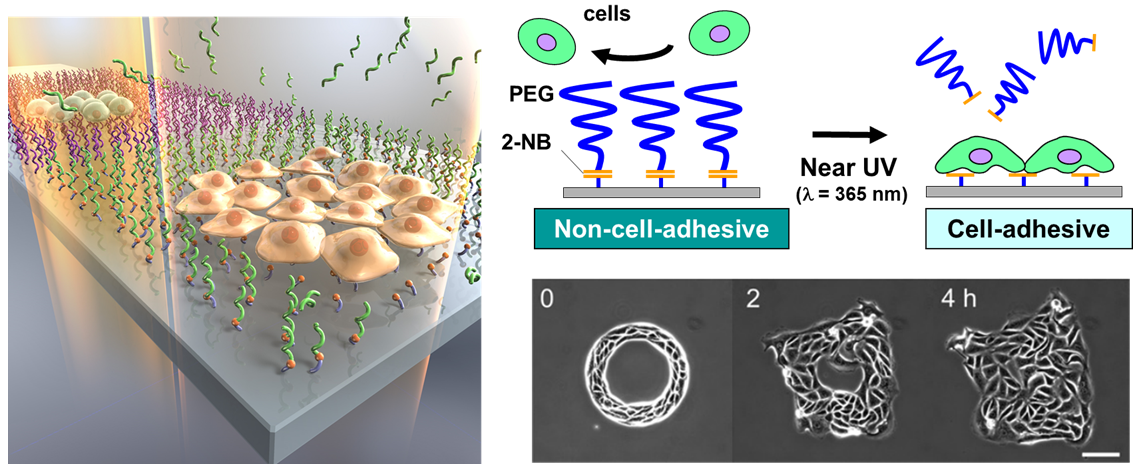
Our group develops functional materials whose interfacial/bulk properties can be controlled by light. For example, we have developed photoactivatable substrates, where cell adhesion and migration can be spatiotemporally controlled by photoirradiation. They are used as a screening platform for anti-cancer drugs and for analyzing collective cell migration and epithelial-mesenchymal transition (EMT).
2. Dissipative materials
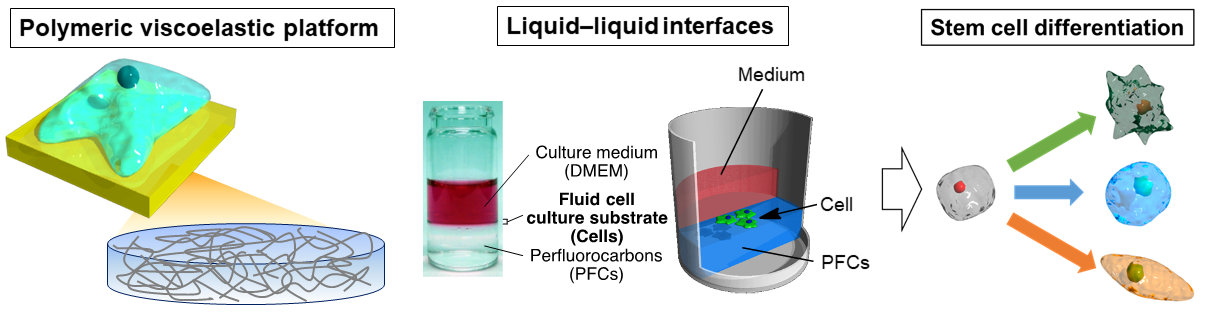
Cells change their activity depending on the mechanical properties of their surrounding matrices. Even though native extracellular matrices are viscoelastic, conventional studies mainly focused on the effect of elasticity on biological processes. We are developing various polymeric viscoelastic platforms and more dissipating hydrophobic liquid interfaces and looking at their effects on stem cell differentiation and mechanobiology responses.
3. Nano-confinement materials
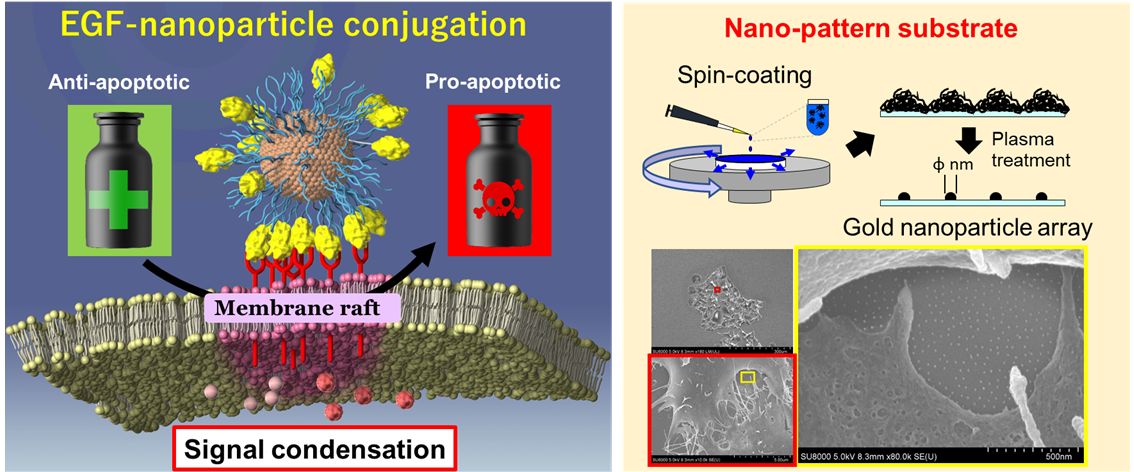
There are a wide variety of nanostructures in cells. We are developing nanomaterials that can react with the intracellular nanostructures to eventually manipulate the global cellular responses. For example, we have identified that nanoconjugates of epidermal growth factor (EGF) and gold nanoparticles were localized to nanodomains called membrane raft in plasma membranes to induce apoptosis rather than cellular growth.