
196th Structural Materials Seminar: Dr. Suresh Neelakantan (IIT Delhi)
On June 23, 2026, Dr. Suresh Neelakantan (Indian Institute of Technology Delhi) gave a lecture at NIMS as the 196th Structural Materials Seminar.
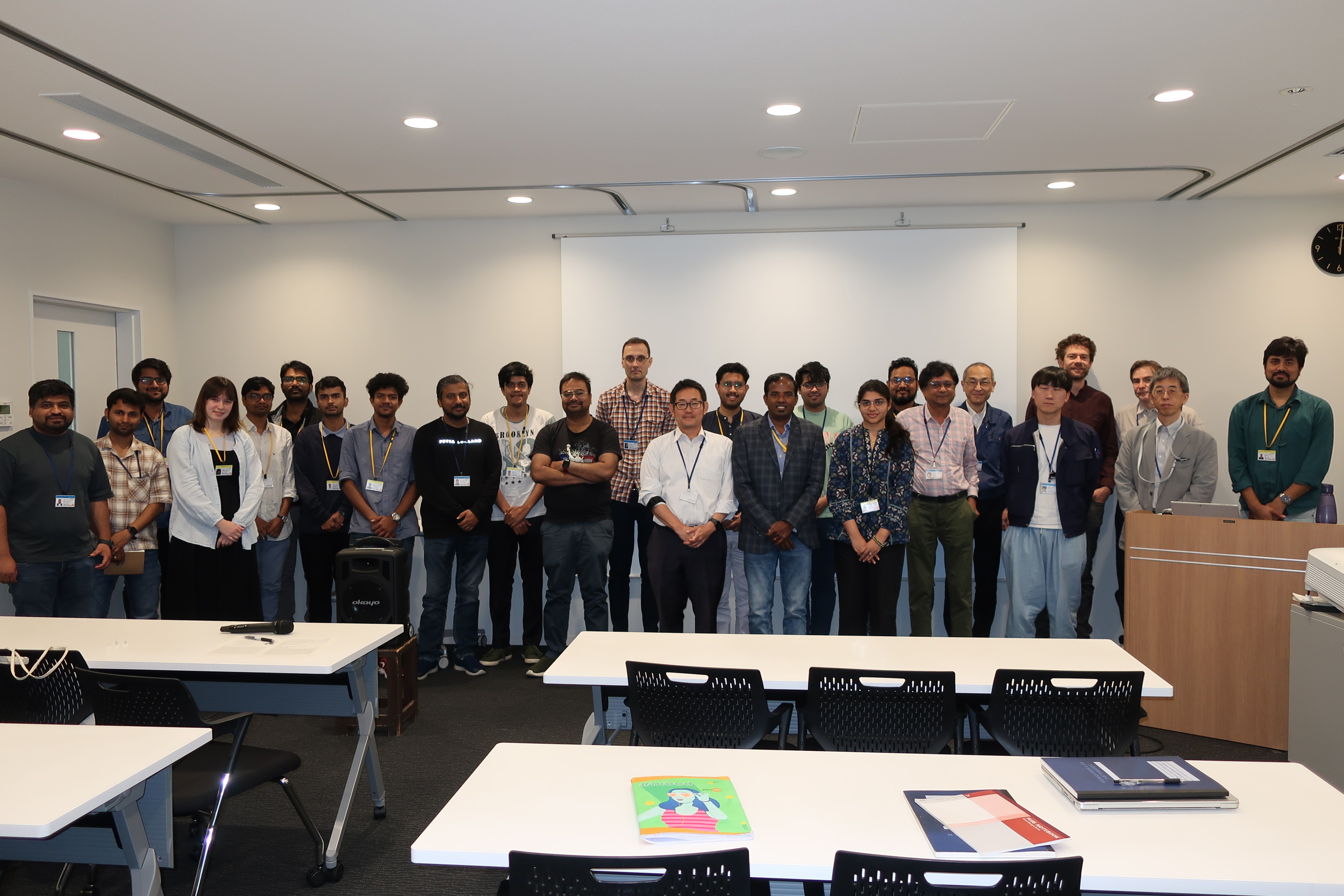
Prof. Suresh Neelakantan (front row, 5th from the right)
- Date and Time
-
June 23, Tue. 2026. 11:00~12:00
- Location
-
Conference Room, 5th Floor, Advanced Structural Materials Building, NIMS Sengen Site
- Title
-
Additive Manufacturing of NiTi Shape Memory Alloys: from Parameter Optimization to Printing Biomedical Devices
- Speaker
-
Prof.Suresh Neelakantan
Department of Materials Science and Engineering, Indian Institute of Technology Delhi, New Delhi
Abstract:
NiTi shape memory alloys (SMAs) are known for their unique superelasticity and shape memory effect (SME), which favours their wide consideration in biomedical applications. Patient-specific biomedical implants are gaining traction in recent years, which could effectively be realised via additive manufacturing (AM) processing. This talk will primarily focus on optimizing AM of pre-alloyed NiTi SMA powder parts and their bio-medical components. A two-step approach, starting with a single scan track (SST) followed by part printing, was employed to optimise parameters. A broad processing window was explored for SST by varying laser power (60-110 W) and scan speed (350-1850 mm/s). Using the SST-optimised (based on track- morphology, conduction mode and continuity) parameter window, cubes (8 x 8 x 8 mm3) were fabricated, with hatch spacing of 110 μm, a layer thickness of 30 μm, and a unique chessboard scanning strategy. Defect-free cube parts with a relative density of 99.16% were further characterized. Differential scanning calorimetry revealed SME through single-step phase transformation with Ms = 26°C, Mf = -48°C, As = -15°C and Af = 52°C transformation temperatures. X-ray diffraction analysis confirmed B19’ and B2 phases. Microstructural variations along the perpendicular and build directions for the printed part, with uniformly distributed nano-sized oxide precipitates were confirmed by field-emission
scanning electron microscopy, electron backscatter diffraction and transmission electron microscopy. Mechanical testing, including cyclic loading-unloading at different strain rates, showed variation of recovery strain as function of cycles and strain levels. Finally, successful attempts through AM have been made to fabricate NiTi biomedical components (stents and dental needles).
At the start of the talk, the speaker shall give an overview of his research group activities on structure – property optimization of: (i) metastable β titanium alloys; (ii) porous metallic fibrous materials and (iii) auxetic (i.e., negative Poisson’s ratio) materials.
Keywords: Martensitic transformation; NiTi Shape memory alloys; Additive Manufacturing; Biomedical Components; Metastable β Titanium alloys; Porous Metallic Fibrous Materials; Auxetic Materials; Strength-ductility relation.
Biography
Academic Background:
・ B.E. in Metallurgical Engineering, GCE-Salem, University of Madras, India. June 2001
・ M.Sc. (Engg.) in Metallurgy from IISc Bangalore, India. April 2004
・ Ph.D. in Materials Science and Engineering, Delft University of Technology (TU Delft), Delft, The Netherlands. July 2010
Research Experience and Expertise:
Dr. Suresh Neelakantan is currently working as an Associate Professor at the Department of Materials Science and Engineering, IIT Delhi. Prior to joining IIT Delhi in 2016, he worked as a post-doctoral research associate at Department of Engineering, University of Cambridge, UK. With 20 plus years of research experience, Dr. Suresh Neelakantan’s research expertise/interest is broadly on “Mechanical behaviour of advanced metallic materials in bulk and porous forms”. Within that, his current research is focused on i) in situ phase transformation effect on deformation behaviour in β Titanium alloys and shape memory alloys for various structural applications and ii) structure-property correlations in high entropy alloys and smart metallic materials such as Ti-, Ni- and Fe- based: shape memory alloys, stochastic fibre networks, auxetic (i.e. negative Poisson’s ratio) materials for structural and biological applications, including medical implants. Till date, he had successfully graduated 7 PhD students, 1 MSR student, 11 MTech students. He has published about 70 research publications in peer-reviewed international journals and proceedings. He holds about 2 patents, including one on Dental splints jointly with AIIMS, New Delhi. He has successfully completed several sponsored (8 Nos.) and industrial/consultancy (~20 Nos.) projects. He is currently handling 6 sponsored projects (funded mainly by SERB, DRDO, DST and MoTA) in the role of both PI and Co-PI. Dr. Suresh Neelakantan’s primary teaching interest is in the core topics of metallurgical/materials engineering. He has received ‘Teaching Excellence Award’ at IIT Delhi in recognition of his contribution to teaching.