
194th Structural Materials Seminar: Dr. Yazid MADI (Mines Paris – PSL, CMAT)
On June 18, 2026, Dr. Yazid MADI (Mines Paris – PSL, CMAT) gave a lecture at NIMS as the 194th Structural Materials Seminar.
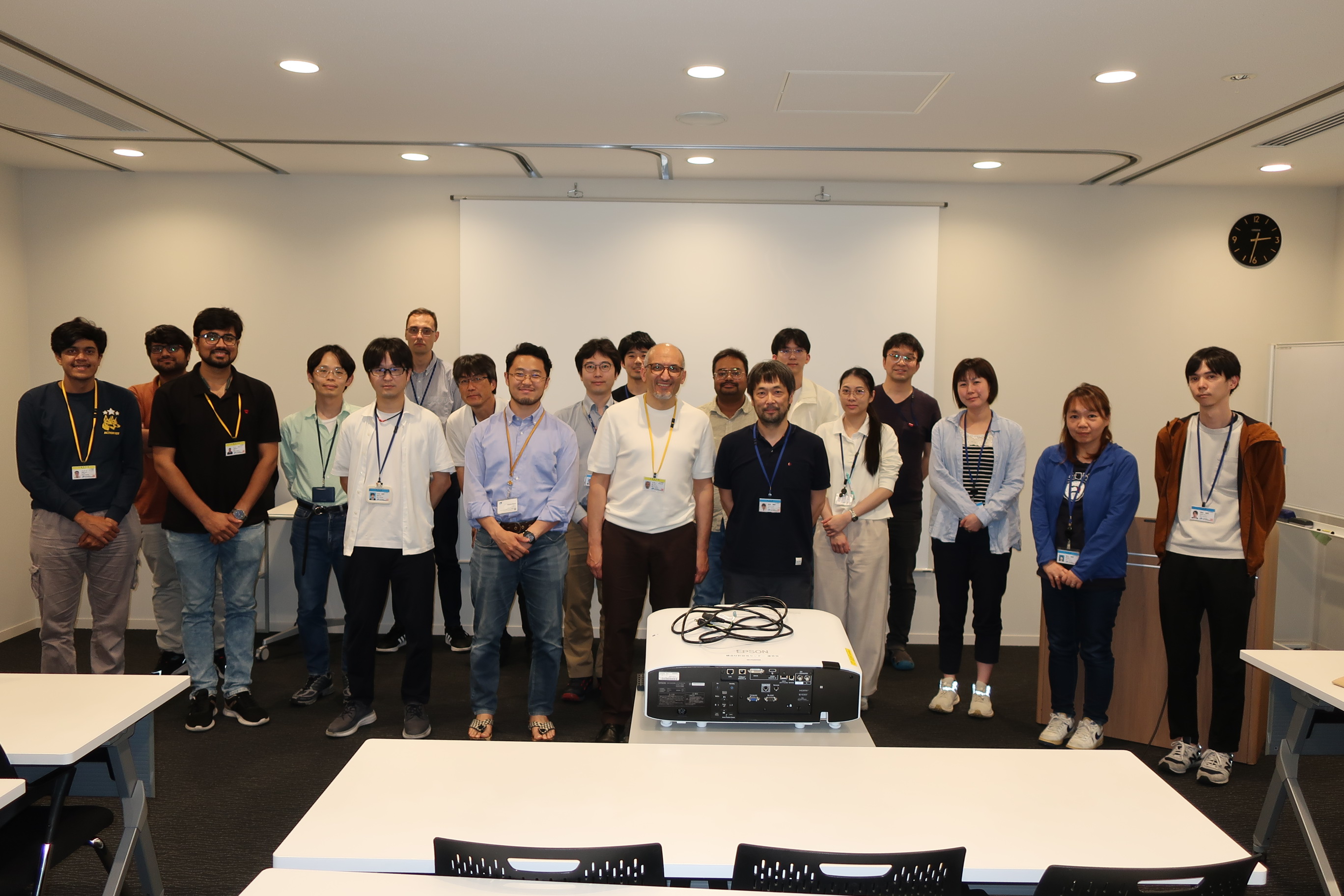
Dr. Yazid MADI (front row, 2nd from right)
- Date and Time
-
June 18, Thu. 2026. 13:30~14:30
- Location
-
Conference Room, 5th Floor, Advanced Structural Materials Building, NIMS Sengen Site
- Title
-
Understanding Hydrogen-Assisted Damage in Steels Using Advanced Mechanical Testing and Synchrotron X-ray Tomography
- Speaker
-
Prof. Yazid MADI
Mines Paris – PSL, CMAT – Centre des Matériaux, Versailles, France
Abstract:
Within the development of miniaturized testing methodologies for assessing hydrogen compatibility of pipeline steels, synchrotron X-ray tomography has recently emerged as a powerful tool for investigating damage mechanisms in gaseous hydrogen environments.
Hydrogen embrittlement in steels is strongly influenced by hydrogen pressure, strain rate, and stress-assisted damage localization, yet the underlying fracture mechanisms remain difficult to observe directly. This work presents recent advances in the use of sub-size tensile specimens combined with synchrotron X-ray tomography to investigate hydrogen-assisted damage evolution in ferritic-pearlitic E355 steel exposed to gaseous hydrogen.
First, tensile tests were performed in air and in 100 bar gaseous hydrogen at strain rates ranging from 10−5 to 5x10⁻⁴ s−1. Ex-situ three-dimensional tomography of interrupted tests revealed a strong strain-rate dependence of damage mechanisms. At intermediate strain rates, fracture involved quasi-brittle surface cracks coexisting with ductile internal voiding, whereas lower strain rates promoted deeper hydrogen ingress and brittle crack-like damage throughout the specimen thickness.
Building on these results, a dedicated experimental device was developed to couple tensile testing under high-pressure gaseous hydrogen with in-situ synchrotron X-ray tomography. Repeated tomographic acquisitions during
deformation provided time-resolved visualization of hydrogen-assisted damage evolution. Tests performed at 20 and 130 bar H2 at 10−4 s−1 showed ductility losses of about 20% and 69%, respectively. The method enabled direct quantification of crack and void volume, morphology, orientation, and spatial distribution during loading. Internal hydrogen-induced cracks were observed to coalesce with surface cracks, demonstrating their contribution to final fracture.
These results highlight the potential of synchrotron tomography to resolve the competition between surface and bulk damage mechanisms in hydrogen-embrittled steels.
References
1. Santana, L. M., Okumko, V., King, A., Henry, L., Bolitt, C., Nicole, S., & Madi, Y. (2026). In-situ 3D X-ray tomography under high-pressure H₂: Direct observation and quantification of hydrogen-induced damage evolution in steel during tensile testing. International Journal of Hydrogen Energy, 229, 154770.
2. Santana, L. M., Okumko, V., King, A., Morgeneyer, T. F., Besson, J., & Madi, Y. (2025). Investigating the influence of strain rate on hydrogen embrittlement in steel sub-size tensile specimens using 3D X-ray tomography. International Journal of Hydrogen Energy, 138, 626–647.
3. Madi, Y., Santana, L. M., Belkacemi, S., Farrugia, V., Meddour, A., Marchais, P. J., et al. (2024). Mechanical characterization of hydrogen embrittlement in a gaseous environment: An innovative test setup using sub-size specimens. Engineering Failure Analysis, 162, 108362.