
188th Structural Materials Seminar -From fundamental understanding through atomistic simulations to hypersonic technology development II-
On March 5, 2026, Dr. Chao-Ping (Cherri) Hsu, (Institute of Chemistry, Academia Sinica, Taipei, Taiwan) gave a lecture at NIMS as the 188th Structural Materials Seminar. From fundamental understanding through atomistic simulations to hypersonic technology development II
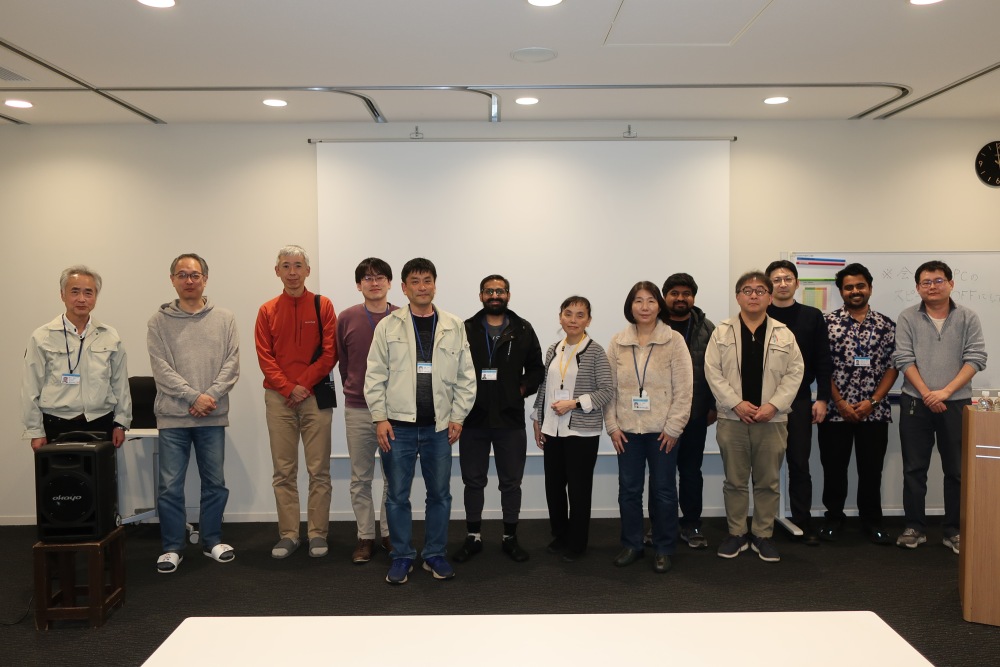
Group photo after the event
- Date and Time
-
Thursday, March 5, 2026. 15:00~16:00
- Location
-
Conference Room, 5th Floor, Advanced Structural Materials Building, NIMS Sengen Site
- Title:
-
Machine Learning aided charge transport dynamics
- Speaker
-
Dr. Chao-Ping (Cherri) Hsu, Institute of Chemistry, Academia Sinica, Taipei, Taiwan
Abstract
Electron transfer couplings, or, the off-diagonal Hamiltonian element in diabatic state representations, are commonly used in characterizing electron transfer rate. It is also an important parameter in polaron models. Electronic couplings are sensitive to molecular geometries, especially in the intermolecular degrees of freedoms, and thus characterizing such nuclear dependency is important for charge-transport dynamics. We developed novel ML approaches for evaluating electronic coupling.[1,2,3] These ML models enabled us to investigate the spectral density function of the off-diagonal term, revealing both sub-Ohmic behavior and temperature dependence.[4] Additionally, we examined the outer-sphere reorganization energies in nonpolar systems, which significantly influence charge transfer activation energies. Although traditional dielectric polarization theories predicted negligible outer-sphere reorganization energy, our findings demonstrate substantial contributions to this parameter.[5] This discovery suggests that charge-transfer processes in typical nonpolar or weakly polar materials experience greater fluctuations than previously theorized models indicated. Our findings advance the fundamental understanding of charge transfer dynamics and challenge existing models in the field.
References
[1] Wang, C.-I., Braza, M. K. E., Claudio, G. C., Nellas, R. B., & Hsu, C.-P. Machine Learning for Predicting Electron Transfer Coupling. J. Phys. Chem. A, 2019,123(36), 7792–7802.
[2] Wang, C.-I., Joanito, I., Lan, C.-F., & Hsu, C.-P. Artificial neural networks for predicting charge transfer coupling. J. Chem. Phys., 2020, 153(21), 214113.
[3] Lin, H.-H.; Wang, C.-I.; Yang, C.-H.; Secario, M. K.; Hsu, C.-P. Two-Step Machine Learning Approach for Charge-Transfer Coupling with Structurally Diverse Data. J. Phys. Chem. A 2024, 128 (1), 271–280.
[4] Wang, Y.-S.; Wang, C.-I.; Yang, C.-H.; Hsu, C.-P. Machine-Learned Dynamic Disorder of Electron Transfer Coupling. The Journal of Chemical Physics 2023, 159 (3), 034103.
[5] Yang, C.-H.; Wang, C.-I.; Wang, Y.-S.; Hsu, C.-P. Non-Negligible Outer-Shell Reorganization Energy for Charge Transfer in