
184th Structural Materials Seminar: Prof. Eason Chen (Nanyang Technological University, Singapore)
On January 8, 2026, Prof. Eason (Yi-sheng) Chen, School of Materials Science and Engineering, Nanyang Technological University (NTU), Singapore, gave a lecture at NIMS as the 184th Structural Materials Seminar.
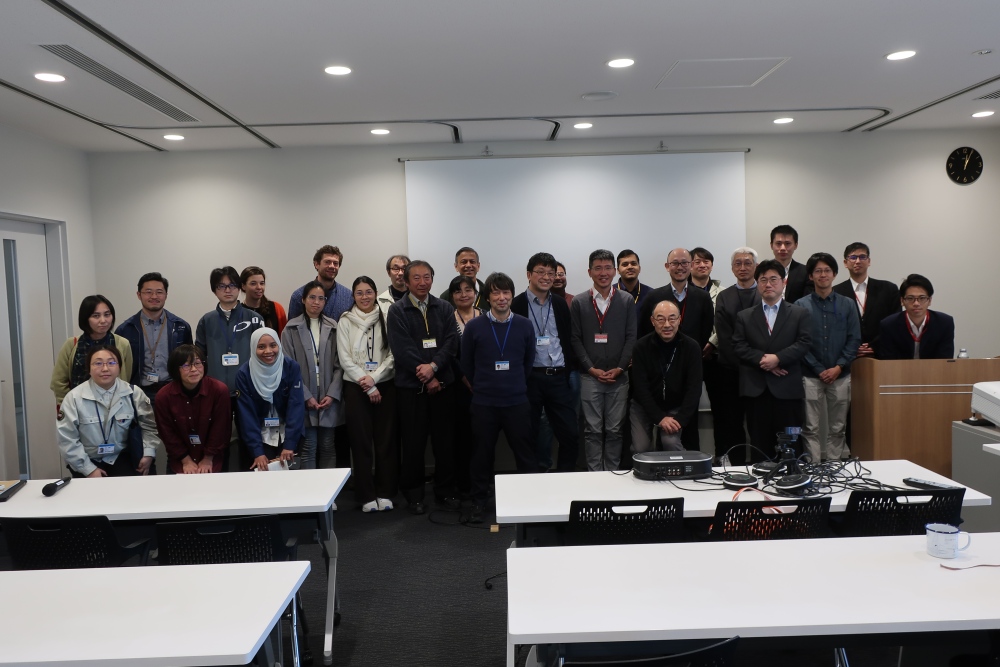
Prof. Eason Chen (front row, 5th from right)
- Date and Time
-
Thursday, January 8, 2026. 11:00~12:00
- Location
-
Conference Room, 5th Floor, Advanced Structural Materials Building, NIMS Sengen Site
- Title
-
Atom probe tomography and micromechanics for understanding hydrogen embrittlement in steels
- Speaker
-
Asst Prof. Eason (Yi-sheng) Chen , School of Materials Science and Engineering, Nanyang Technological University (NTU), Singapore
Abstract:
Hydrogen embrittlement poses a significant challenge to the durability of structural steels essential for the hydrogen economy. Understanding the interaction between hydrogen and materials plays a crucial role to address this issue. As such, the research in my group dedicates to characterizing how hydrogen distributes in material microstructure and the related embrittling and anti-embrittling effects. We aim to establish the microstructure-property-processing relationships of materials in the presence of hydrogen, which leads to the development of safe and long-lasting infrastructure in the hydrogen economy.
In this presentation, I will give an overview about hydrogen embrittlement and what have been achieved in my group for several major research outcomes [1-5]. I will shed light on the validation of the influence of hydrogen trapping on reducing the susceptibility of hydrogen embrittlement, using cold-drawn high-strength pearlitic steels as a model system. By using atom probe tomography, equipped with a cryogenic sample handling workflow, in combination with hydrogen-charging mechanical testing and transmission electron microscopy, we found the high-strength steels containing a specific type of dislocation strong hydrogen traps are less susceptible to hydrogen embrittlement. The result is informative for gas pipeline sectors when using pearlite in their steel pipes.
References
[1] P.-Y. Liu et al., Nature Communication, 15, 724 (2024).
[2] R. Niu et al., Acta Materialia, 281, 120327 (2024).
[3] Y.-S. Chen et al., International Journal of Hydrogen Energy, 136, 789-821 (2024).
[4] Y.-S. Chen et al., Science, 367, 171-175 (2020).
[5] Y.-S. Chen et al., Science, 355, 1196-1199 (2017).