
The 179th Structural Materials Seminar: Associate Professor.Pavel Souček (the Department of Plasma Physics and Technology, Masaryk University, Czech Republic)
On October 23, 2025, Associate Prof. Pavel Souček, (the Department of Plasma Physics and Technology, Masaryk University, Czech Republic) gave a lecture at NIMS as the 179th Structural Materials Seminar.
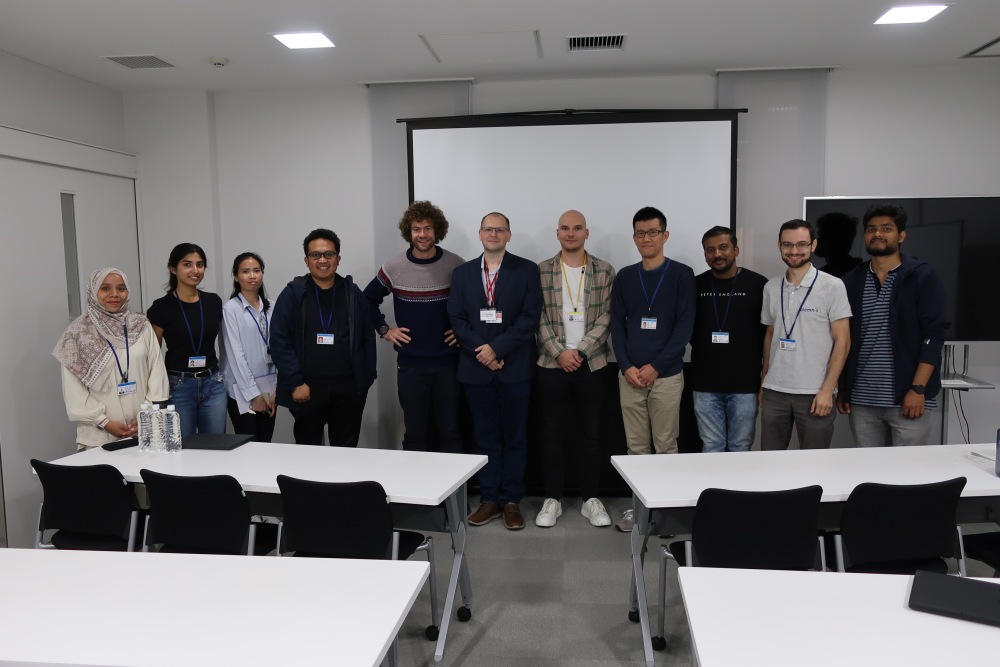
Prof. Pavel Souček (front row, 6th from right)
- Date and Time:
-
Thursday, Oct. 23, 2025. 15:00~15:45
- Location
-
Advanced Structural Materials Bldg. 2F 213 Conference Room
- Title
-
When Entropy Meets Heat: Unveiling the Thermal Limits of Refractory High-Entropy Nitrides
- Speaker
-
Associate Professor.Pavel Souček, the Department of Plasma Physics and Technology, Masaryk University, Czech Republic
Abstract:
Since the Bronze Age, alloy design has relied on adding minor elements to a dominant base metal, limiting the number of achievable compositions and tying properties to a single principal element. In 2004, a paradigm shift introduced multi-principal-element alloys—known as high-entropy materials—which abandon the concept of a base element and instead combine several in near-equiatomic ratios. The resulting high configurational entropy stabilises simple solid-solution phases even in chemically complex systems. This concept has since expanded beyond metals to include nitrides, oxides, carbides, and borides, where entropy is typically maximised on the metallic sublattice.
Refractory-metal high-entropy nitrides are particularly promising for hard, thermally stable coatings, inheriting superior mechanical properties from their binary counterparts. Yet their true high-temperature stability remains poorly understood, with most studies limited to application-driven tests below 600–1000 °C.
Here, we investigate the thermal behaviour of Cr-Hf-Mo-Ta-W-N and Mo-Ta-W-N coatings deposited by DC and High-Power Impulse Magnetron Sputtering at both room temperature and 580 °C. We discuss how the vastly different ion bombardment conditions affect their structure and properties. Selected coatings were annealed at 1000 °C and 1200 °C, with oxidation studied at 1400 °C. Combined with ab initio modelling, these results reveal how elemental interactions and configurational entropy govern stability at extreme temperatures.