Theory for tunnel magnetoresistance oscillation
We proposed a new theoretical framework to address the longstanding unresolved issue in spintronics known as tunnel magnetoresistance (TMR) oscillation, and successfully explained the large oscillation observed experimentally (Masuda et al., 2025).
The TMR effect is a key spintronic phenomenon used in magnetic sensors and magnetic memory devices. Further expansion of these applications requires a higher TMR ratio. In 2023, an experimental group at NIMS achieved a new world record for the room-temperature TMR ratio (T. Scheike et al., Appl. Phys. Lett. 122, 112404 (2023)). In the same experiment, they observed pronounced oscillations of the TMR ratio as a function of insulating-barrier thickness. Clarifying the origin of this TMR oscillation has therefore become a key step for further improving device performance. Despite being known for more than 20 years, its origin had remained unresolved.
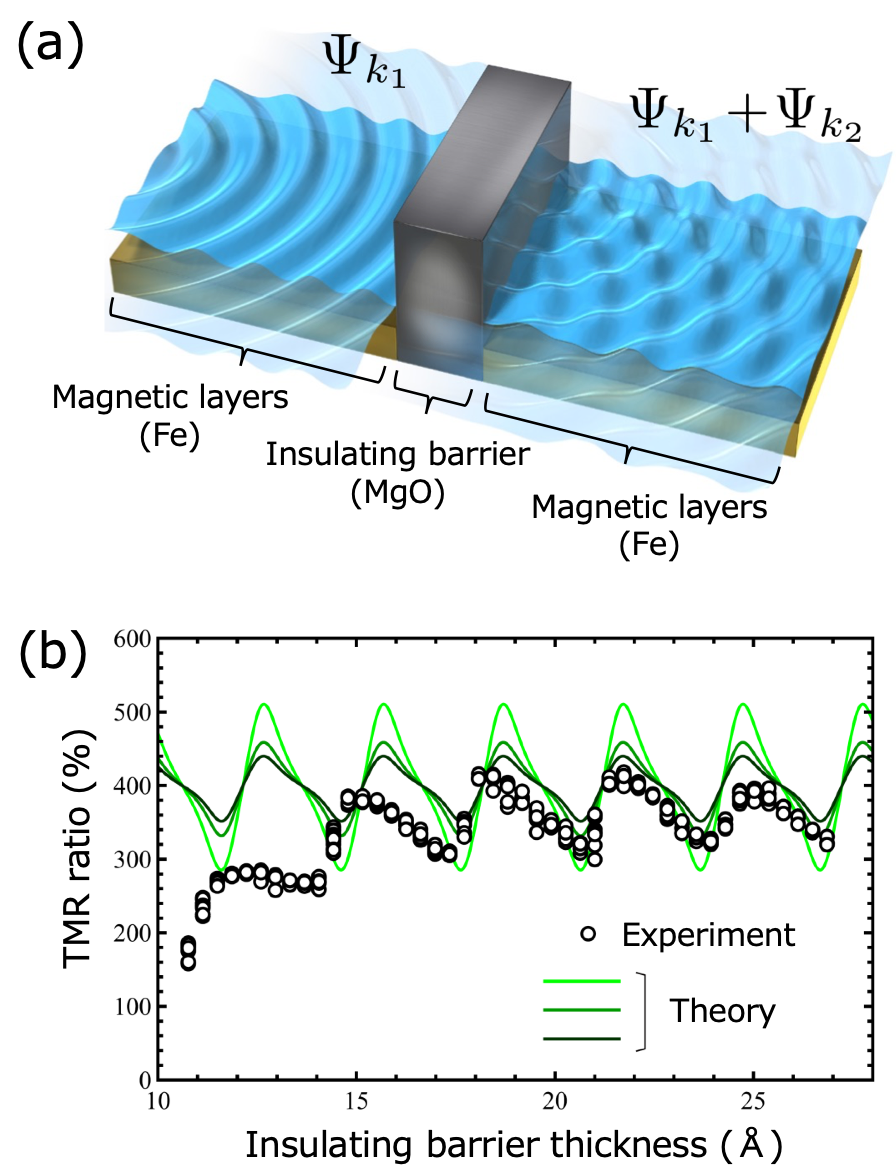
Our theory incorporates an interfacial mechanism overlooked in previous studies. The TMR effect arises in magnetic tunnel junctions (ferromagnet/insulator/ferromagnet), where interface electronic states play a critical role. The key point of our model is the inclusion of wavefunction superposition states at the interfaces [Fig. (a)]. TMR ratios calculated from this model reproduce the experimentally observed oscillatory behavior [Fig. (b)].
So far, experiments on TMR oscillation have focused mainly on MTJs with a limited set of ferromagnets such as Fe. Future experiments using broader material sets, together with comparison to our theory, are expected to deepen understanding of TMR oscillation and provide concrete design principles for controlling the oscillation and improving the TMR ratio.
The TMR effect is a key spintronic phenomenon used in magnetic sensors and magnetic memory devices. Further expansion of these applications requires a higher TMR ratio. In 2023, an experimental group at NIMS achieved a new world record for the room-temperature TMR ratio (T. Scheike et al., Appl. Phys. Lett. 122, 112404 (2023)). In the same experiment, they observed pronounced oscillations of the TMR ratio as a function of insulating-barrier thickness. Clarifying the origin of this TMR oscillation has therefore become a key step for further improving device performance. Despite being known for more than 20 years, its origin had remained unresolved.
Our theory incorporates an interfacial mechanism overlooked in previous studies. The TMR effect arises in magnetic tunnel junctions (ferromagnet/insulator/ferromagnet), where interface electronic states play a critical role. The key point of our model is the inclusion of wavefunction superposition states at the interfaces [Fig. (a)]. TMR ratios calculated from this model reproduce the experimentally observed oscillatory behavior [Fig. (b)].
So far, experiments on TMR oscillation have focused mainly on MTJs with a limited set of ferromagnets such as Fe. Future experiments using broader material sets, together with comparison to our theory, are expected to deepen understanding of TMR oscillation and provide concrete design principles for controlling the oscillation and improving the TMR ratio.