研究内容 計算科学と実験科学を結合した研究手法により,金属材料のメゾ組織と機械的特性の相関性を解明し,同時にその特性を飛躍的に向上できる最適なメゾ組織構造を実現する塑性加工プロセスを確立することで,安心・安全な構造材料を開発することを目的にしています.特性向上の組織構造へのアプローチは,先人の知恵,自らのアイデア,そして生物の持つ緻密で複雑な組織構造を融合します.材料創成では,小型試験片を用いた基礎研究で得られた組織と主要なプロセスパラメータの定量的関係を確立し,計算科学による仮想実験により,最適な組織構造を有する大型部材へ基礎研究成果を直接展開できる形質制御技術を確立します.また,機械的特性では,使用環境に即した適材適所の思想に基づき,不均質組織を積極的に活用することで,飛躍的な特性向上に繋げます.本研究を通して,発想から実用化までの時間と労力を飛躍的に短縮し,社会の要請に迅速に応えます.
 Hot News!
「ノコギリガザミ」のめちゃくちゃ巨大なハサミ外骨格の驚くべき組織・構造的戦略
~究極の強靭化材料の組織・構造を探求~
研究成果の概要はこちら(ヤシガニとどっちが強いのか?)
詳細資料が必要な方はご連絡ください.
2023年1月掲載 ハサミ先端の鋼鉄並みに硬い白色外骨格の秘密に迫りました.白色外骨格は,カニにとって攻撃性と防御性に優れた有用な部位でした.
Tissue structure and mechanical properties of the exoskeleton of the huge claws of the mud crab, Scylla serrata
Tadanobu INOUE, Takanobu HIROTO, Yuka HARA, Koji NAKAZATO, Shin-ichiro OKA
Journal of Materials Science
58 (2023) 1099-111510.1007/s10853-022-08083-x
2022年12月掲載 身体全体の網目褐色外骨格の表面には微細な凹凸があり,凹部直下には硬い部分と軟い部分で構成された魚の鱗のような魚鱗(ぎょりん)組織がありました.
Mud crab’s mottled, deep-blue exoskeleton: surface morphology and internal microstructure
Tadanobu INOUE, Erina KITAHARA, Yuka HARA, Koji NAKAZATO
Minerals
12 (2023) 160710.3390/min12121607
圧延実験(スローにしています)
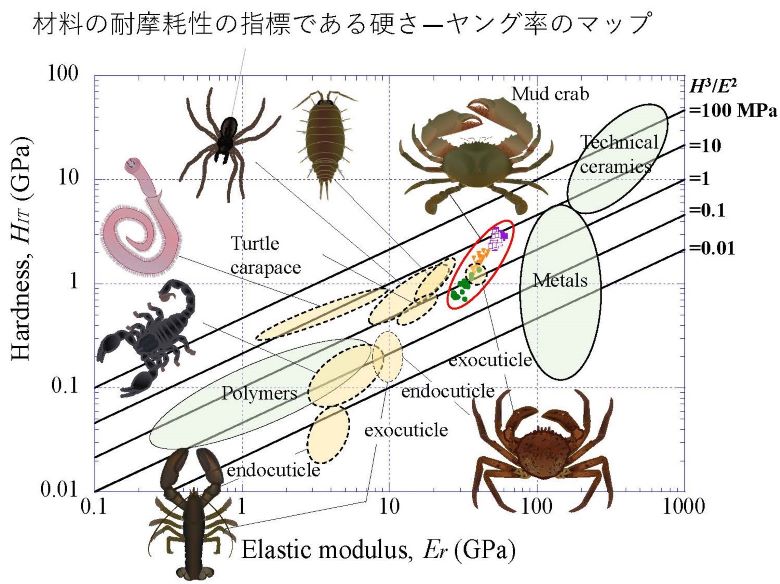
2023年12月掲載 『アミメノコギリガザミ』のハサミの可動側にある一番大きな白突起Largest denticle(長さ15×幅13×厚さ5mm)の組織,成分,硬さ,ヤング率を検討しました.ガサミが挟む時には,この白突起部分で硬い貝やカニなどを砕き中身を食べます.Largest denticleの表層部分の耐摩耗性(硬さとヤング率の関係)は,クモの牙,サソリ・ロブスターのハサミ,亀の甲羅などに比べ優れていたことがわかりました.この優れた特性は,表層に平行に積層した螺旋構造と密な組織によって達成されています.今後は,究極の材料創出に向けたNext stageに向かいます.
Mechanical Resistance of the Largest Denticle on the Movable Claw of the Mud Crab
Sizes in the Mud Crab
Tadanobu Inoue, Yuka Hara, Koji Nakazato
Biomimetics
8 (2023) ;602 10.3390/biomimetics8080602
2023年5月掲載 『アミメノコギリガザミ』のハサミにある歯のような
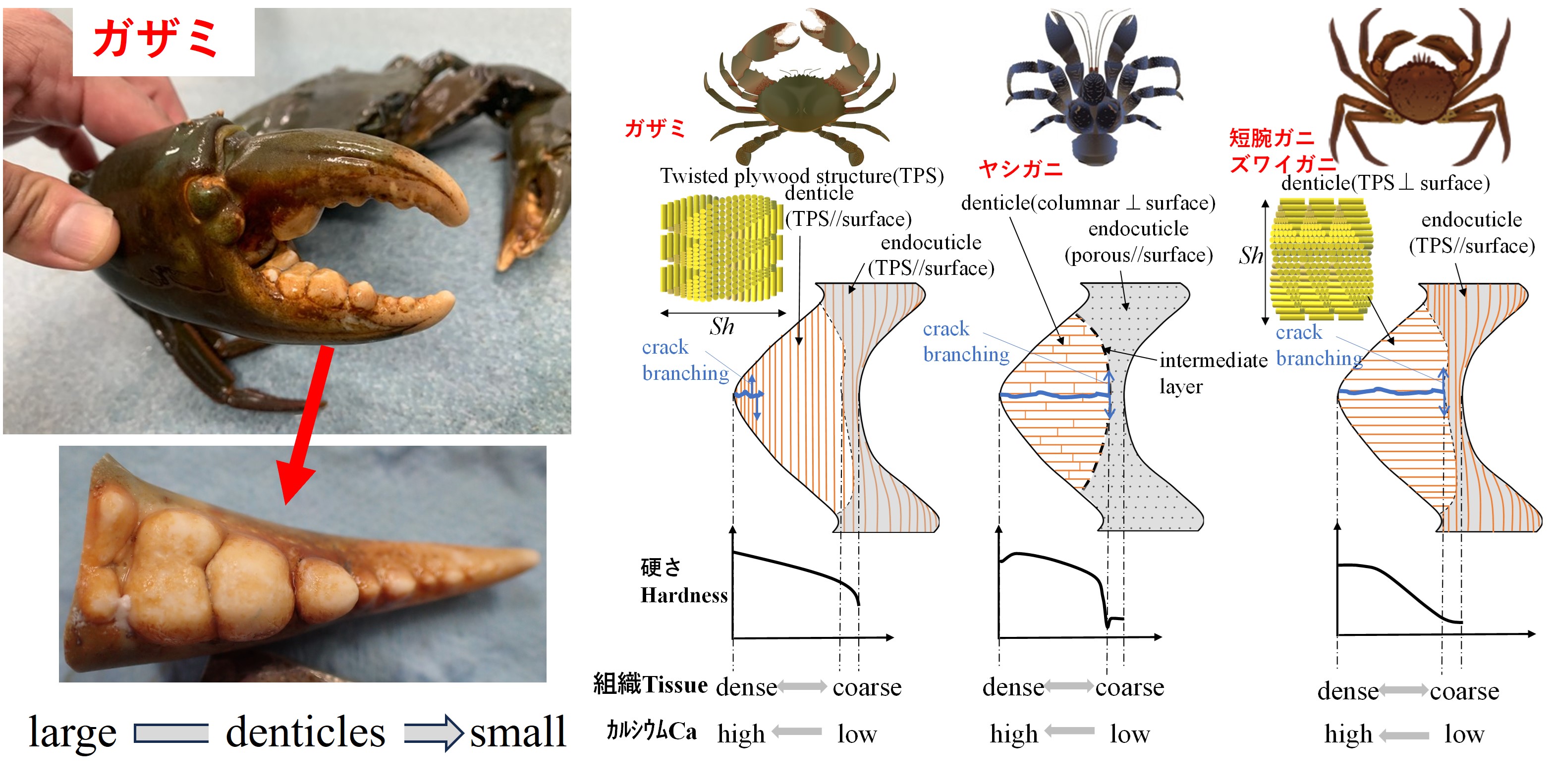
白い突起denticlesの組織構造と硬さ・弾性定数の関係を明らかにしました.不動指上のdenticlesは根元で大きく,先端にいくにつれ小さくなります.denticles硬さは,表面から内部に進むにつれやかに低下し,根元の一番大きなdenticles表面が一番硬く,密な組織となっていました.denticlesは表面に平行な螺旋上の積層構造を有しており,き裂がdenticles内部に進展しない,すなわちdenticles全体は決して壊れない組織構造を有していました.
Mechanical Resistance and Tissue Structure of Claw Denticles of Various
Sizes in the Mud Crab, Scylla serrata
Tadanobu Inoue, Yuka Hara, Koji Nakazato
Materials
16 (2023) ;4114 10.3390/ma16114114
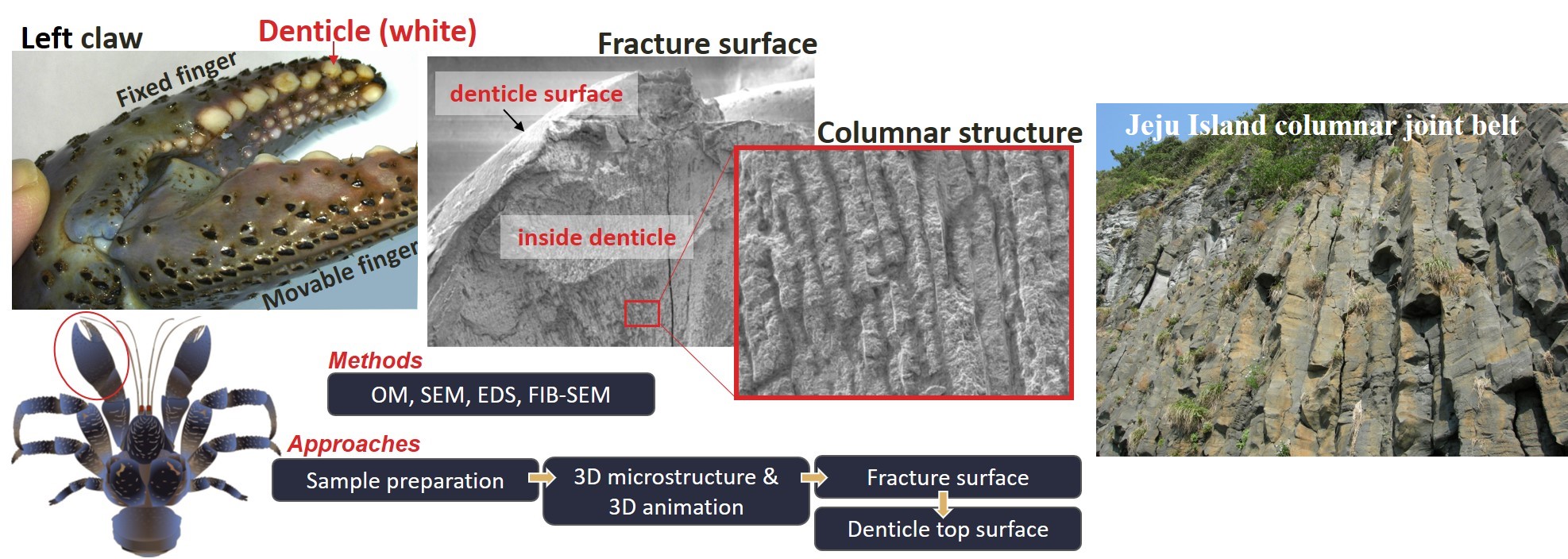
2022年2月掲載 『ヤシガニ』のハサミにある歯のような白い突起denticlesの組織構造を明らかにしました.denticles表面の一部は摩耗によって外クチクラ層を失ってました.denticles破面は,まるで火山から流れ出た溶岩がゆっくりと冷えて固まって形成される柱状節理でした.
Columnar Structure of Claw Denticles in the Coconut Crab,Birgus latro
Tadanobu Inoue, Sin-ichiro OKA, Koji Nakazato, Toru HARA
Minerals
12 (2022) 274 10.3390/min12020274
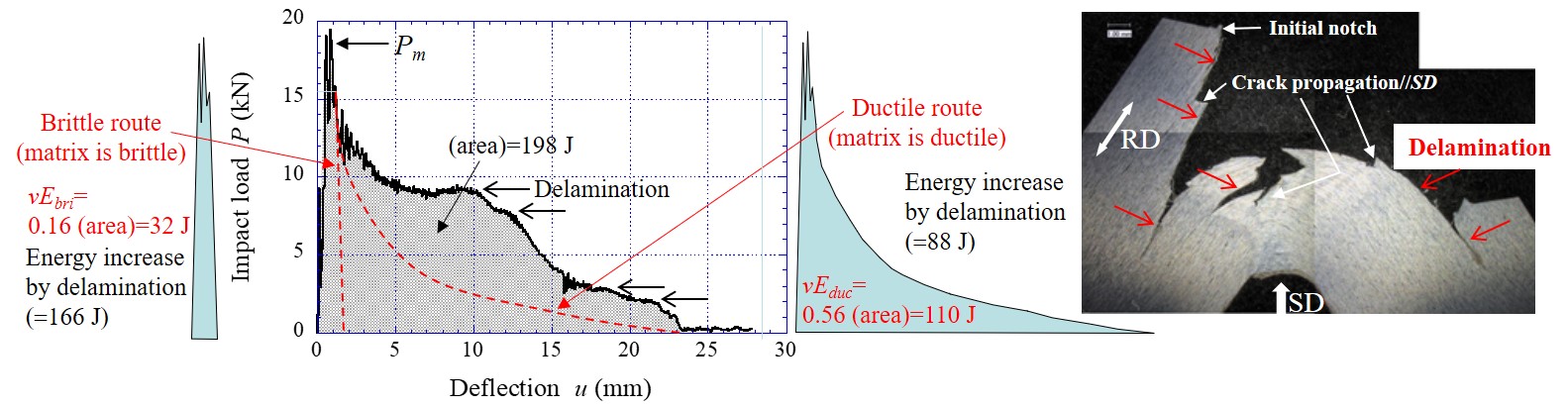
2022年1月掲載 計装化シャルピー試験で得られる層状破壊した鋼の荷重―変位曲線から,超微細粒鋼のシャルピーエネルギ曲線の予測手法を提案しました.数十年後の未来において,もし集合組織がない等軸超微細粒鋼の創製に成功できた人がいましたら,シャルピー試験結果を比較してみて下さい.
Effect of Delamination and Grain Refinement on Fracture Energy of Ultrafine-Grained Steel Determined Using an Instrumented Charpy Impact Test
Tadanobu Inoue, Yuuji Kimura
Materials
15 [3] (2022) 867 10.3390/ma15030867
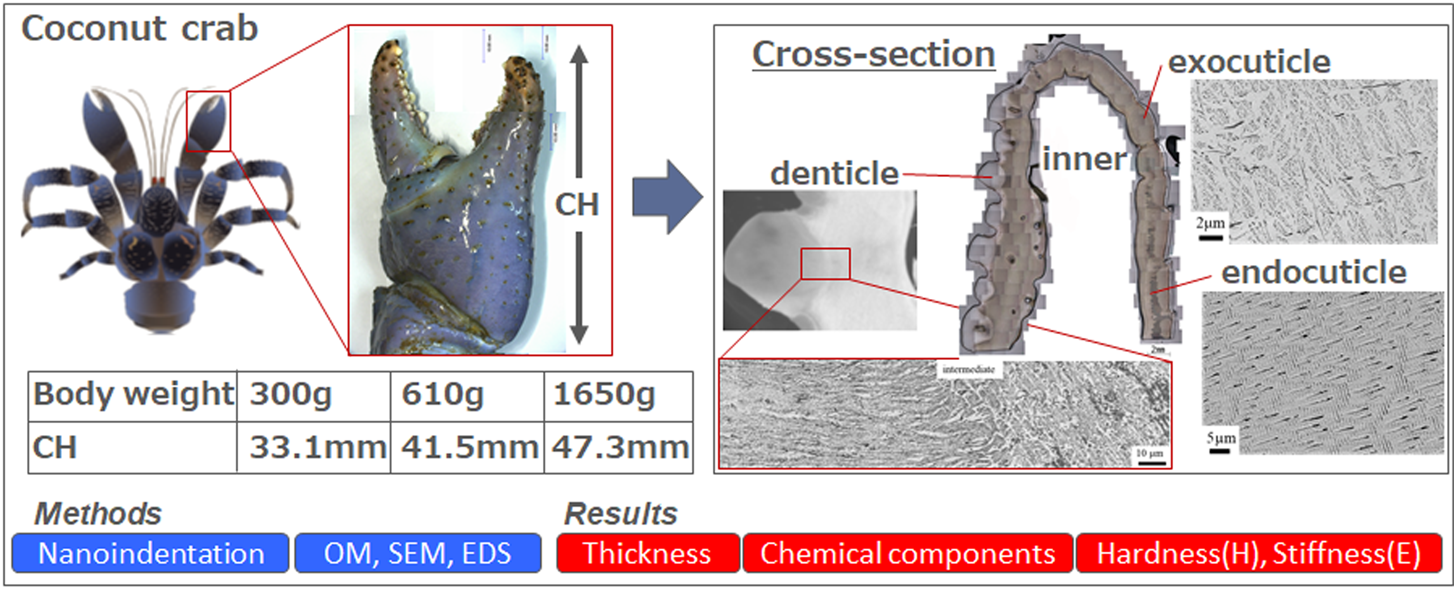
2021年12月掲載 『ヤシガニ』が体の成長とともに外骨格の厚さ,組織構造,化学成分,硬度,剛性がどのように変化するかを調べました.また,ハサミの挟む側にのみ存在する歯のような白い突起物の謎に迫っています.
Structural Changes and Mechanical Resistance of Claws and Denticles in Coconut Crabs of Different Sizes
Tadanobu Inoue, Sin-ichiro OKA, Koji Nakazato, Toru HARA
Biology
10 [12] (2021) 1304 10.3390/biology10121304
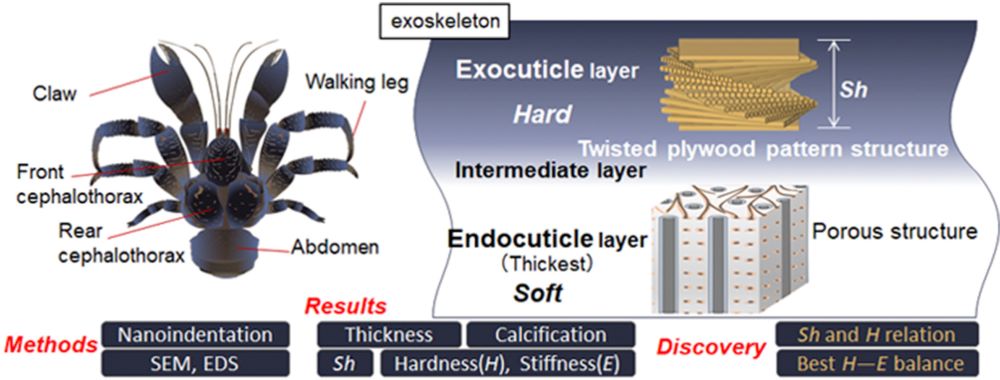
2021年9月掲載 『ヤシガニ』のハサミ,第1歩脚,胸部(甲),腹部の外骨格の組織構造,化学成分,硬度,剛性を調べ,また他の節足動物と比較することで,ヤシガニの外クチクラが持つ優れた耐摩耗性を明らかにしました.
Superior mechanical resistance in the exoskeleton of the coconut crab, Birgus latro
Tadanobu Inoue, Toru HARA, Koji Nakazato, Sin-ichiro OKA
Materials Today Bio
12 (2021) 1001325 10.1016/j.mtbio.2021.100132
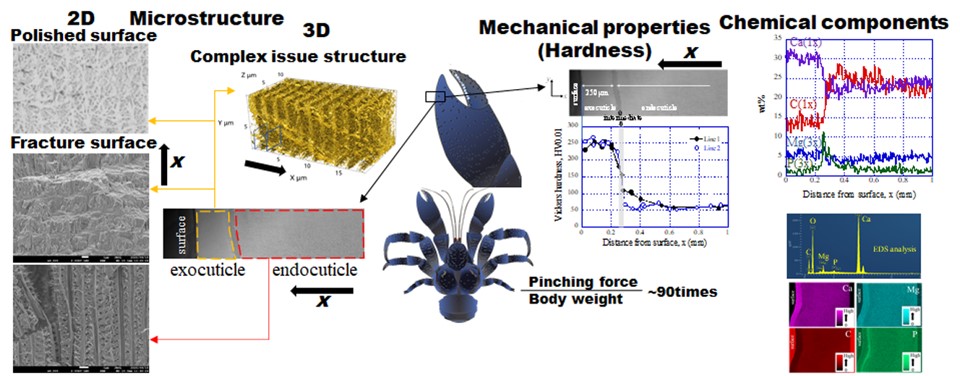
2021年8月掲載 希少生物の謎に迫り,究極の強靭化材料の組織・構造を探求することを一つの目的にし,新しい研究課題をスタート!
甲殻類最強の把持力(はじりょく)を持つ『ヤシガニ』のハサミの内部構造を明らかにしました.
Three-dimensional microstructure of robust claw of coconut crab, one of the largest terrestrial crustaceans
Tadanobu Inoue, Sin-ichiro OKA, Toru HARA
Materials & Design
206 (2021) 109765 10.1016/j.matdes.2021.109765 ←3Dアニメーションをお楽しみください!
2021.5.24 プレス発表
めちゃくちゃ硬い!『ヤシガニ』のハサミの驚くべき内部構造
~生物の謎に迫るハサミ内部の3D表示に成功、究極の強靭化材料の組織・構造を探求~https://www.nims.go.jp/news/press/2021/05/202105240.html
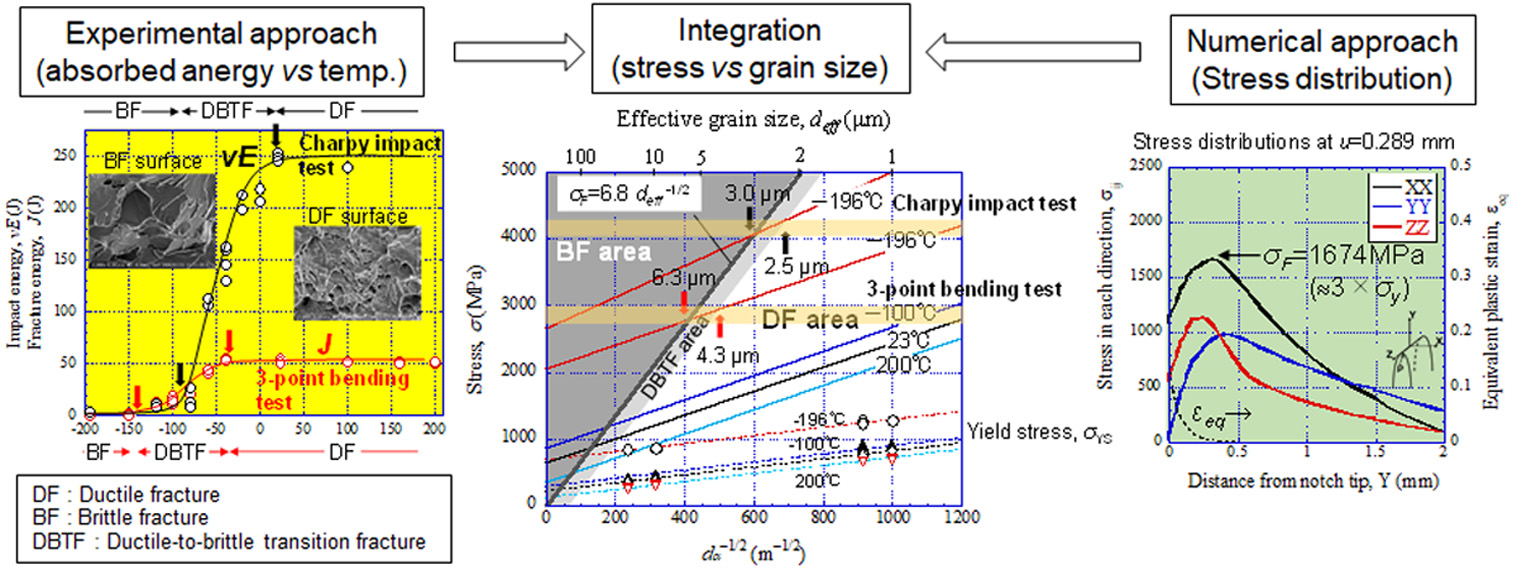
2021年4月掲載 低炭素鋼の破壊応力を定量化し,応力ー粒形-0.5マップから,DBTTのサイズ依存性を明確に示すことに成功しました
Ductile-to-Brittle Transition and Brittle Fracture Stress of Ultrafine-Grained Low-Carbon Steel
Tadanobu Inoue, Hai Qiu, Rintaro Ueji, Yuuji Kimura
Materials
14[7] (2021) 1634 10.3390/ma14071634
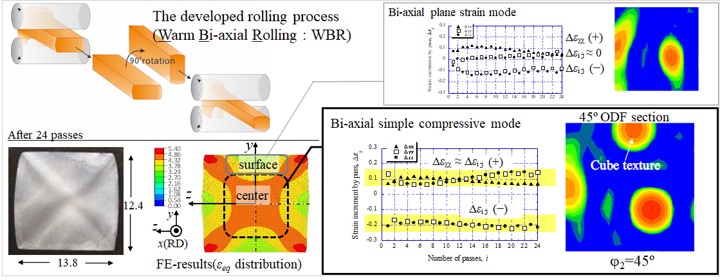
2021年1月掲載 2軸温間圧延で発達するcube方位の変形モードを3次元有限要素解析から検討しました
Effect of strain and deformation mode on cube texture formation in warm bi-axial rolled low-carbon steel
Tadanobu Inoue, Rintaro Ueji
Finite Elements in Analysis and Design
183-184 (2021) 103491 10.1016/j.finel.2020.103491
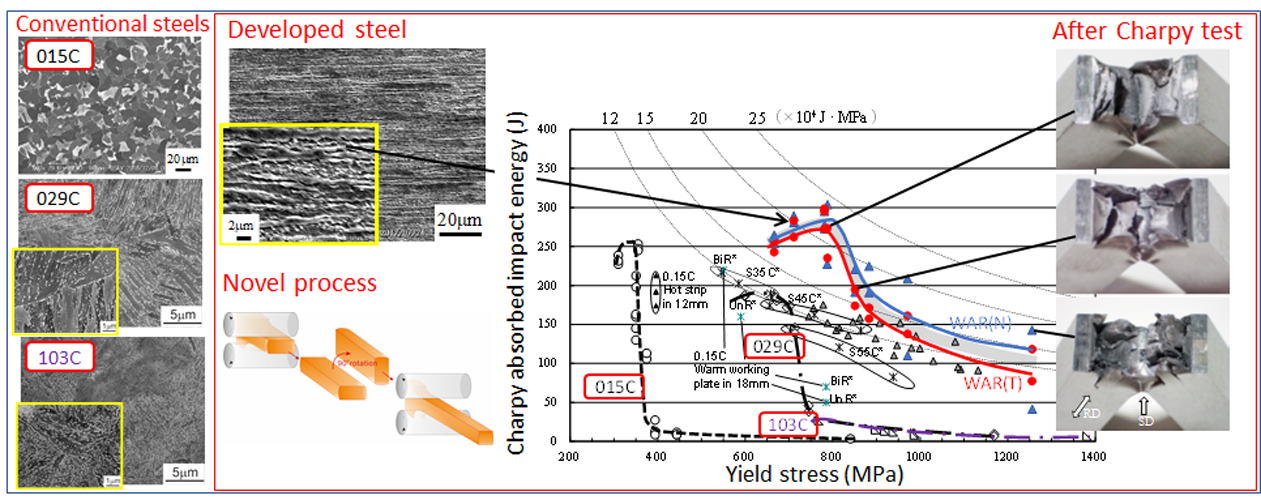
2020年6月掲載 2軸温間圧延でcube方位を有する鋼を創成し,強度-衝撃靭性バランスを調べました
Improvement of strength, toughness and ductility in ultrafine-grained low-carbon steel processed by warm bi-axial rolling
Tadanobu Inoue, Rintaro Ueji
Materials Science and Engineering: A
786 (2020) 139415 10.1016/j.msea.2020.139415
2020年1月掲載 微細粒薄鋼板創成の1st stepとして大径ロールを提案しました
Through-thickness microstructure and strain distribution in steel sheets rolled in a large-diameter rolling process
Tadanobu Inoue, Hai Qiu, Rintaro Ueji
Metals
10-1 (2020) 91 10.3390/met10010091
2019年4月掲載 2軸温間圧延プロセスを提案し,Cube方位を有した微細粒鋼を創成しました
Improvement of toughness and strength balance in low-carbon steel bars with cube texture processed by warm bi-axial rolling
Tadanobu Inoue, Rintaro Ueji, Yuuji Kimura
Materials Letters
240 (2019) 172-175 10.1016/j.matlet.2019.01.007
2015年10月公開 フェールセーフ鋼のき裂伝播挙動観察から壊れにくさの機能を考えてみました
超微細粒組織を活用した1800MPa級超高強度鋼のき裂伝播挙動 (微視組織制御からの破壊制御の構築)
井上 忠信, 木村 勇次,邱 海,王 成鐸
日本機械学会論文集
81 [830] (2015) 15-00281 10.1299/transjsme.15-00281
2015年8月 1800MPaクラスの強靭な中炭素低合金鋼を創成し、200℃から -196℃の温度範囲で組織と静的な強靭性 の関係について検討しました
Strength-toughness balance of low-alloy steel by fail-safe design
Tadanobu INOUE, Yuuji KIMURA,Hai QIU
Mechanical Engineering Letters
2013年8月 強靭な低炭素鋼を創成し、組織と強靭性の関係について検討しました
超微細粒組織を活用した低炭素鋼の強靭化 論文賞受賞!!
井上 忠信, 木村 勇次
日本機械学会論文集A編
79 [804] (2013) 1226-1238 10.1299/kikaia.79.1226
☆科学研究費補助金(基盤研究A)☆
研究課題: |
甲殻類最強の把持力を持つヤシガニの3D組織構造と機械的特性 |
期間 |
2021.4~2025.3 |
内容: |
構造用金属材料は高強度化することで脆化するため,強靭化を実現するためのアイデアと
共にその実証が求められているが,従来型の合金化主体の材料設計手法(合金添加,不純
物除去,均一組織設計)には限界が見えている.2008年,研究代表者(井上)らは300 nm
まで超微細繊維状化した組織を有する鋼を創成し,強くて壊れにくい高強度鋼の開発に成
功した.2016年,共同研究者(岡)らは,ヤシガニの挟む力は生物界最強であることを発
表した.“貝殻をもたないヤドカリ”に進化したヤシガニのハサミは,堅牢な胴体で一番
の強靭さを持つ.しかし,生態調査に比べ,ハサミの組織構造は未着手である.本研究は
,甲殻類最強の把持力(はじりょく)を持つヤシガニやその他の生物の外骨格を対象に,材料
工学の最先端の手法を活用して,①組織や構造および主要成分を3次元で観察・分析
し,②機械的特性試験(硬度,剛性,曲げ強度,靭性)および③有限要素法による挟む際
の応力解析を通じて,堅牢なハサミの組織構造を解明し,生物機械工学の観点で“材料力
学および機械材料関連”分野をより発展させることを目的にしたものである.
並行して,地球上で一番硬い生物の探索も行う.
|
対象材料 |
ヤシガニなどの甲殻類やその他硬い生物 |
☆科学研究費補助金(基盤研究A)☆
研究課題: |
微細組織を制御した強くて壊れにくい強靭な鋼の開発と破壊制御技術の構築 |
期間 |
H26(2014).4~H30(2018).3 実績報告はこちらへ |
内容: |
構造用金属材料は高強度化することで脆化するため,“強靭な材料”を実現す
るためのアイデアと共にその実証が常に求められている.我々は,これまで加工
ひずみによって,靭性を飛躍的に向上させた超微細繊維状結晶粒組織を有する高
強度鋼を創成し,その破壊挙動を解明してきた.その強靭鋼の更なる性能向上と
具体的高強度部材への適用を図るためには,素材創成プロセスの適正化と共に,
静的なき裂感受性試験を通じ,き裂の発生条件,およびその後の進展という破壊
挙動と組織(結晶粒の大きさ,形状そして方位)の普遍的関係を構築し,さらに
それらの異方特性(強度・靭性)を調べ,強くて壊れにくい鋼の最適な組織設計
指針を明示することが必要である.本研究により,強靭材開発の新しい方向性を
提示すると共に,“塑性加工で組織を制御して破壊を制御する”新しい学術領域
を切り拓くことを目的とする. |
対象材料 |
低炭素鋼,中炭素鋼 |
☆科学研究費補助金(基盤研究B)☆
研究課題: |
結晶粒の形態と方位を制御した高強度高靭性鋼の破壊挙動解明 |
期間 |
H23(2011).4~H26(2014).3 実績報告はこちらへ |
内容: |
本研究では,新しい着想に基づいて開発した800MPa級および1800MPa級の壊れにくい高強度鋼を創製し(①材料創製),-197℃から室温の温度範囲における静的なき裂感受性試験(②特性試験)と数値解析(③有限要素シミュレーション)を通じ,き裂の発生条件,およびその後の進展という破壊挙動と組織(④組織解析)の関係を明確にし,破壊のメカニズム解明とともに,さらなる特性向上に向けた最適な組織設計指針を提示(⑤まとめ)することを目的にする. |
対象材料 |
低炭素鋼,中炭素鋼 |
☆新学術領域研究(研究領域提案型) バルクナノメタル☆
| 研究課題: |
バルクナノメタル創製の計算機・物理シミュレーション
A02エ班研究代表者:柳本潤(東大),分担者:井上忠信(NIMS),土田紀之(兵庫県立大),柳田明(横浜国大) |
期間 |
H22(2010).4~H27(2015).3実績報告はこちらへ |
内容: |
本研究では,相変態を含む加工・熱処理プロセスによるバルクナノメタルの超微細粒組織形成を,計算機シミュレーション及び加工熱処理再現試験装置などを駆使した物理シミュレーションによって解明する.出口として,「多様なプロセスによるバルクナノメタルの製造手法の確立」を目指す |
☆科学研究費補助金(基盤研究B)☆
研究課題: |
加工ひずみ制御による微細粒組織創成の定量的予測技術の構築 |
期間 |
H21(2008).4~H23(2010).3→実績報告はこちらへ |
内容: |
本研究の目的は,計算科学と実験科学を結合した研究手法により,加工の進行に伴うひずみの蓄積とその空間分布による組織の変化を定量的に明らかにし,微細粒組織形成の予測技術を構築することである. |
対象材料 |
低炭素鋼,純アルミニウム |
|
電子材料・実装技術における 熱応力の解析・制御とトラブル対策 情報技術協会より2006年1月に出版された標記の本の一部を執筆しています。
第5章第5節 異種金属材料の接合
内容:
本節では、異種材料接合体における熱応力場を理論的な観点から検討し、応力特異性のオーダーの種類と乗ぜられる強さの特徴を示し、熱応力特異性の低減・消失条件を紹介する。その後、熱応力特異性を数値解析で行う場合の問題点について記述する。
|
プレス発表 研究成果をプレス発表しました。
井上は数値解析を駆使し、表面から内部まで、直径1μm以下の超微細粒鋼でできた35mm厚の鋼板の作成に成功しました。今回の試作では,スクラップを原料とした連続鋳造
材(王子製鉄社製)を使用し,数値解析で最適化された精緻な加工を
実現するために,日本製鋼所室蘭製作所に加工を委託しました。今後、造船、土木、建築などへの応用が期待できます。
【35mm厚超微細粒鋼板に関する記事一覧】←クリック!
◇2004/5/26 日刊工業新聞
◇2004/5/26 化学工業新聞
◇2004/5/28 鉄鋼新聞
◇2004/6/2 産業新聞
◇2004/6/15 常陽新聞
◇2004/6/16 日経産業新聞
◇2004/9/21 橋梁新聞
◇2005/1/13 鉄鋼新聞
【その他】
□2006/4/7 北海道新聞 |
|
|
更新履歴
|


 2016年10月